
Getting to and from Georgia and Armenia is not straightforward. Drive to Barcelona, then Lufthansa Barcelona, change at Munich, on to Tbilisi. Back from Yerevan to Vienna, change to Frankfurt, then change and on to Barcelona
Tbilisi is the capital and the largest city of Georgia, lying on the banks of the Kura River with a population of approximately 1.5 million people. Tbilisi's diverse history is reflected in its architecture, which is a mix of medieval, neoclassical, Beaux Arts, Art Nouveau, Stalinist and the Modern structures. Historically, Tbilisi has been home to people of multiple cultural, ethnic, and religious backgrounds, though it is currently overwhelmingly Eastern Orthodox Christian.
Founded in the 5th century AD by Vakhtang I of Iberia. Between 1801 and 1917, then part of the Russian Empire, Tbilisi was the seat of the Imperial Viceroy, governing both Southern and Northern Caucasus. Because of its location on the crossroads between Europe and Asia, and its proximity to the lucrative Silk Road, throughout history Tbilisi was a point of contention among various global powers. The city's location to this day ensures its position as an important transit route for various energy and trade projects.
In 1921, the Democratic Republic of Georgia was occupied by the Soviet Bolshevik forces from Russia, and until 1936 Tbilisi functioned first as the capital city of the Transcaucasian SFSR (which included Armenia, Azerbaijan, and Georgia), and afterwards until 1991 as the capital of the Georgian Soviet Socialist Republic. During Soviet rule, Tbilisi's population grew significantly, the city became more industrialized, and it also came to be an important political, social, and cultural centre of the Soviet Union.
In 1980 the city housed the first state-sanctioned rock festival in the USSR. As a major tourist destination for both Soviet citizens and foreign visitors, Tbilisi's "Old Town" (the neighbourhoods within the original city walls) was reconstructed in the 1970s and 1980s.
Since the break-up of the Soviet Union, Tbilisi has experienced periods of significant instability and turmoil. After a brief civil war, which the city endured for two weeks from December 1991 to January 1992 (when pro-Gamsakhurdia and Opposition forces clashed), Tbilisi became the scene of frequent armed confrontations among various mafia clans and illegal business operators. Even during the Shevardnadze Era (1993–2003), crime and corruption became rampant at most levels of society. Many segments of society became impoverished because of unemployment caused by the crumbling economy. Average citizens of Tbilisi started to become increasingly disillusioned with the existing quality of life in the city (and in the nation in general). Mass protests took place in November 2003 after falsified parliamentary elections forced more than 100,000 people into the streets and concluded with the Rose Revolution.
Since 2003, Tbilisi has experienced considerably more stability with decreasing crime rates, an improved economy, and a real estate boom. During the 2008 South Ossetia war the Tbilisi area was hit by multiple Russian air attacks. After the war, several large-scale projects were started, including a streetcar system, a railway bypass and a relocation of the central station and new urban highways.
Click on any of the thumbnails to get a bigger version of the picture
 |
 |
 |
 |
 |
 |
 |
 |
 |
 |
 |
 |
 |
 |
 |
 |
 |
 |
 |
 |
 |
 |
 |
 |
 |
 |
 |
 |
 |
 |
 |
 |
 |
 |
 |
 |
 |
 |
 |
 |
 |
 |
 |
 |
 |
 |
 |
 |
 |
 |
The boys enjoyed both the cable car and the funicular on the same day

Click on any of the thumbnails to get a bigger version of the picture
 |
 |
 |
 |
 |
 |
 |
 |
Vinhotel
We stayed here for 5 nights, and liked the hotel, but were dismayed by the lack of service. They are quite clearly over manned with 6 or 7 waiters in the restaurant (more waiters than customers), but most of them spend their entire shift smoking in the garden. They rarely visit the restaurant to check if guests actually need anything - in fact the only way to get any service is to go and find one of them
The hotel is on the other side of the river from the old town, and it is about 500 metres to get to that. The walk is not easy and involves dark underpasses. There are no restaurants around the hotel, so you do not have much choice but to eat in the hotel.
It is a restored traditional house, and furnished in keeping with that. We had a superior first floor room overlooking the garden, and it was indeed superior,but somewhat old fashioned..
Dinner was nice in the garden, as was breakfast. Though the food at breakfast was more basic than I would have expected. Getting service was difficult at both meals, even though we could see the waiters smoking away in the garden.
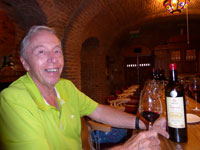
We had a very good wine tasting from Anna, the sommelier, in a modern tasting facility in the cellars of the hotel
The hotel needs more hands on management to supervise staff, and ensure that the customers do get reasonable service
Click on any of the thumbnails to get a bigger version of the picture
 |
 |
 |
 |
 |
 |
 |
 |
 |
 |
There were other restaurants that the tour operator took us to for lunch, but they are best forgotten (it will take time to forget)
We stayed at Tbilisi at the start and at the end of our trip to Georgia, so the options are below