 |
 |
 |
 |
Travel to the Armenia border. It was a pretty bad road with a lot of unmade sections. Our guide kept quiet all of the time with not a word.
The border crossing was quiet, not really surprising due to the state of road , and hence very few lorries crossing. The frontier buildings themselves were very new - designed to facilitate trade between Georgia and Armenia, but as often happens with grandiose schemes, they lack the detail to make them work. In this case the road in Georgia was too bad to attract any lorry traffic.
We were through in 5 minutes and about the same to get into Armenia. Our Armenian guide was a feisty young lady who was prepared to argue about the politics of the region.
Click on any of the thumbnails to get a bigger version of the picture
|
|
|
|
Marmashen monastery.

Marmashen Monastery is a 10th-century Armenian monastic complex near the village of Marmashen in the Shirak Province of Armenia. The buildings at Marmashen are very similar in style to those of Khtzkonk Monastery. This monastery has four churches (one of which, circular, has only recently been discovered with a jhamatun and a chapel); the jhamatun and the chapel are nearly in ruins. An inscription on the south wall of the main church informs us that it was built between 986 and 1029 by Prince Vahram Pahlavuni. Of cupola'd hall type, with an umbrella shaped cupola, the church is constructed of huge stones, some of which are two meters high. Three of the exterior walls have double niches. The only entrance is on the west. Like the exterior walls, the drum of the cupola is adorned with half columns, which produce a beautiful decorative effect.
Click on any of the thumbnails to get a bigger version of the picture
 |
 |
 |
 |
 |
 |
 |
 |
 |
 |
Gyumri Museum

Officially Dzitoghtsyan House-Museum of Social Life and National Architecture, is a museum in Gyumri, Armenia. It was founded in 1984 in the Dzitoghtsyan family house, dating back to the 19th century. The museum exhibits elements of the daily urban life of Gyumri, as well as the local cultural and architectural characteristics of the city.
The famous house of the Dzitoghtsyan family was built in 1872 by 4 brothers who migrated from the Western Armenian village of Dzitogh, to the city of Alexandropol. It is built with the red tuff stone of Shirak. The museum exhibits a collection of the Alexandropol social life characteristics, from the 19th century up to the 1920s. It also features the cultural, architectural and religious aspects of the city. And an appreciation of the devastating 1988 earthquake.
Click on any of the thumbnails to get a bigger version of the picture
 |
 |
 |
 |
 |
 |
 |
 |
Gyumri City

Gyumri is an urban municipal community and the second largest city in Armenia, serving as the administrative centre of Shirak Province in the northwestern part of the country.
By the end of the 19th century, when the city was known as Alexandropol, it was one of the largest cities of Russian-ruled Eastern Armenia with a population similar to that of Yerevan. It was renamed Leninakan during the Soviet period.
The city's population grew above 200,000 prior to the 1988 Spitak earthquake, when it was devastated. As of the 2011 census, the city had a population of 121,976, down from 150,917 reported at the 2001 census.
The 1988 Armenian earthquake, also known as the Spitak earthquake, occurred on December 7 with a surface wave magnitude of 6.8 and a maximum MSK intensity of X (Devastating). The shock occurred in the northern region of Armenia (then part of the Soviet Union) which is vulnerable to large and destructive earthquakes and is part of a larger active seismic belt that stretches from the Alps to the Himalayas. Activity in the area is associated with tectonic plate boundary interaction and the source of the event was slip on a thrust fault just to the north of Spitak. The complex incident ruptured multiple faults, with a strike-slip event occurring shortly after the initiation of the main shock. Between 25,000 and 50,000 were killed and up to 130,000 were injured.
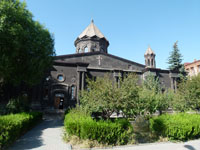
The city appears to have been mainly rebuilt, though the church on the square was still under reconstruction, and will be for some years.. Our hotel was within walking distance of the square, but oddly there were no restaurants or shops around it.
Click on any of the thumbnails to get a bigger version of the picture
 |
 |
 |
 |
 |
| church after 1988 earthquake |
Berlin Art Hotel

This is an odd place. It is an old hospital, and the rooms are the individual hospital wards, which are still clearly hospital wards, down to the bathrooms. There is no pleasure in staying here There is nothing to show that the place is an "Art Hotel". There are no public rooms, no lounge, no bar - if you want a drink you ask at reception - if you can find anyone - and take it outside to drink
The staff are not easy to find (they hide themselves away) and not particularly helpful when you do find them The restaurant is small with 4 large tables , presumably designed to cope with the large groups that are the majority of customers at the hotel.
Food at dinner was plentiful, but the quality was very middle of the road cuisine. Breakfast was of a similar quality, but the large German group had eaten before us and food had not been replenished, so I had to settle for a yogurt for my breakfast
The hotel is in walking distance of the main city square, but there is little there. I would recommend that you chose a different hotel. We were disappointed with this place.
Click on any of the thumbnails to get a bigger version of the picture
 |
 |
 |
 |
 |
 |
 |
 |
St Hovannes Church at Mastara

The Church of Saint John (Surp Hovanes), also known as Mastara Church, in Mastara, Armenia dates from the 5th century.
It features a variation of the cruciform plan and central cupola'd church. In accordance with its square plan, the four projecting apses, inward-facing circular and outward facing polygonal, offer the requisite supports to hold up the imposing polygonal cupola. The complex church designs are like those in Avan and St. Hripsime Church, Echmiadzin. The works of medieval architecture in Mastara include, among others, numerous khachkars.
Click on any of the thumbnails to get a bigger version of the picture
 |
 |
 |
 |
 |
 |
 |
 |
Dashtadem Fortress


Dashtadem Fortress is a substantial fortress of the 10th to 19th centuries located at the southern outskirts of Dashtadem village in the Aragatsotn Province of Armenia.
An octagonal walled enceinte surrounds the fortress and was constructed during the beginning of the 19th century. A continuous line of eight bastions and curtain walls encloses interior fortifications; seven regular polygonal bastions and a single semi-circular or "half-moon" bastion to the north. Where fully developed bastions consist of two faces and two flanks with fire from the flanks being able to protect the exposed curtain walls and adjacent bastions, curtain walls between the semi-circular and regular bastions at Dashtadem are angled-in slightly so that the former is protected by the adjacent projecting fortifications.
The main gate requires one to enter at a right angle from the east of the northern bastion. This design prevented cavalry from charging the entry. Low-relief depictions of lions on "panels" are upon the exterior wall above the arched gateway. A low-irregular dechagonal interior wall surrounds a fortress keep and an adjacent 10th-century chapel of S. Sargis. Five of the ten original semi-circular bastions remain standing.
The keep consists of four semi-circular towers (12th century?) that were affixed at a later date to earlier 10th-century Armenian fortifications. Beneath the towers are large cisterns and tunnels that lead to the top of the keep. The structure has been partially renovated in recent years, while the chapel has been entirely rebuilt.
On the east wall of the fortress keep is an Arabic dedicatory inscription of 1174, written in Kufic script attributing the structure to Sultan ibn Mahmud (Shahanshah), one of the Shaddadid Princes that ruled in Ani. It reads the following passage: May Allah exalt him. In the blessed month of Safar in the year 570 (September 1174) the lord of this strong fortress, the Prince, the great Spasalar, the Pillar of Faith, the Glorifier of Islam, Sultan son of Mahmud son of Shavur.
Until recently, the fortress had been home to local shepherds and their families. These individuals have been displaced from the grounds while renovations have been underway.
Click on any of the thumbnails to get a bigger version of the picture
 |
 |
 |
 |
 |
 |
 |
 |
Armas Winery
We visited the Armas winery set against the backdrop of Ararat, Ara and Aragats.
ArmAs Estate is a brand new winery built in a formerly dry and arid land by Armenian-Americans who came from California to participate in the rebirth of the wine business in this country. They're betting on the renaissance of Armenian wine and have been investing in both land surface and tools, building a facility from scratch in this corner of the Aragatsotn province in the west of Armenia. The winery had its start in 2007 when the founder, Armenak Aslanian, decided to invest there, planting dozens of hectares of vineyards in a large ranch-size empty land with a majestic view of the mountains.
The property with its vineyards is totally walled in order to keep predators out . The total planted surface (with vineyards) is something like 110 hectares, and they also reserved more surface for a few orchards in the lot, some of which are already planted in the midst of the parcels and the hills.
They produce white, rose and red wines and brandy. The logo of the factory ARMAS had been chosen as it has Armenian print “trchnagir”.

Click on any of the thumbnails to get a bigger version of the picture
 |
 |
 |
 |
 |
 |
 |
 |
 |
 |
Continue to Yerevan and overnight Grand Hotel Yerevan