
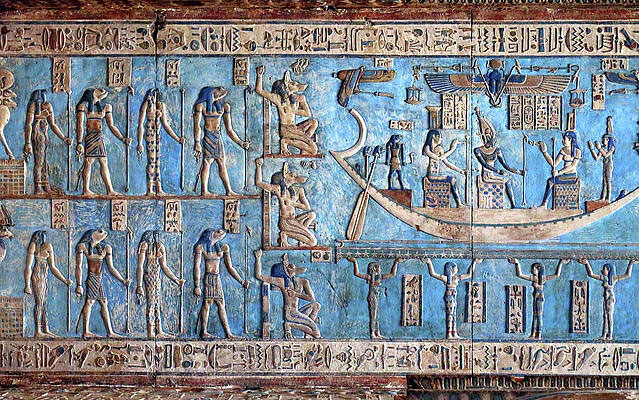
Dendera Zodiac
Wednesday 24th April . Dendera
Our boat had started sailing about 4 am in order to reach the mooring point for Dendera Temple by 8 am.
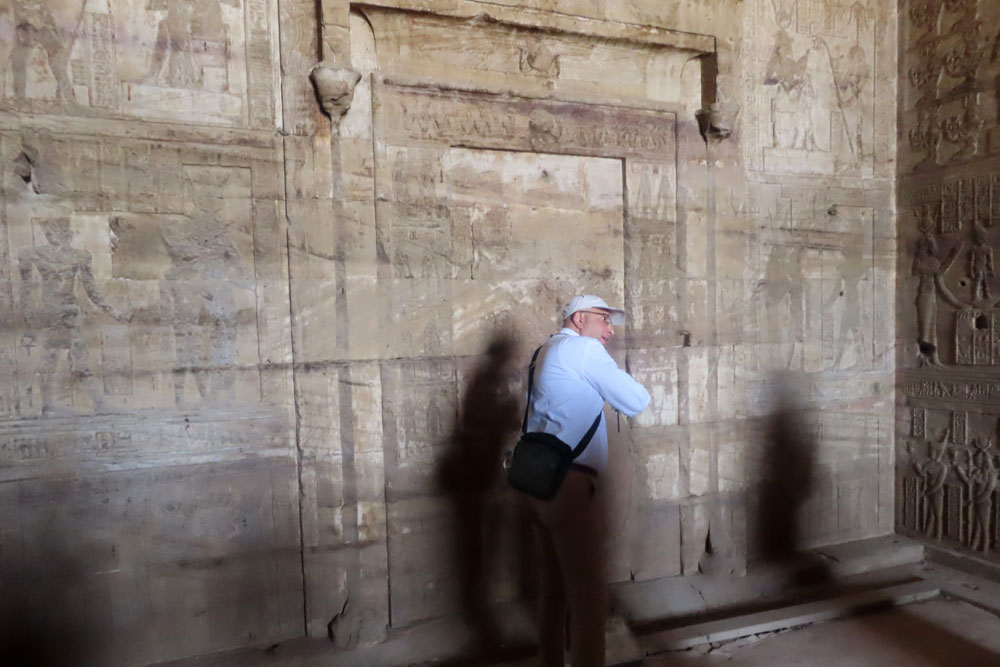
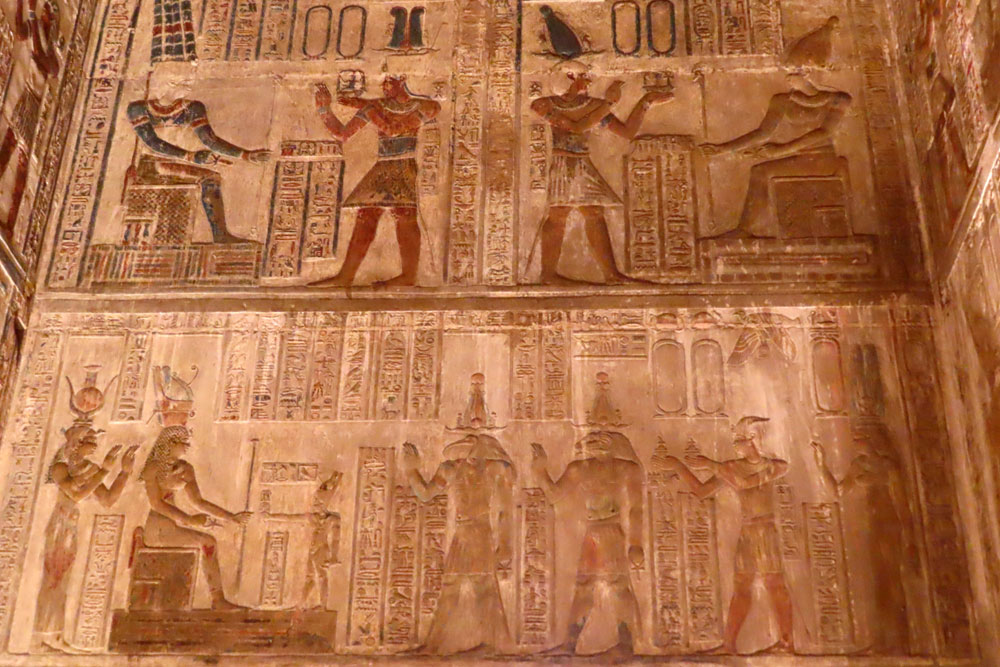
We boarded the coach after breakfast at 8:30 am and it was about 20 minutes to the Dendera temple. This temple had some fantastic ceilings that contained the signs of the zodiac and it also images of Cleopatra, the only temple in Egypt to possess these. We spent almost 2 hours there. Being early, it was not too hot.
When we went up on deck after returning, around 11.30 . And found that we were just about to pass under a low bridge. The had to lower the funnel and all the shade structures on the upper deck. We were told to sit down quick and were able to photograph the crew touching the bridge as we went under it. After this, it was fascinating to see the funnel being pulled back upright with a pulley system.
We went into the ships shop and David purchased an Egyptian shirt and head dress ready for the party on the following day. Chris had the Saudi abaya which had come with us.
Lunch was at 12.30. An Indian buffet but there was a very pleasant spaghetti that was not spicy and then had a siesta before going up on deck around 15.00 to try to access the Internet, but without success. Chris had a swim at this time.
We docked in a town Haga Hammady, where the buildings were not very picturesque, at 5 pm. Rules seem to dictate that we have to moor at approved locations
We had a film on Abydos temple which we are about to visit tomorrow. It was a very interesting but strange tale about the life of a seemingly normal English lady called "Omm Seti" who believed she had lived at the Abydos Temple 3000 years ago. She first moved to Egypt age 28 and married an Egyptian and had a son called Citi (after the pharaoh). After she divorced her husband she moved to this temple permanently at the age of 45. She then worked as a skilled assistant at the temple site. She was eventually in charge of it until retirement. The film was made around 1980 and she died 1981.
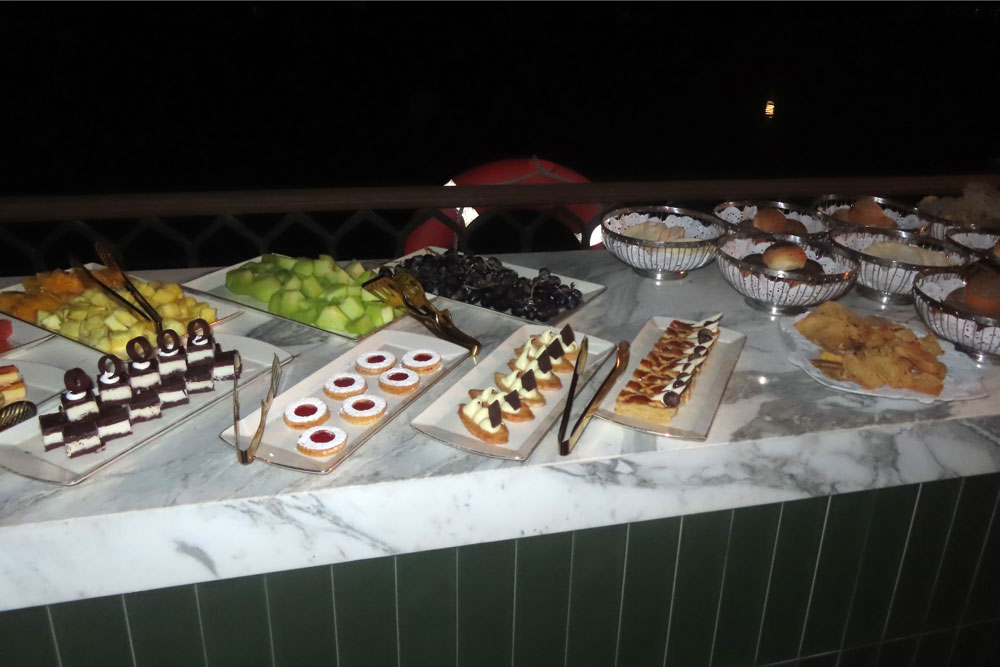
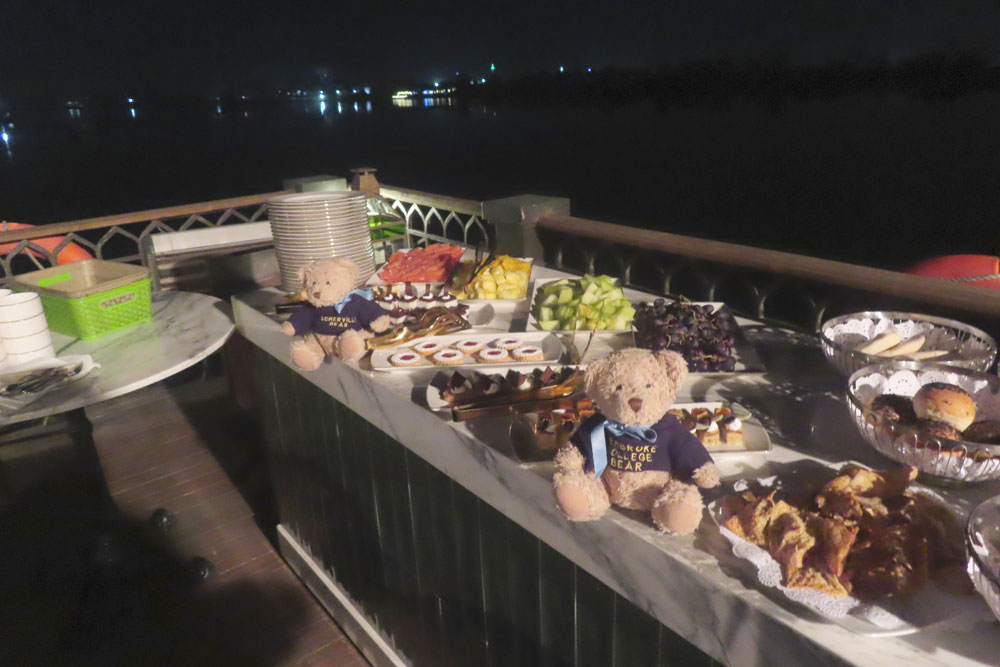
After this we went up on deck and had a sundowner with, Nigel and Jill. Dinner was a barbecue on the open part of deck floor the food quite acceptable.
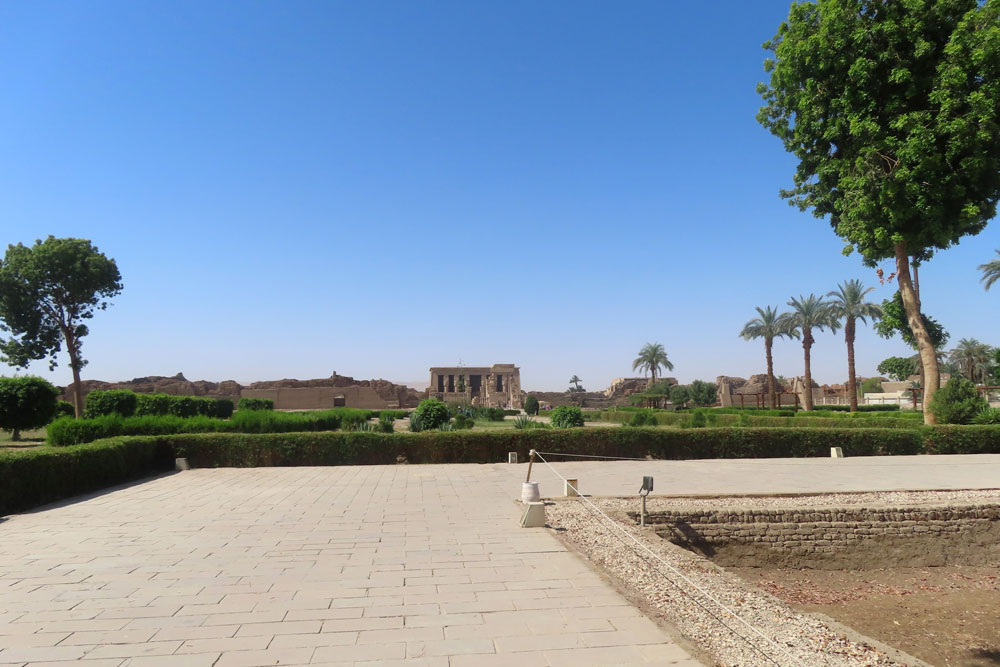
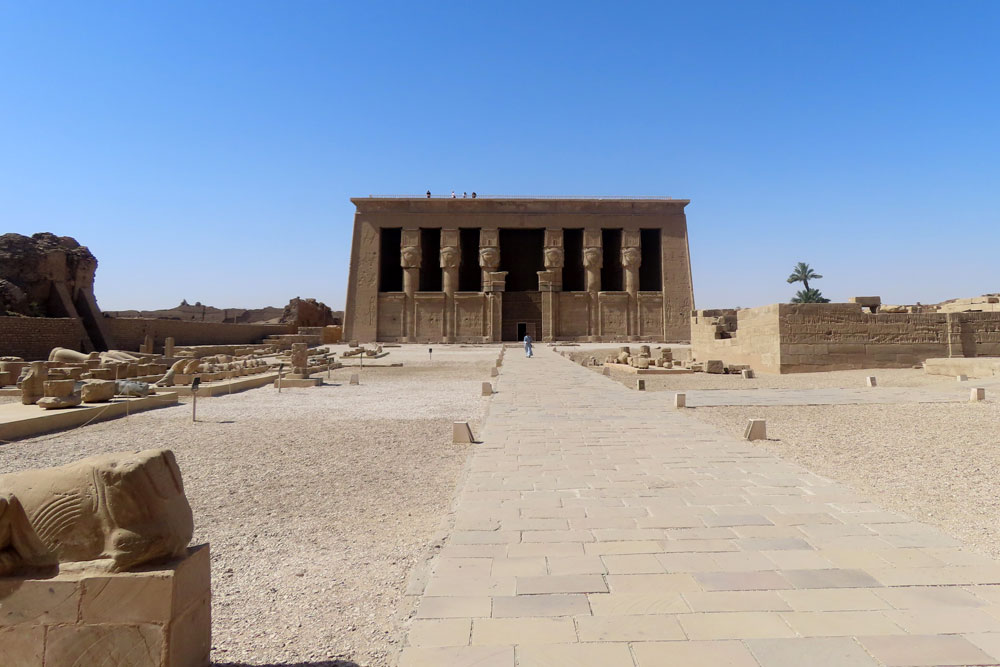
Dendera Temple
The entire complex is surrounded by a sizable mud brick wall. Dendera, an oasis on the banks of the Nile, was inhabited by thousands at its peak.
Due to its massive size, the structures throughout the complex were constructed over many eras, such as the Middle Kingdom, the Ptolemaic Era, and the period characterized by Roman provincial rule. There is evidence that there was an even earlier building on this site, circa 2250 B.C. which could have begun during the reign of Pepi I and completed during the reign of his son, Merenre Nemtyemsaf I. Evidence also exists of a temple in the Eighteenth Dynasty (ca. 1500 BC). The earliest extant (surviving) building in the compound today is the mammisi raised by Nectanebo II – last of the native pharaohs (360–343 BC).
The temple that dominates the complex, the structure that commands the attention of those who visit, is the Temple of Hathor. The original temple structure underwent continuous modifications throughout the Middle Kingdom and up until the beginning of the reign of the Roman emperor Trajan.The existing temple's structure began construction in 54 B.C, the late Ptolemaic period, under the reign of Ptolemy Auletes. The hypostyle hall was built in the Roman period under Tiberius
The sculptured Dendera zodiac is a widely known Egyptian bas-relief from the ceiling of the portico of a chapel dedicated to Osiris in the Hathor temple at Dendera, containing images of Taurus (the bull) and Libra (the scales). This chapel was begun in the late Ptolemaic period; its pronaos was added by the emperor Tiberius. The relief, which John H. Rogers characterised as "the only complete map that we have of an ancient sky", has been conjectured in the past to represent the basis on which later astronomy systems were based. It is now on display at the Musée du Louvre, Paris.
The sky disc is centered on the north pole star, with Ursa Minor depicted as a jackal. An inner disc is composed of constellations showing the signs of the zodiac. Some of these are represented in the same Greco-Roman iconographic forms as their familiar counterparts (e.g. the Ram, Taurus, Scorpio, and Capricorn), whilst others are shown in a more Egyptian form: Aquarius is represented as the flood god Hapy, holding two vases which gush water. Rogers sees the Dendera zodiac as "a complete copy of the Mesopotamian zodiac". A comparison with other Mesopotamian pre-zodiac astronomical material led Hoffmann to the suggestion that the depiction shows a Babylonian star chart (and not only the Babylonian zodiac) with some Greco-Egyptian additions and variants. Four women and four pairs of falcon-headed figures, arranged 45° from one another, hold up the sky disc, the outermost ring of which features 36 figures representing the 36 asterisms used to track both the 36 forty-minute "hours" that divided the Egyptian night, as well as the 36 ten-day "weeks" (decans) of the Egyptian year (with 5 days excluded). The square of the overall sculpture is oriented to the walls of the temple. This sculptural representation of the zodiac in circular form is unique in ancient Egyptian art. More typical are the rectangular zodiacs which decorate the same temple's pronaos.
This was the only temple we visited that allowed us to climb to the roof. The temple has a rare carving of Cleopatra and her son by Caesar
Click on any of the thumbnail photos for a larger version
 |
 |
 |
 |
 |
 |
 |
 |
 |
 |
 |
 |
 |
 |
 |
 |
Then on downstream
Click on any of the thumbnail photos for a larger version
 |
 |
 |
 |
With an evening barbecue on the back deck of the Misr
Click on any of the thumbnail photos for a larger version
 |
 |
 |
 |
 |
 |