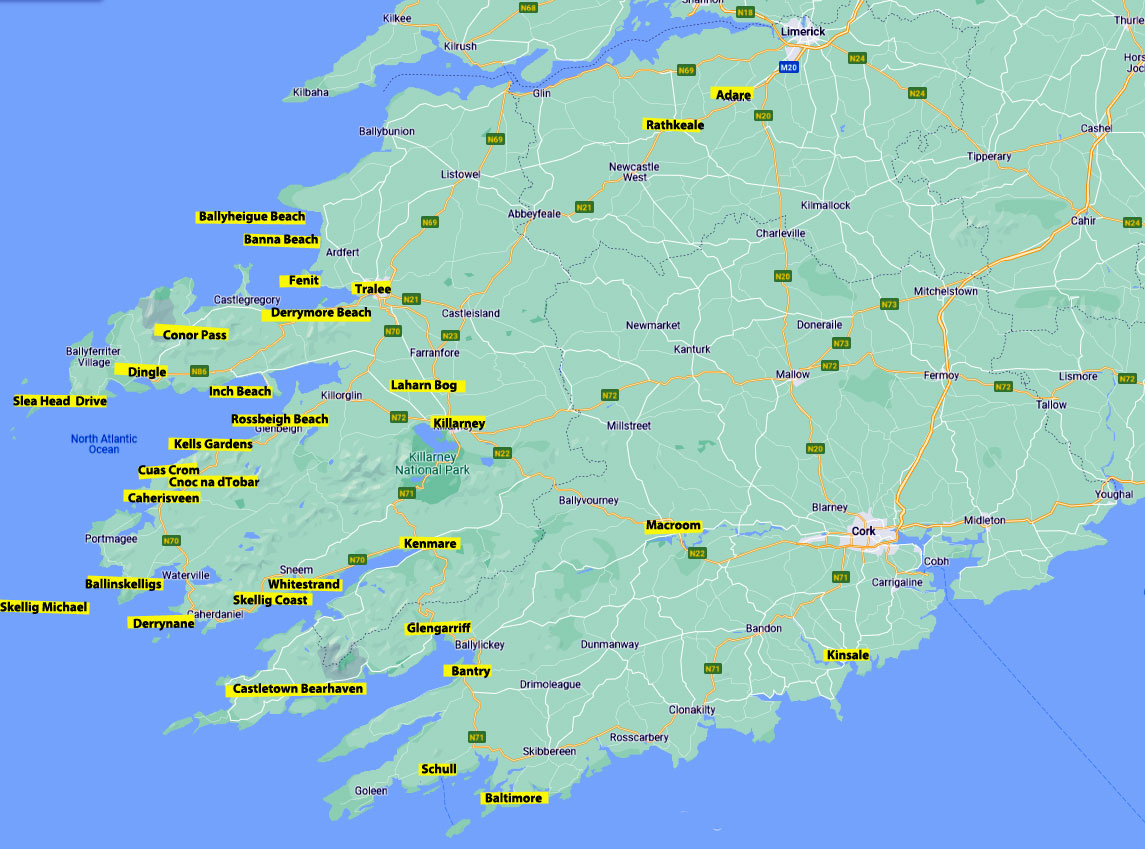
Ennis to Killarney
We left the Ennis hotel soon after 10.30 hours. A short stop at Shannon airport to see how it had grown since David had been there years ago. After this we went to the flying boat museum at Foynes, which David had visited in the past, Chris had not.
Carrigafoyle Castle Here we were very adventurous and climbed up the tower house. This was quite a challenge for Chris to descend the spiral staircase which had no rope to help. But wondrous views were to be had from the top.
The next diversion, was at Banna Strand, where Sir Roger Casement had landed from a German submarine in 1916, and quickly was captured by the by the British.
1916 Apr 11. The the 3 men set off in the U-20 bound for Ireland, but technical problems forced the submarine to return to port. They transferred to the U-20 and set off again on 15 April 1916. The submarine reached Tralee Bay in Kerry on 21 April. The reception committee from the Irish failed to materialise. About 2 a.m., Robert Monteith, Bailey, and Casement climbed into a small boat for the trip to shore. Their boat capsized before they reached Banna Strand, near Tralee. Monteith helped an exhausted Casement to safety on shore. Leaving Casement at the ruins of McKenna's Fort, Monteith and Bailey headed for Tralee. About 1:30 p.m., Casement was discovered by two Royal Irish Constabulary officers. Bailey was captured soon afterwards. Unlike his two companions, Monteith avoided capture, and in December 1916 Monteith was finally able to make his escape to New York. Casement and Bailey were put on trial for treason. Bailey turned Kings evidence and within weeks was back in the British army, posted to East Africa. Casement, as is well known, was hanged in August 1916.
We stopped at Fenit Strand, where Chris had a brisk walk along the windy sands, which she really enjoyed. Then on to Ballyheigue, where we had a picnic in the car overlooking the gorgeous view.
We arrived at Killaney, and with some difficulty found the Victoria Hotel
Touring from Killarney
After a very pleasant breakfast we went to reception to ask whether we could speak to the duty manager. We were told that said manager/owner was not there, but would be in later in the day
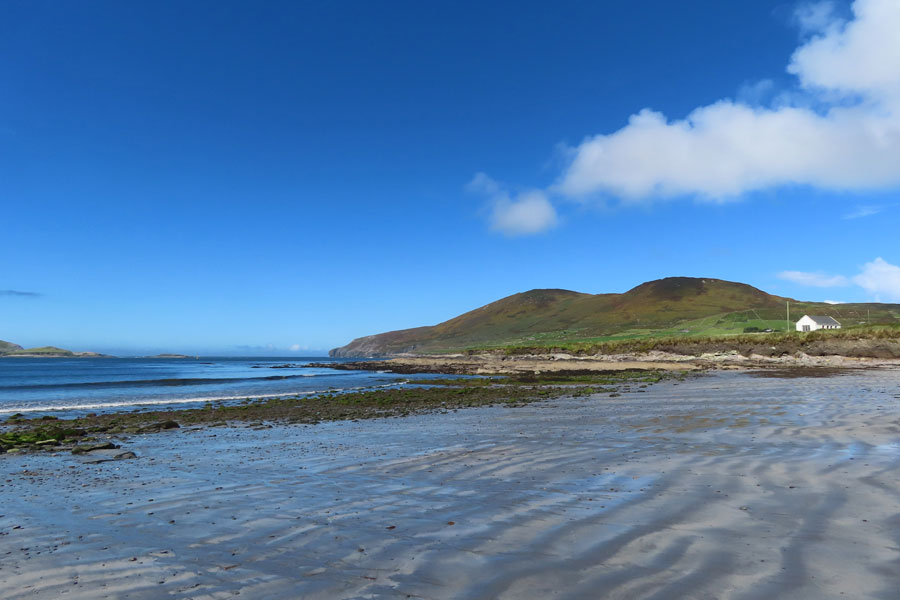
We set off around the Kerry ring stopping at two magnificent features, Rossbeigh and FIona Strand, where we had to invigorating walks. And absolutely beautiful, White Strand Beach.
We continued round the Ring of Kerry stopping at Portmagee opposite Valencia Island, a very scenic village where we indulged in a café latte and a piece of carrot cake between us.
From here we crossed the bridge to Valencia Island, this is the wettest place in Ireland, but the sun shone for us today. On the island we stopped at a Protestant church of which only the tower remained. We drove round most of the Valencia island. Just before leaving the island, we parked at a museum where we enjoyed our picnic in their grounds and there were great views back over to mainland Ireland. We continued on round the Kerry ring with more good views and photo opportunities. Unfortunately the rain came in and continued almost all the rest of the day. Back ay the hotel the owner had not appeared, but she appeared as we went in to dinner and failed appear repentant about the fact that our Credit Card was refused. She ended up offering us a glass of lager, which was not really enough to overcome the problems we had faced.
The Victoria Killarney
A run of the mill hotel, with worse than average staff
To get a larger photo, please click on thumbnail below
 |
 |
 |
 |
 |
 |
 |
 |
Ennis to Killarney
Foynes Flying Boats, Carrigafoyle Castle, Beale, Ballyheigue, Banna Strand, Ardfert Cathedral
To get a larger photo, please click on thumbnail below
 |
 |
 |
 |
 |
 |
 |
 |
 |
 |
 |
 |
 |
 |
 |
 |
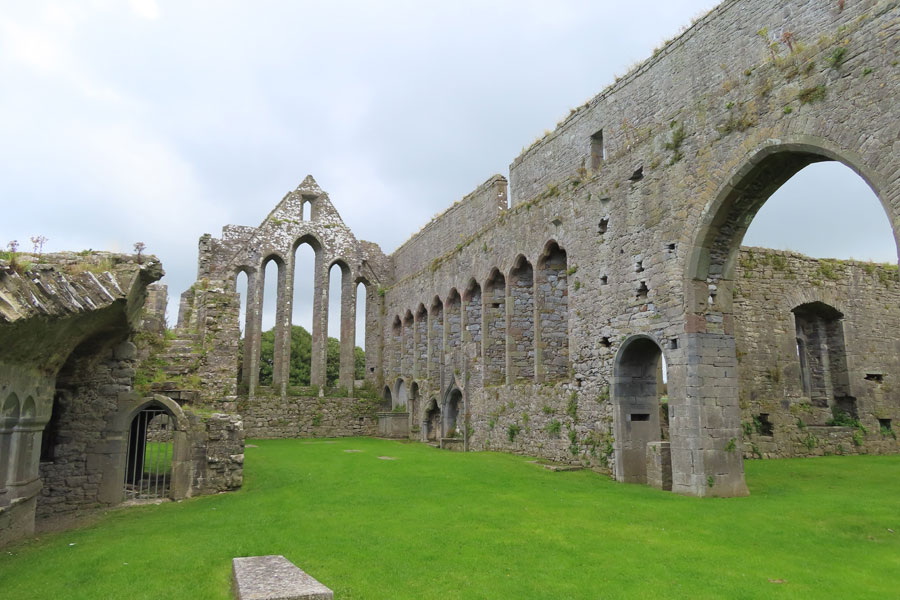
Ardfert Cathedral & Friary
The Ardfert Cathedral in County Kerry. Dedicated to Saint Brendan, it was the seat of the Diocese of Ardfert from 1117. It is now a heritage tourism site.
Ardfert was the site of a Celtic Christian monastery reputedly founded in the 6th century by Saint Brendan. The site has three medieval church ruins, the main and earliest building being from the 12th century. Within the adjoining graveyard there are two other churches, Temple Na Hoe dating from the 12th century and Temple Na Griffin dating from the 15th century. The main church has an ogham stone and a number of early Christian and medieval grave slabs. In the 15th century, a small transept was added and battlements were constructed.
During the Reformation in Ireland, the established Church of Ireland became Protestant. The cathedral roof was destroyed during the Irish Rebellion of 1641, but the south transept was re-roofed and extended later in the 17th century. From 1663 the diocese was united with the Diocese of Limerick and the former cathedral then became a parish church. In 1871, when a new Church of Ireland church was opened, the cathedral's roof was again removed.
After the 1871 disestablishment of the Church of Ireland, its disused historic sites, such as Ardfert Cathedral, were transferred to the Board of Public Works. Part of the transept has been restored, and houses the entrance and a gift shop.
Ardfert Friary stands in a secluded and peaceful position half a kilometre Friary Ardfert to the east of the village. The Friary was founded about 1253 by the Anglo Norman Fitzmaurice family and it has had a chequered history. It was originally built as a Franciscan foundation but in the 16th century it was occupied by English soldiers and later by Protestant bishops. A large portion of the structure still remains including one side of the cloister walk. A residential tower was added to the west end of the church in the 15th century. It contains five floors each with a single room, some with window seats and garderobes (toilets).
To get a larger photo, please click on thumbnail below
 |
 |
 |
 |
 |
 |
 |
 |
 |
 |
 |
 |
Ring of Kerry - Rossbeigh, Old Barracks, Portmagee, Valencia Island
To get a larger photo, please click on thumbnail below
 |
 |
 |
 |
 |
 |
 |
 |
 |
 |
 |
 |
 |
 |
 |
 |
 |
 |
 |
 |
 |
 |
 |
 |