
Constanta in its heyday
Constanța, historically known as Tomis, is the oldest continuously inhabited city in Romania. It was founded around 600 BC
On October 22, 1916 (during World War I), the Central Powers (German, Turkish and Bulgarian troops) occupied Constanța. Allied troops liberated the city in 1918 after the successful offensive on the Thessaloniki front knocked Bulgaria out of the war. In the interwar years, the city became Romania's main commercial hub, so that by the 1930s over half of the national exports were going through the port.
During World War II, when Romania joined the Axis powers, Constanța was one of the country's main targets for the Allied bombers. While the town was left relatively undamaged, the port suffered extensive damage, recovering only in the early 1950s.
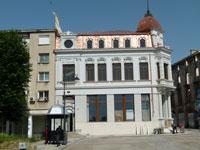
Completed in 1910 , the art-nouveau style Constanța Casino features sumptuous architecture and a wonderful view of the sea . Originally planed to be in keeping with the country's artistic traditions, it was in the event erected as an Art Nouveau palace for the Belle Epoque. All details were considered, right down to the unique shell-shaped windows and 18th century Baroque accents. The casino eventually came to be a symbol of the seaside city and a similar building was built in Monte Carlo, Monaco. Located in what was once Romania's most important port, the casino proved to be a major attraction for Europe's royalty and elite and became a preferred destination of those who used to frequent the French Riviera. The casino opened to host the Russian Imperial Family in 1914. During World War Two, this casino was used as a hospital. And it became a restaurant under the rule of communist party after the war. However it was too expensive to operate it; the building has been closed since 1990. Currently owned by the Constanta Municipality, the European Union reportedly granted €10 million in 2013 to a proposed restoration plan, with renovations now begun. There is an article in The Daily Mail will many photos of the interior.
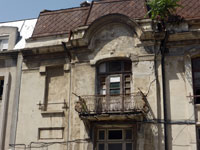
The Lion Building was built in 1897 as a personal dwelling of an Armenian merchant, it first housed an important art collection, then, later on, it became a bank and ended up as an elegant restaurant 100 years later. The grandeur and the location of the house situated on a street that links the port to the city centre led along the years to a series of stories about the building and about the origin of its name that comes from the four statues representing lions that dominate the entrance columns. During the 1930s, its elegant salons hosted the Constanța Masonic Lodge. Unfortunately, the house currently looks abandoned, with it’s former beauty shining from underneath the deserted exterior.
We had a non-descript buffet lunch at Mamaia, a suburb of Constant & on the beach at Iaki Hotel. Its rating of 8.1 on Booking is about what it deserves. We tried the beach in the chairs provided, but quickly decided that a Black Sea beach was not for us, and retreated to their pool for the next few hours. There are better hotels than this along the beach at Mamaia - though I was not that impressed, as a foreigner, by the beach itself, with people packed in like sardines The Iaki has the air of not quite having thrown off communism. Service is from that era. Restaurant tablecloths are of a low quality and appeaedr unwashed - I think you can get my drift. To avoid the rigours of the beach, you can use the hotel pool, but here there were not enough sun-umbrellas to go round. Personally I thought that there were too many out of control children jumping and fighting round the pool - but accept that that is personal! So if you really need to stay at Mamaia, then my suggestion is to try to find a more agreeable hotel, with a more progressive view on what the client needs in quality and service
Click on any thumbnail photo to get a larger version
 |
 |
 |
 |
 |
 |
 |
 |
 |
 |
 |
 |
 |
 |
 |
 |
 |
 |
 |
 |
History Museum & Roman Mosaics
The National History and Archaeology Museum of Constanta is one of the richest museums in Romania. The cornerstone of the museum was laid in 1879 in an attempt to counter the smuggling of antiquities discovered in archaeological sites of Constanta. For nearly a century, the Historical Museum of Constanta has experienced periods of decline and prosperity, being disorganized, reorganized and moved to different locations in the city. In 1977 the museum exhibits were permanently moved to its current headquarters in Ovidiu Square. The imposing building of the museum was built in the Romanian architectural style in the early twentieth century and served as the town hall until 1921.
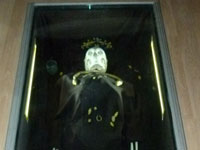
The institution houses Greek, Romanian, Byzantine and medieval objects. The ground floor of the Museum of National History and Archaeology consists of two rooms where archaeological monuments of outstanding value, rare and unique pieces, are exposed. In this section noted are: the Glykon Snake - a unique piece in the world, representing a deity of the Romanian mythology (II century BC), the statuary group of Fortuna with Pontos - protective deities of Tomis city and harbour (II-III century BC), the dual aediculae representation of Nemesis - one of the most remarkable parts of the Museum (II century BC) collections of gold jewellery, gems and cameos, silver vessels from Sucidava fortress sources etc..
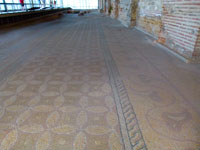
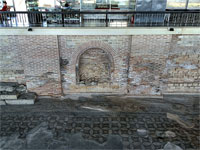
The Roman Mosaics are in a vast complex on three levels and once linked the upper town to the harbour. Today, only about a third of the original edifice remains, including more than 850 m2 of colourful mosaics. Built toward the end of the 4th century AD and developed over the centuries, it was the city's commercial centre until the 7th century. Archaeological vestiges point to the existence of workshops, warehouses and shops in the area. Remains of the Roman public baths can still be seen nearby. Aqueducts brought water 10 km to the town.
Click on any thumbnail photo to get a larger version
 |
 |
 |
 |
 |
 |
 |
 |
 |
 |
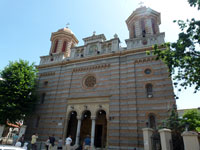
St. Peter & Paul Orthodox Cathedral
Constructed in Greco-Roman style between 1883 and 1885, the church was severely damaged during World War II and was restored in 1951. The interior murals display a neo-Byzantine style combined with Romanian elements best observed in the iconostasis and pews, chandeliers and candlesticks (bronze and brass alloy), all designed by Ion Mincu and completed in Paris.
Click on any thumbnail photo to get a larger version
 |
 |
 |
 |
 |
MS Treasures
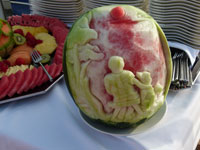
This was the final night on board the Treasures, before we were taken to Bucharest. It was barbecue night - hamburgers always go down well with Americans.
Click on any thumbnail photo to get a larger version
 |
 |
 |
 |
 |
 |
 |
 |
 |
 |