
Bucharest was first mentioned in documents in 1459. It became the capital of Romania in 1862 and is the centre of Romanian media, culture, and art. Its architecture is a mix of historical (neo-classical), inter bellum (Bauhaus and art deco), communist-era and modern.
One cannot talk about Romania, without mentioning Vlad the Impalor. As the name "The Impaler" suggests, his practice of impaling his enemies is part of his historical reputation. During his lifetime, his reputation for cruelty spread abroad to Germany and elsewhere in Europe. The name of the vampire Count Dracula in Bram Stoker's 1897 novel Dracula was inspired by Vlad's patronymic and reputation. He ruled part of this area from 1456 to 1462. Vlad's reputation was considerably darker in western Europe than in eastern Europe and Romania. In the West, he has been characterized as a tyrant who took sadistic pleasure in torturing and killing his enemies. Estimates of the number of his victims range from 40,000 to 100,000. He also had whole villages and fortresses destroyed and burned to the ground. Impalement was Vlad's preferred method of torture and execution. Several woodcuts from German pamphlets of the late 15th and early 16th centuries show Vlad feasting in a forest of stakes and their grisly burdens outside Brașov, while a nearby executioner cuts apart other victims. It has also been said that in 1462 Mehmed II, the conqueror of Constantinople, returned to Constantinople after being sickened by the sight of 20,000 impaled corpses outside Vlad's capital of Târgoviște. The connection of the name "Dracula" with vampirism is recent and was made by Bram Stoker around the 1890s. Since then, the character of 'Count Dracula' has recurred through vampire mythology and popular culture.
In 1862, after Wallachia and Moldavia were united to form the Principality of Romania, Bucharest became the new nation's capital city under King Carol I. During the second half of the 19th century, the city's population increased dramatically, and a new period of urban development began. During this period, gas lighting, horse-drawn trams, and limited electrification were introduced. The Dâmbovița River was also massively channeled in 1883, thus putting a stop to previously endemic floods.
In the period between the two World Wars, the city's elegant architecture and the sophistication of its elite earned Bucharest the nickname of "Little Paris". Although buildings and districts in the historic city centre were heavily damaged or destroyed by war, earthquakes, and above all Nicolae Ceaușescu's program of systematisation, many survived. In recent years, the city has been experiencing an economic and cultural boom
Between 6 December 1916 and November 1918, the city was occupied by German forces as a result of the Battle of Bucharest, with the official capital temporarily moved to Iași, in the Moldavia region. After World War I, Bucharest became the capital of Greater Romania
In January 1941, the city was the scene of the Legionnaires' rebellion and Bucharest pogrom. As the capital of an Axis country and a major transit point for Axis troops en route to the Eastern Front, Bucharest suffered heavy damage during World War II due to Allied bombings. On 23 August 1944, Bucharest was the site of the royal coup which brought Romania into the Allied camp. The city suffered a short period of Nazi Luftwaffe bombings, as well as a failed attempt by German troops to regain the city.
After the establishment of communism in Romania, the city continued growing. New districts were constructed, most of them dominated by tower blocks. During Nicolae Ceaușescu's leadership (1965–89), much of the historic part of the city was demolished and replaced by "Socialist realism" style development: developments included the Palace of the Parliament, for which an entire historic quarter was razed to make way for Ceaușescu's megalomaniac plans. On 4 March 1977, an earthquake centred in Vrancea, about 135 km away, claimed 1,500 lives and caused further damage to the historic centre.
The Romanian Revolution of 1989 began with massive anti-Ceaușescu protests in Timișoara in December 1989 and continued in Bucharest, leading to the overthrow of the Communist regime.
After a brief period of relatively moderate rule, Ceaușescu's regime became increasingly brutal and repressive. He maintained controls over speech and the media that were very strict even by Soviet-bloc standards, and internal dissent was not tolerated. His secret police, the Securitate, was one of the most brutal secret police forces in the world. In 1982, with the goal of paying off Romania's large foreign debt, Ceaușescu ordered the export of much of the country’s agricultural and industrial production. The resulting extreme shortages of food, fuel, energy, medicines, and other basic necessities drastically lowered living standards and intensified unrest. Ceaușescu’s regime collapsed after he ordered his security forces to fire on anti-government demonstrators in the city of Timișoara on 17 December 1989. The demonstrations spread to Bucharest and became known as the Romanian Revolution, which was the only violent removal of a Communist government in the course of the revolutions of 1989. Ceaușescu and his wife, Elena, fled the capital in a helicopter but were captured by the armed forces. On 25 December the couple were hastily tried and convicted by a special military tribunal on charges of genocide and sabotage of the Romanian economy in a one-hour long court session. Ceaușescu and his wife were then shot by a firing squad
Click on any thumbnail photo to get a larger version
 |
 |
 |
 |
 |
 |
 |
 |
 |
 |
 |
 |
 |
 |
 |
Caru' cu bere Cafe
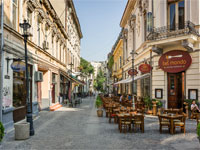
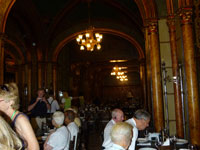
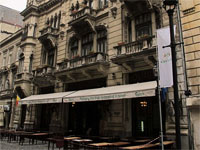
Caru' cu Bere ( "the beer wagon") is a bar and restaurant on Stavropoleos Street and is classed as a historic monument. It is part of a chain and is operated by Dragoș Petrescu's City Grill chain, which perhaps explains why the place is such a tourist trap
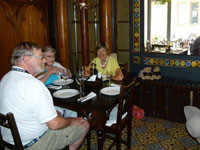
An authentic old cafe in the centre of Bucharest. Built in 1898 with a vaulted ground floor in Neo-Gothic style, it is richly decorated with paints, stained glass, mosaics and carved panelings. High ceilings, wood panels are still there today so you can imagine that it has not changed for a century.
The food is certainly piled high on the plate, but its quality is on the low side. The service is typical of tourist traps, where the customer is looked on with contempt. Depending on how you look at it, the staff are either overworked, or uncaring - but either way the service is bad.
So a wonderful building where you can certainly admire the architecture, but you really do not want to have a meal here. My advice would be to go for a glass of beer and skip the meal
Click on any thumbnail photo to get a larger version
 |
 |
 |
 |
 |
 |
 |
Stavropoleos Monastery
Stavropoleos Monastery is an Eastern Orthodox monastery in central Bucharest. Its church is built in Brâncovenesc style. The patrons of the church (the saints to whom the church is dedicated) are St. Archangels Michael and Gabriel. The name Stavropoleos is a Romanian rendition of a Greek word, Stauropolis, meaning "The city of the Cross". One of the monastery's constant interests is Byzantine music, expressed through its choir and the largest collection of Byzantine music books in Romania.
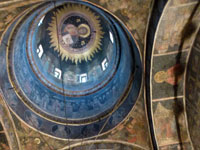
The church was built in 1724, during the reign of Nicolae Mavrocordat (Prince of Wallachia, 1719-1730), by archimandrite Ioanichie Stratonikeas. In 1726 abbot Ioanichie was elected metropolitan of Stavropole. Since then the monastery he built has been called Stavropoleos, after the name of the old seat. Ioanichie died in 1742 and was buried in his church. Over time the church suffered from earthquakes, which caused the dome to fall. The dome's paintings were restored at the beginning of the 20th century. All that remains from the original monastery is the church, alongside a building from the beginning of the 20th century which shelters a library, a conference room and a collection of old (early 18th century) icons and ecclesiastical objects, and parts of wall paintings recovered from churches demolished during the communist regime.
Click on any thumbnail photo to get a larger version
 |
 |
 |
 |
 |
 |
Palace of the Parliament
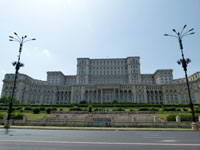
The Palace of the Parliament is the seat of the Parliament of Romania. As we were told by guides many times, it is the second largest building in the world, after The Pentagon in the United States.
After the earthquake of 1977, Nicolae Ceaușescu started a reconstruction plan of Bucharest, and this "People's House" was the centre of this project. A contest among architects was held for the design of the new building. This was by Anca Petrescu, who was only 28 at the time she won. A team of 10 architects coordinated the building of the Palace. The actual construction began in 1984. Major demolition work was carried our to clear the large area required in the centre of the city: apart from houses, some monasteries were demolished and Uranus Hill was leveled.
A large list of building was demolished including the National Archives, Văcărești Monastery, Brâncovenesc Hospital, as well as about 37 factories and workshops. 7 square kilometers of the old city centre were demolished, and 40,000 people were relocated from this area. The works were carried out with forced labour of soldiers and so the cost was minimized. 20,000 and 100,000 workers then worked on the building site, sometimes in three shifts a day. Building costs were estimated at $1.75 billion to €3 billion, but nobody seems certain as accounts were not kept at the time.

The construction initially should have been completed in only two years. The term was then extended until 1990, but even now it is not finalized. Only 400 rooms and two meeting rooms are finished and used, out of 1,100 rooms. The building has eight underground levels, the last one being a nuclear bunker, linked to the main state institutions by 20 km of catacombs. Nicolae Ceaușescu feared a nuclear war. The bunker is a room with 1.5 m thick concrete walls and can not be penetrated by radiation.
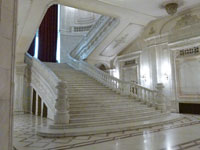
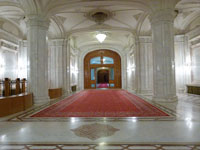
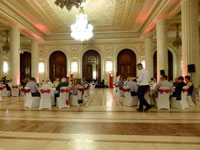
The building was constructed almost entirely of materials of Romanian origin. The only exceptions are the doors of Nicolae Bălcescu Hall. These were received by Ceaușescu as a gift from his friend Mobutu Sese Seko, the President of Zaire. Among the construction materials were : 3,500 tonnes of crystal – 480 chandeliers, 1,409 ceiling lights and mirrors were manufactured; 700,000 tonnes of steel and bronze for monumental doors and windows, chandeliers and capitals; 900,000 m3 of wood (over 95% domestic) for parquet and wainscoting, including walnut, oak, sweet cherry, elm, sycamore maple; 200,000 m2 of woolen carpets of various dimensions (machines had to be moved inside the building to weave some of the larger carpets); velvet and brocade curtains adorned with embroideries and passementeries in silver and gold. The resultant weight means that the building is sinking by 6 mm a year
Click on any thumbnail photo to get a larger version
 |
|
 |
 |
 |
 |
 |
 |
 |
 |
 |
 |
 |
 |
 |
 |
 |
 |
JW Marriott
The JW Marriott is an average 5 star hotel which could be in any city - in other words it is nothing special. Its location is a fair way from the old town, so although you might walk there in daylight, you are stuck with either eating in the hotel or taking a taxi somewhere (problematic for foreigners).

In common with most people booking we are not Platinum/Gold Marriott members, so I can describe the standard treatment that guests may expect without the frills that these cards impart.
Rooms are large, but are accessed by walking miles down long corridors - there is only one set of lifts for guests, located in the centre of the building, so if your room is at the end, as ours was, you get to walk a long way to get to the elevator. They did seem to have a problem with elevators, and service took ages.
Our room overlooked what looked like a dreary staff car park at the back of the building. Half the rooms therefore have this view. I have no idea therefore where the rooms on the other side have any better a view.
Arriving for breakfast you get a good going over to ascertain that you qualify for breakfast. We did, but I felt that the approach was confrontational. The breakfast buffet was good, but no better than I world expect from a hotel of this grading
So a typical American 5 star hotel which you would probably choose if you had a Marriott card that would get you upgraded and access to executive lounges. But if, like me, you wanted somewhere more comfortable, personal and convenient to stay, then I would go for one of the many hotels in the city centre which get better ratings than this Marriott
Peles Castle
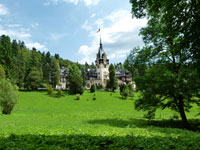
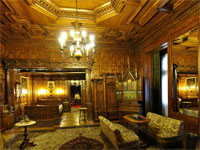
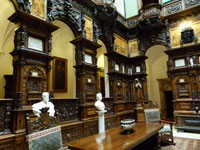
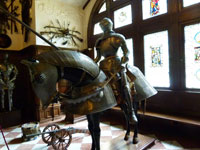
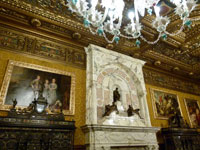
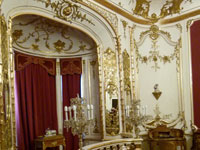
Peleș Castle is a Neo-Renaissance castle in the Carpathian Mountains, near Sinaia, Romania, on an existing medieval route linking Transylvania and Wallachia, built between 1873 and 1914. It was constructed by King Carol I, during whose reign the country gained its independence. He first visited the site of the future castle in 1866 and he fell in love with the magnificent mountain scenery. In 1872, the Crown purchased 1,300 square kilometres of land near the Piatra Arsă River. The estate was named the Royal Estate of Sinaia. The King commissioned the construction of a royal hunting preserve and summer retreat on the property, and the foundation was laid for Peleș Castle in 1873. Several auxiliary buildings were built simultaneously with the castle: the guards' chambers, the Economat Building, the Foişor hunting lodge, the royal stables, and a power plant. Peleș became the world's first castle fully powered by locally produced electricity.
After King Michael I's forced abdication in 1947, the Communist regime seized all royal property, including the Peleș Estate. The castle was opened as a tourist attraction for a short time. It also served as a recreation and resting place for Romanian cultural personalities. The castle was declared a museum in 1953. Nicolae Ceauşescu closed the entire estate between 1975 and 1990, during the last years of the Communist regime. The area was declared a "State Protocol Interest Area", and the only persons permitted on the property were maintenance and military personnel.
Ceauşescu did not like the castle very much and rarely visited. After the December 1989 Revolution, Peleş and Pelişor Castle were re-established as heritage sites and opened to the public. Today, Foişor Castle (the old hunting lodge) serves as a presidential residence. The Economat Building and the Guard's Chambers Building are now hotels and restaurants. Some of the other buildings on the Peleş Estate were converted to tourist villas and some are now "state protocol buildings". In 2006, the Romanian government announced the restitution of the castle to former monarch Michael I. Negotiations soon began between the former king and the government of Romania, and have not concluded yet. The castle is on lease from the royal family to the Romanian state. Peleş Castle receives between a quarter and almost a half million visitors annually.
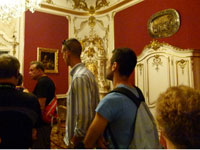
For reasons I never discovered, our private tour was joined by 2 men who were a cross between Special Forces and Secret Police. They elbowed us tourists aside, and in spite of my questions to our guides, I never did find out who they were or why they were with us.
Click on any thumbnail photo to get a larger version
 |
 |
 |
 |
 |
 |
 |
 |
 |
 |
 |
 |
 |
 |
 |
 |
 |
 |
 |
 |
Heading for Home
It's over, let's get back home now boys - regretfully it is by Ryanair via Stansted and not via Singapore Air Business Class.
Click on any thumbnail photo to get a larger version
 |
 |
 |