
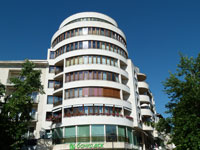
Between World War I and II, after Southern Dobruja was lost to Romania, the economic significance of the city decreased. So did the population, Ruse was no longer the second-largest city in Bulgaria, being quickly surpassed by Sofia and Varna. All foreign consulates were closed, except for the Russian one, which has remained functional since. The return of Southern Dobrudja to Bulgaria in September 1940 fostered good conditions for restoration of the city's leading role. It became a provincial centre, and economic activity revived. Typical for the post-war architecture of the city was the wide usage of iron, concrete and glass as construction materials. Examples are the River port - 1931, the Freight station - 1935, Market Hall - 1939 and the Court house - 1940.
In the early 1980s, Ruse entered a dark period of its history. The Verachim factory was built in Giurgiu, which polluted the air with its chlorine between 1980 and 1987, impacting the city's development. Population decreased, and 15,000 people moved out between 1985 and 1992. Fortunately, in 1987, the Romanian factory ceased the pollution, under pressure from environmental organizations on both Bulgarian and Romanian communist leadership. Organizations, such as Ekoglasnost, provoked the first nationwide demonstrations and strongly influenced the change to democracy.
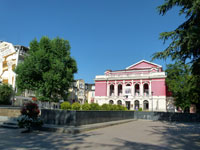
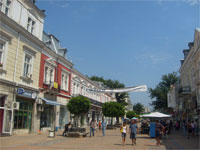
The main street of the city is "Aleksandrovska". It is an architectural ensemble of buildings in Neo-Baroque, Neo-Rococo and other architectural styles.
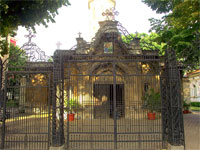
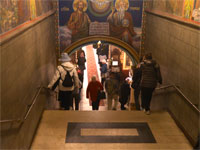
The church “St. Trinity” is the oldest building in the town. It was built in 1632 when the Ottomans controlled the region.. It seems that the church was built below ground (hence the steps down into the church) so that Christians could worship out of sight. There are some suggestions that the temple was erected over Christian catacombs or over a Medieval Bulgarian church. The building is with a nave and two aisles. The church is dug four and a half meters below ground level and there are 22 steps leading to its interior. The iconostasis was made in 1807 and is very rare because it is with painted wood carvings. The belfry of the church was built after the Liberation. Now there are five bells, and the oldest one is from 1899.
Click on any thumbnail photo to get a larger version
 |
 |
 |
 |
 |
 |
 |
 |
 |
 |
The Rock-hewn Churches of Ivanovo
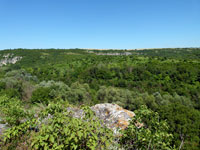
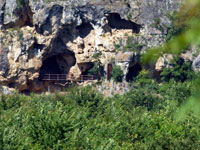
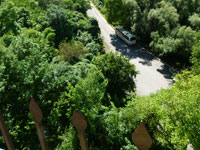
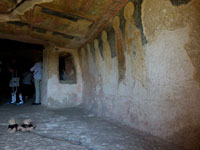
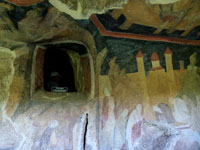
The Rock-hewn Churches of Ivanovo are a group of monolithic churches, chapels and monasteries hewn out of solid rock, located near the village of Ivanovo, 20 km south of Russe, on the high rocky slopes of the park Rusenski Lom. The complex is noted for its beautiful and well-preserved medieval frescoes. The Rock-hewn Churches of Ivanovo are included in the UNESCO World Heritage List since 1979.The caves in the region had been inhabited by monks from the 1220s, when it was founded by the future Patriarch of Bulgaria Joachim I, until the 17th century. They hewed cells, churches and chapels out of solid rock. At the peak of the monastery complex, the number of churches was about 40, while the other premises were around 300, most of which are not preserved today.
The monastery complex owes much of its fame to 13th- and 14th-century frescoes, preserved in 5 of the churches, which are thought of as wonderful examples of Bulgarian mediaeval art. The rock premises used by the monks include the St Archangel Michael Chapel ("The Buried Church"), the Baptistery, the Gospodev Dol Chapel, the St Theodore Church ("The Demolished Church") and the main Church, with the 14th-century murals in the latter one being arguably the most famous of all in Ivanovo and noted as some of the most representative examples of Palaeologan art. Many century-old inscriptions have also been preserved in the monastic premises
Click on any thumbnail photo to get a larger version
 |
 |
 |
 |
 |
 |
 |
 |
 |
 |
 |
 |
 |
 |
 |
MS Treasure
The boys get a bit of attention
Click on any thumbnail photo to get a larger version
 |
 |
 |