
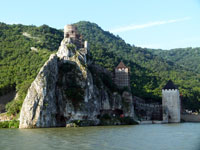
The Iron Gates is a gorge on the River Danube where it forms part of the boundary between Serbia and Romania. It contains two hydroelectric dams, with two power stations. At this point, the river separates the southern Carpathian Mountains from the northwestern foothills of the Balkan Mountains. The Romanian side of the gorge constitutes the Iron Gates natural park, whereas the Serbian part constitutes the Đerdap national park.
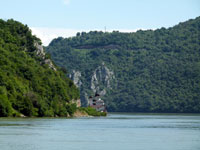
The rock sculpture of Decebalus is a massive 43 m in height and 32 m in width carving in rock of the face of Decebalus, the last king of Dacia, who fought against the Roman emperors Domitian and Trajan to preserve the independence of his country, which corresponded to modern Romania. The sculpture was made between 1994 and 2004, on a rocky outcrop, at the Iron Gates. It was commissioned by Romanian businessman and it took 10 years for twelve sculptors to finish it. The first six years involved dynamiting the rock into the basic shape, and the remaining four years were devoted to completing the detail. Under the face of Decebalus there is a Latin inscription which reads "DECEBALUS REX—DRAGAN FECIT" ("King Decebalus—Made by Drăgan") - Mr Dragan being the businessman who financed the whole thing. The carving was placed opposite an ancient memorial plaque, carved in the rock on the Serbian side of the river facing Romania. The plaque, known as the Tabula Traiana, records the site of Trajan's Bridge and thus commemorates the final defeat of Decebalus by Trajan in 105, and the absorption of the Dacian kingdom into the Roman Empire. Drăgan wanted the Serbs to carve a giant head of a Roman Emperor, as if confronting Decebalus on the opposite side of the river, but the Serbs refused.
Lepenski Vir is an important Mesolithic archaeological site located in Serbia in central Balkan peninsula The latest radiocarbon and AMS data suggests that the chronology of Lepenski Vir is compressed between 9500/7200-6000 BC. The Lepenskir Vir site consists of one large settlement with around ten satellite villages. Numerous piscine sculptures and peculiar architecture have been found at the site. The first excavations were made on the site in 1965. It was only in 1967 that its importance was fully understood after the discovery of the first Mesolithic sculptures. The excavations ended in 1971 when the whole site was relocated 30m higher to avoid flooding from a new artificial lake created in the Iron Gates gorge. 136 buildings, settlements and altars were found in the initial excavations in 1965-1970. The Lepenski Vir sculptures are numerous prehistoric figurines dating from 7000 BC found intact in the Lepenski Vir. They are present in all the following layers until the end of the distinct Lepenski vir culture. All the sculptures were carved from round sandstone cobbles found on the river banks. The sculptures can be separated in two distinct categories, one with simple geometric patterns and the other representing humanoid figures. The latter are the most interesting.
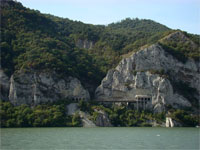
On the Serb bank a Roman memorial plaque ("Tabula Traiana"), 4 metres wide and 1.75 metres high, commemorating the completion of Trajan's military road is located on the Serbian side facing Romania near Ogradina. In 1972, when the Iron Gate I Hydroelectric Power Station was built, the plaque was moved from its original location, and lifted to the present place. It reads:
Emperor Caesar son of the divine Nerva, Nerva Trajan, the Augustus, Germanicus, Pontifex Maximus, invested for the fourth time as Tribune, Father of the Fatherland, Consul for the third time, excavating mountain rocks and using wood beams has made this road.
Click on any thumbnail photo to get a larger version
 |
 |
 |
 |
 |
 |
 |
 |
 |
 |
 |
 |
 |
 |
 |
 |
 |
 |
 |
 |
 |
 |
 |
 |
 |
 |
 |
 |
 |
 |