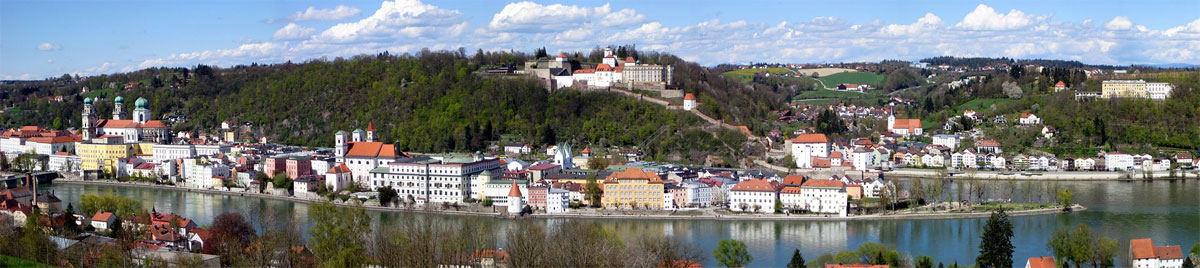
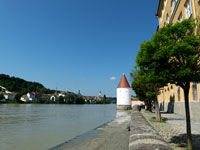
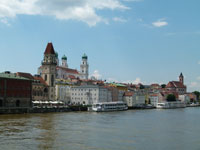
Passau is a pretty town in Lower Bavaria. It is also known as the Dreiflüssestadt or "City of Three Rivers," because the Danube is joined at Passau by the Inn from the south and the Ilz from the north.
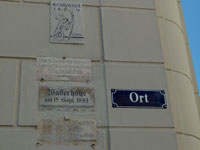
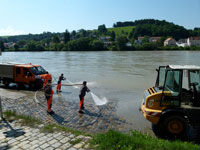
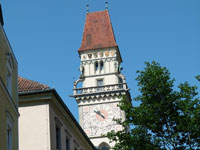
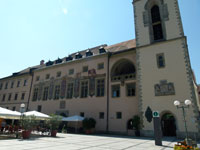
Floods are a recurrent problem, and many of the ground floors of houses are no linger used for this reason. On June 2, 2013 the old town suffered from severe flooding as a result of several days of rain and its location at the confluence of three rivers . Peak elevations of floods as early as 1501 are displayed on a wall at the Old City Hall. Flood water reaches the base of that wall on average once every 5 years. We were there three years later and they were clearing up yet again the debris from this year's flood.
We noticed that our local guide was very anti-imigrant. Due to its location on the German-Austrian border, and in the south-east of the country, Passau has become a major migrant entry point into Germany. Refugees and economic migrants who have reached Europe, often entering either overland via Greece or across the sea via the Mediterranean, then head north and sometimes enter Germany. In 2015 the BBC reported that traffickers drive migrants and refugees through Austria and leave them on the side of the autobahn. The migrants and refugees then often walk unaccompanied into Passau, the first German town northwards. This situation has caused the government of Passau to divert funds from flood prevention to housing and feeding the refugees and migrants, around 10% of whom are unaccompanied children.
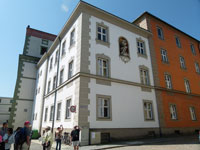
Whether it is true or not, but we were told that the colour of the houses reflected the trade being plied therein - for example you could rely on finding the chemist in the house painted green
Click on any thumbnail photo to get a larger version
 |
 |
 |
 |
 |
 |
 |
 |
 |
 |
 |
 |
 |
 |
 |
 |
 |
 |
 |
 |
 |
 |
 |
 |
 |
St. Stephen's Cathedral Organ Recital.
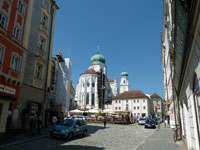
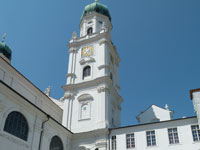
The Cathedral is a baroque church dating from 1688 in Passau and dedicated to Saint Stephen. It is the seat of the Catholic Bishop of Passau and the main church of his diocese. Since 730, there have been many churches built on the site of the current cathedral. The current church, a baroque building around 100 metres long, was built from 1668 to 1693 after a fire in 1662 destroyed its predecessor, of which only the late gothic eastern side remains.
Over time, the Passau Cathedral has acquired the largest cathedral organ in the world. The organ currently has 17,774 pipes and 233 registers, all of which can be played with the five-manual general console in the gallery. Portions of the organ have their own mechanical-action or electric-action consoles, for a total of six consoles. The cathedral has eight large bells in the bell rooms in the north and south towers. The heaviest, "Pummerin" at 7550 kg cast in 1952 and "Sturmerin" weighing 5300 kg cast in 1733 hang in the south tower. The other six bells hang in the north tower.
The organ consists of five separate parts – the great organ above the main entrance, the epistle and the gospel organ on the western gallery of the aisle, the choir organ at the altar and the echo organ in the attic behind the „Holy Spirit Hole“ in the ceiling in the middle of the nave. The organ‘s muted tones reach the interior through that hole in the ceiling. The largest pipe is more than 11 meters long and weighs 306 kilos. Its deepest tone is almost inaudible with a frequency of 16 Hz. The smallest pipes are 6 mm and their tones are almost too piercingly high for our hearing with a frequency of 16 000 Hz. More than 120 km cable had to be laid in the attic to connect the five organ parts.
They do a number of recitals a day - quite big business with the number of river cruise boats in town every day. We had quite an impressive, but un-commentated, recital for about 30 minutes. I have no idea what they were playing, or even who was playing or where they were playing from. But it was an interesting experience
Click on any thumbnail photo to get a larger version
 |
 |
 |
 |
 |
 |
Passau Castle
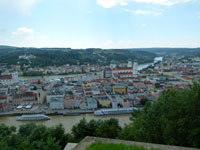
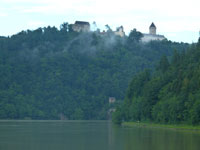
Veste Oberhaus is a fortress that was founded in 1219 and, for most of its time, served as the stronghold of the Bishop of Passau, Germany. It is currently the site of a museum, a youth hostel, and a restaurant, as well as an open-air theatre dating to 1934. The fortress is located on the mountain crest (St. Georgsberg) on the left side of the Danube between it and the Ilz, and dominates the old city of Passau, which it faces across the Danube.
The medieval Bishops maintained their hold over the town by dominating the town from the commanding heights of this fortress
We reached the castle on foot via the 200 steps of the Oberhausleiten-Stiege stairway from the Schanzlbrücke Danube bridge. We tarried long enough to enjoy the view over Passau, then with rain starting to fall, took the shuttle bus back down to the town
Click on any thumbnail photo to get a larger version
 |
 |
 |
 |
 |
 |
MS Treasures
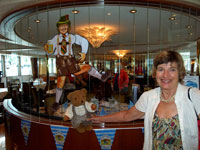
Lunch was a themed German Sausage and Beer affair which was very enjoyable, and as we headed south along the Danube that evening there was another classical concert.
Click on any thumbnail photo to get a larger version
 |
 |
 |
 |
 |
 |
 |
 |
 |
 |
 |
 |
 |