
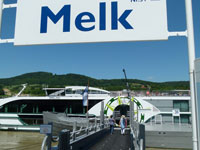
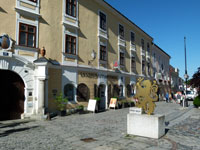
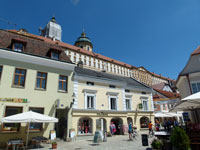
Melk is a city in the federal state of Lower Austria, next to the Wachau valley along the Danube. Melk has a population of 5,257. It is best known as the site of a massive baroque Benedictine monastery named Melk Abbey.
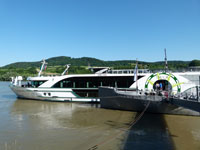
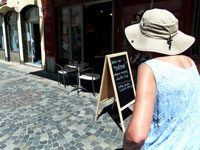
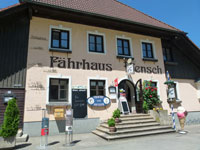
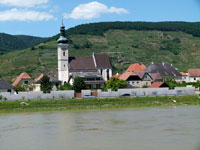
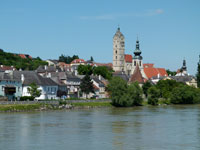
We did not dally in the town, walking through it en-route from the boat to the abbey
Click on any thumbnail photo to get a larger version
 |
 |
 |
 |
 |
 |
 |
 |
 |
 |
Melk Abbey
Melk Abbey is a Benedictine abbey above the town, on a rocky outcrop overlooking the Danube river. The abbey contains the tomb of Saint Coloman of Stockerau and the remains of several members of the House of Babenberg, Austria's first ruling dynasty.
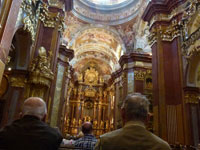
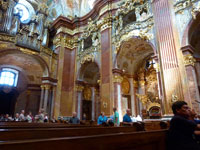
Today's Baroque abbey was built between 1702 and 1736. Particularly noteworthy are the abbey church with frescos by Johann Michael Rottmayr and the library with many medieval manuscripts. Due to its fame and academic stature, Melk managed to escape dissolution under Emperor Joseph II when many other Austrian abbeys were seized and dissolved between 1780 and 1790. The abbey managed to survive other threats to its existence during the Napoleonic Wars, and also in the period following the Anschluss in 1938, when the school and a large part of the abbey were confiscated by the state. The school was returned to the abbey after the Second World War and now caters for nearly 900 pupils of both sexes.
The grand restoration project was financed in part by the sale of the abbey's Gutenberg Bible to Harvard (which was later donated to Yale University). And was completed by 1996 to celebrate the 1,000th anniversary of the first reference to a country named Österreich (Austria).
Apart from the abbey itself, there are extensive gardens complete with tea room, presided over by a fearsome Austrian lady
Click on any thumbnail photo to get a larger version
 |
 |
 |
 |
 |
 |
 |
 |
 |
 |
 |
 |
 |
 |
 |
 |
 |
 |
 |
 |
 |
 |
 |
 |
MS Treasures
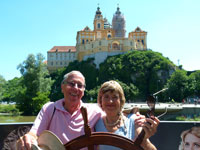
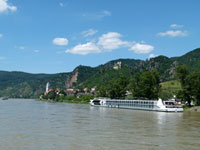
We are on our way to Vienna in time for dinner
Click on any thumbnail photo to get a larger version
 |
 |
 |
 |
 |
 |
 |
 |
 |
 |
 |
 |
 |
 |
 |
 |
 |
 |
 |
 |
 |
 |
 |