
Cologne was one of the most heavily-bombed cities in Germany during World War II, the RAF dropping 35,000 tons of bombs on the city. Cologne suffered 262 air raids by the Western Allies, which resulted in 20,000 civilian casualties and almost completely wiped out the central part of the city. The heaviest attack was during the night of 31 May 1942, when Cologne was the target of "Operation Millennium", the first 1,000 bomber raid by the Royal Air Force in World War II. 1,046 heavy bombers attacked the city with mixed high explosive and incendiary bombs. This raid lasted about 75 minutes, destroyed 600 acres of built-up area, killed 486 civilians and made 59,000 people homeless.
In 1945 urban planner Rudolf Schwarz called Cologne the "world's greatest heap of rubble". Schwarz designed the master plan for reconstruction in 1947, which included the construction of several new thoroughfares through the city centre, especially the Nord-Süd-Fahrt ("North-South-Drive"). The master plan took into consideration the fact that even shortly after the war a large increase in automobile traffic could be anticipated.
The destruction of 95% of the city centre, including the famous twelve Romanesque churches such as St. Gereon, Great St. Martin, St. Mariaim Kapitol and several other monuments in World War II, meant a tremendous loss of cultural treasures.The reconstruction lasted until the 1990s, when the Romanesque church of St. Kunibert was finished.
In 1959, the city's population reached pre-war numbers again. It then grew steadily, exceeding 1 million for about one year from 1975. It remains about 1 million today.
Click on any thumbnail photo to get a larger version
 |
 |
 |
Today you visit Koln for the Cathedral. We also saw the Roman Museum, which was impressive. But a wander round the city centre was under-inspiring with 1960s concrete developments which were aging badly. Little else caught the eye.
Click on any thumbnail photo to get a larger version
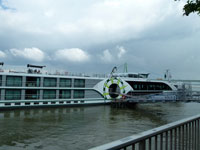 |
 |
 |
Cologne Cathedral
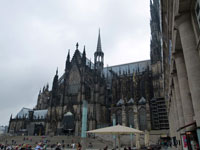
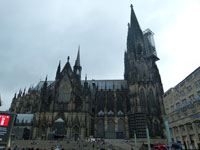
Cologne Cathedral (German: Kölner Dom) is a Roman Catholic cathedral. It is the seat of the Archbishop of Cologne and of the administration of the Archdiocese of Cologne. It was declared a World Heritage Site in 1996. It is Germany's most visited landmark, attracting an average of 20,000 people a day.
Construction of Cologne Cathedral commenced in 1248 and was halted in 1473, leaving it unfinished. Work restarted in the 19th century and was completed, to the original plan, in 1880. The cathedral is the largest Gothic church in Northern Europe and has the second-tallest spires (after Ulm Minster). Its two huge spires give it the largest façade of any church in the world. Cologne's medieval builders had planned a grand structure to house the reliquary of the Three Kings and fit its role as a place of worship for the Holy Roman Emperor.
The cathedral suffered fourteen hits by aerial bombs during World War II. Badly damaged, it nevertheless remained standing in an otherwise completely flattened city. The twin spires were an easily recognizable by Allied aircraft bombing - they say locally that the reason the cathedral ruins were left standing was that the towers were needed as a navigation mark.. Repairs were completed in 1956. An emergency repair on the northwest tower's base carried out in 1944 using poor-quality brick taken from a nearby ruined building remained visible until 2005 as a reminder of the war, when it was decided to restore the section to its original appearance.
Repair and maintenance work is constantly being carried out in one or another section of the building, which is rarely completely free of scaffolding, as wind, rain, and pollution slowly eat away at the stones. The Dombauhütte, established to build the cathedral and keep it in repair, is said to employ the best stonemasons of the Rhineland. There is a common joke in Cologne that the leader of the Dombauhütte, the Dombaumeister (master builder of the cathedral), has to be Roman Catholic and free from giddiness.
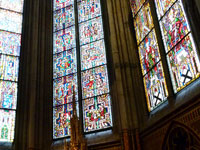
In 2007, the cathedral received a new stained glass in the south transept window. With 113 square metres of glass, the window was created by the German artist Gerhard Richter. It is composed of 11,500 identically sized pieces of coloured glass resembling pixels, randomly arranged by computer, which create a colourful "carpet". Since the loss of the original window in World War II, the space had been temporarily filled with plain glass. Then archbishop of the cathedral, Joachim Cardinal Meisner, who had preferred a figurative depiction of 20th-century Catholic martyrs for the window, did not attend the unveiling.
Click on any thumbnail photo to get a larger version
 |
 |
 |
 |
 |
 |
 |
 |
 |
 |
 |
 |
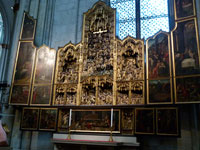
One of the treasures of the cathedral is the High Altar, which was installed in 1322. It is constructed of black marble, with a solid slab 15 feet long forming the top. The front and sides are overlaid with white marble niches into which are set figures, with the Coronation of the Virgin at the centre.
The most celebrated work of art in the cathedral is the Shrine of the Three Kings, commissioned by Philip von Heinsberg, archbishop of Cologne from 1167 to 1191 and created by Nicholas of Verdun. It is traditionally believed to hold the remains of the Three Wise Men, whose relics were acquired by Frederick Barbarossa at the conquest of Milan in 1164. The shrine takes the form a large reliquary in the shape of a basilica church, made of bronze and silver, gilded and ornamented with architectonic details, figurative sculpture, enamels and gemstones. The shrine was opened in 1864 and was found to contain bones and garments. (see photo above)
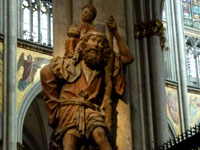
The Cathedral contains a medieval statue of St Christopher, the patron saint of travellers (above)
The "swallows' nest" organ was built into the gallery in 1998, to celebrate the cathedral's 750 years.(above)
Roman Cologne
The first settlement on the grounds of modern-day Cologne was Oppidum Ubiorum, founded in 38 BC by the Ubii, a Cisrhenian Germanic tribe. In 50 AD, the Romans founded Colonia on the Rhine and the city became the provincial capital of Germania Inferior in 85 AD. The city was named "Colonia Claudia Ara Agrippinensium" in 50 AD. From 260 to 271 Cologne was the capital of the Gallic Empire under Postumus, Marius, and Victorinus. In 310 under Constantine a bridge was built over the Rhine at Cologne. Roman imperial governors resided in the city and it became one of the most important trade and production centres in the Roman Empire north of the Alps.The city was the capital of a Roman province until occupied by the Ripuarian Franks in 462.
Considerable Roman remains can be found in present-day Cologne, especially near the wharf area, where a notable discovery of a 1900-year-old Roman boat was made in 2007
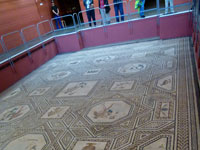
The Roman-Germanic Museum is the city's archaeological museum. It has a large collection of Roman artifacts from the Roman settlement on which modern Cologne is built. The museum protects the original site of a Roman town villa, from which a large Dionysus mosaic remains in its original place in the basement, and the related Roman Road just outside. In this respect the museum is an archaeological site. The museum also has the task of preserving the Roman cultural heritage of Cologne, and therefore houses an extensive collection of Roman glass from funerals and burials and also exercises archaeological supervision over the construction of the Cologne underground.
The Museum is near the Cologne Cathedral on the site of a 3rd-century villa. The villa was discovered in 1941 during the construction of an air-raid shelter. On the floor of the main room of the villa is the Dionysus mosaic. Since the mosaic could not be moved easily, the architects Klaus Renner and Heinz Röcke designed the museum around the mosaic. The inner courtyards of the museum mimic the layout of the ancient villa.
Sepulcher of Poblicius, 40 AD. In addition to the Dionysus mosaic, which dates from around A.D. 220/230, there is the reconstructed sepulcher of legionary Poblicius (about A.D. 40). There is also an extensive collection of Roman glassware as well as an array of Roman and medieval jewellery. Many artifacts of everyday life in Roman Cologne — including portraits (e.g., of Roman emperor Augustus and his wife Livia Drusilla), inscriptions, pottery, and architectural fragments — round out the displays.
Click on any thumbnail photo to get a larger version
 |
 |
 |
 |
 |
MS Treasures
And on board that night, classical entertainment.
Click on any thumbnail photo to get a larger version
 |
 |