
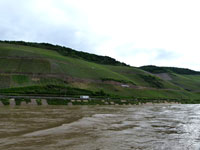
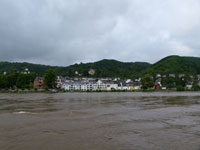
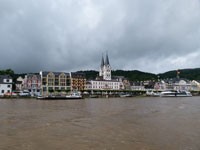
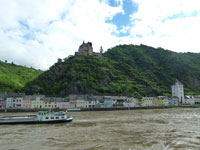
We woke up as the Treasures entered the Rhine valley. Schloss began to appear, the result of medieval warlords desire to enforce tolls on river traffic. The day was cold, and there was little sunshine, but the scenery was breath-taking. Castles came thick and fast, and eventually we docked at Rudesheim in time for lunch, a visit to a mechanical musical instrument museum and a cable car ride up to the top of the vineyards
The Lorelei (German: Loreley) is a 132 m high, steep slate rock on the right bank of the River Rhine in the Rhine Gorge at Sankt Goarshausen in Germany. There are a number of Lorelei legends, but in essence it has to do with the dangers of the river in this location, and the murmur made by the river as it sweeps around the Lorelei rock formation. This is one of the narrowest parts of the Rhine river, and the very strong currents and underground rocks in this section of the river have caused many maritime accidents. The name Lorelei comes from Old German and Celtic, and means ‘murmuring rock’.
In German literature this gave rise to stories of Lore Lay, a beautiful maiden betrayed by her sweetheart. Lore Lay falls – or jumps – off the Lorelei Rock. It is said her voice can still be heard in the murmurs of the river and the rock, and that Lore Lay at times distracts sailors with her voice and her beauty, causing them to have accidents. The basic story is extremely well known in Germany, and has inspired and become part of ballads, poems, music and songs, as well as operas.
Rüdesheim lies at the foot of the Niederwald on the Rhine's right (east) bank on the southern approach to the Lorelei. It is a famous wine making town, and a destination in is own right.
Click on any thumbnail photo to get a larger version
 |
 |
 |
 |
 |
 |
 |
 |
 |
 |
 |
 |
 |
 |
 |
 |
 |
 |
 |
 |
 |
 |
 |
 |
Rudesheimer Schloss
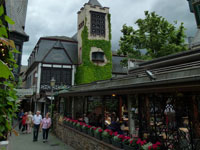
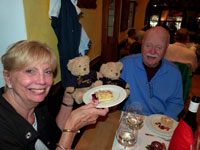
Lunch at the Rudesheimer Schloss, which offers the bierstube type of atmosphere inside. We came with a cruise group, and enjoyed the lunch enormously. When you consider that I do not enjoy travelling in a group, and the Rudesheimer Schloss put on hundreds of such events every year, that is a remarkable valediction.
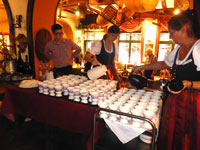
We were treated to the full "package" of a good meal, a live band playing, serving girls in full costume, schnapps drinking, and rounded off with Rudesheimer Coffee (Irish Coffee, but using the local brandy as the base)
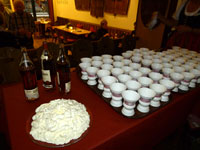
The schnapps is drunk from a board with 5 schnapps cups on it. Participants line up holding the board and after each cup is filled with schnapps, there was a countdown and everyone drinks at once! If you don't drink your schnapps, then it gets poured over you by the board!
It was interesting to watch the Rudesheimer coffees being prepared, as they manage to produce something like 100 all at the same time, and very good they were too. Asbach Uralt brandy and sugar cubes are added to a cup. In Rüdesheim, a cup that is specially designed for this beverage is used. The brandy is flambéed and stirred for a minute until the sugar dissolves. Strong coffee is added, followed by a topping of thickly whipped cream sweetened with vanilla sugar. Chocolate flakes are scattered onto the cream as a garnish. Not a calorie in sight!
Should you have an opportunity to visit them, the gentlemen's loos were decorated with interesting wine themed cartoons
Click on any thumbnail photo to get a larger version
 |
 |
 |
 |
 |
 |
 |
 |
 |
 |
 |
 |
 |
 |
 |
Siegfried’s Mechanical Music Museum
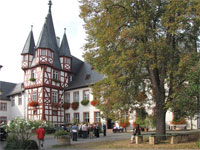
The museum is housed in Brömserhof which was a noble court built in 1542. Our guide took us around the museum which covers a very large area and has one of the largest collections of mechanical music boxes. The exhibits of mechanical instruments date from the 18th to the 20th century – from delicate musical boxes to a gigantic piano-orchestrion. The museum also includes tools and machines for manufacturing barrel organs, cardboard music, piano rolls and musical box plates.
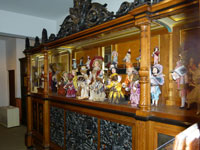
This is the brainchild of eccentric Siegfried Wendel, whose hobby in the 1960s was to rescue and repair 19th-century “automatic musical instruments” that were being discarded as scrap metal. Today, Herr Wendel is still at work in his 70s, and his Musik-Kabinett displays 350 or so automatic musical instruments—prototype jukeboxes, hand-cranked carnival machines and monstrous pianolas—all still in working order. Several gramophones still transmit voices directly from the 19th century, as they turn wax barrels that recorded the voices of opera legends such as Enrico Caruso. The most elaborate devices are the century-old orchestrions– huge wooden artworks as large as minibuses that play all the instruments of an orchestra, including trombones and cymbals. The sound can be deafening, and the first audiences in the early 1900s apparently regarded them as either unholy creations of the devil or the Eighth Wonder of the World. But everyone marvels at the device that plays six violins in perfect harmony like an invisible chamber group.
Click on any thumbnail photo to get a larger version
 |
 |
 |
 |
 |
 |
 |
 |
Cable Car
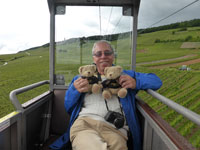
We took the cable car (2 people per bucket) up to the Niederwald Monument. The view up the hill from the cable car is amazing with the vineyards, towns & Rhine River.
Then we walked the short distance to the impressive Niederwald Monument. The 38 metres tall monument represents the union of all Germans and was constructed to commemorate the foundation of the German Empire after the end of the Franco-Prussian War. The first stone was laid in 1871, by Kaiser Wilhelm I. The sculptor was Johannes Schilling, and the architect was Karl Weisbach. The total cost of the work is estimated at one million gold marks. The monument was inaugurated in 1883.
Click on any thumbnail photo to get a larger version
 |
 |
 |
 |
 |
 |
 |
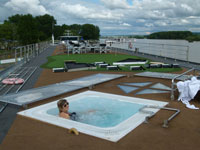
And back to the ship - where we found that they were dismantling the sun deck in preparation for low bridges on the Main-Danube Canal. No more hot tubs for a week!
Click on any thumbnail photo to get a larger version
 |
 |
 |