
The touristic synthesis of Amsterdam - the Amsterdam sign with the Rijksmuseum behind
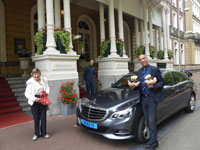
First impressions of Tauck were very favourable. We were met at Amsterdam Airport by a very smart Mercedes and driver. First stop, our accommodation for the night was in the Intercontinental Hotel.
Click on any thumbnail photo to get a larger version
 |
 |
 |
 |
 |
 |
 |
 |
Set in a monumental building on the banks of the Amstel River, Intercontinental Amstel is impressive. Less impressive however was our welcome. We arrived at 14.30 (check in time is 14.00) and were brusquely informed, without any apology, that our room was not ready . Reception was not prepared to guarantee that it would be ready by 16.00 when I voiced that hour as a possibility. They scuffed us away and told us to wait somewhere in the hotel.. We transferred to the terrace, an agreeable enough location, if you were not needing your hotel room after hours of travel from home. Half an hour later Chris went to the reception desk, and found that the room had been ready for an unknown length of time, but reception inferred that it was not their responsibility to let us know that
We were then shown into a pleasant, but not outstanding room, with views over a city street - half the hotel rooms have no views of the canal which features in all their publicity. Reception had also neglected to tell us about the swimming pool, which Chris eventually found. We were told nothing about the hotel nor its services, so we did not use any of them.
Service was particularly bad at breakfast, with none of the inordinately large number of staff bothering to serve us - eventually I had to high jack one, against their better judgment, to take our coffee order.
Not surprisingly, we did not partake of dinner here - I have no idea what they offer, but would not have taken the chance on their restaurant service anyway. I saw the duty manager in the morning to give her my views, and although she obviously found it difficult dealing with me, as I was right and there was no defence, she did probably make the best of a difficult situation.
It never fails to astound me that this type of hotel can rely on its brand name and position to "wow" the client. For me this was a nice hotel with badly trained staff.
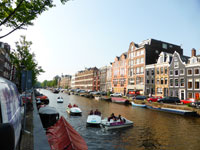
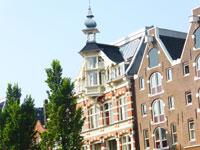
Once we finally got our room, we went for a walk to see the sights and sounds of Amsterdam. We walked past the Bols Museum (see further below) and the Rijksmuseum (see also below) , wended our way along a myriad of canals and eventually reached the Anne Frank House - here the queue to get in was of the order of 2 hours, so we eschewed the opportunity so see Anne Frank's hiding place and went for an early dinner in a nearby restaurant (see also below). The next morning we had a further walk, Chris queuing for the Rembrandt, and I, who has less patience, wandered off to look at more of Amsterdam for a few hours
We met up again at the hotel, for the transfer to MS Treasures, to settle in and eat dinner on board. We tried the Bistro as it is small and you have to book. A very humourless Serbian waiter was not very pleased to see us . We gave the Bistro a second chance for lunch a few days later, but that was the end of our experience of the bistro. We got a table for two in the main restaurant, and settled for that.
Click on any thumbnail photo to get a larger version
 |
 |
 |
 |
 |
 |
 |
 |
 |
 |
 |
 |
 |
 |
 |
 |
 |
 |
 |
 |
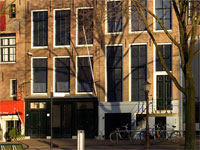
The Anne Frank House
The queues of around two hours made a visit untenable for us, but the essence of it is thus:-
Click on any thumbnail photo to get a larger version
 |
 |
 |
 |
 |
It is a museum dedicated to Jewish wartime diarist Anne Frank. The building is on a canal , close to the Westerkerk, in central Amsterdam. During World War II, Anne Frank hid from Nazi persecution with her family and four other people in concealed rooms at the rear of the 17th-century canal house. Anne Frank did not survive the war, but in 1947 her wartime diary was published. In 1957, the Anne Frank Foundation was established to protect the property from developers who wanted to demolish the block. The museum opened on 3 May 1960. It preserves the hiding place, has a permanent exhibition on the life and times of Anne Frank, and has an exhibition space about all forms of persecution and discrimination. In 2014, the museum had 1.2 million visitors and was the 3rd most visited museum in the Netherlands, after the Rijksmuseum and Van Gogh Museum.
The Secret Annex is the rear extension of the building. It was concealed from view by houses on all four sides of a quadrangle. Its secluded position made it an ideal hiding place for Otto Frank, his wife Edith, two daughters (of whom Anne was the younger), and four other Jews seeking refuge from Nazi persecution. Though the total amount of floor space in the inhabited rooms came to only about 46 m2, Anne Frank wrote in her diary that it was relatively luxurious compared to other hiding places they had heard about. They remained hidden here for two years and one month until they were anonymously betrayed to the Nazi authorities, arrested, and deported to their deaths in concentration camps. Of the hidden group, only Otto Frank survived the concentration death camps. After those in hiding were arrested, the hiding place was cleared and all the remaining contents (clothes, furniture, and personal belongings) of the Frank family and their friends were seized and distributed to bombed-out families in Germany. Before the building was cleared, Miep Gies and Bep Voskuijl, who had helped hide the families, returned to the hiding place against the orders of the Dutch police and rescued some personal effects. Amongst the items they retrieved was The Diary of Anne Frank.
The "Secret Annexe" was a three-story space entered from a landing above the Opekta offices. Two small rooms, with an adjoining bathroom and toilet, were on the first level, and above that a larger open room, with a small room beside it. From this smaller room, a ladder led to the attic. The door to the Achterhuis was later covered by a bookcase to ensure it remained undiscovered. The main building, situated a block from the Westerkerk, was nondescript, old, and typical of buildings in the western quarters of Amsterdam. The only connection between the outside world and the occupants of the house was the very small number of people who knew they were there. These people catered to all of their needs, ensured their safety, and supplied them with food, a task that grew more difficult with the passage of time. Frank wrote of their dedication and of their efforts to boost morale within the household during the most dangerous of times. All were aware that, if caught, they could face the death penalty for sheltering Jews
Amsterdam Coffee Houses
Amsterdam is renowned for its “coffee shops”. In the Netherlands the term coffee shop has come to mean alcohol-free establishments where cannabis (weed, hash, marijuana) are sold and consumed. Amsterdam has around 250 of these coffee shops. According to the Dutch Drug and Coffee Shop Law the coffee shops are licensed to sell small quantities of cannabis to adults over 18. Tourists can buy and enjoy weed, hash and marijuana in a pleasant and safe environment. Plans to introduce a so called “Weed-Pass”, intended to register Dutch smokers and exclude tourists, were dropped in 2012.
Click on any thumbnail photo to get a larger version
 |
 |
 |
 |
 |
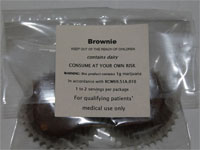
Cannabis edibles are cooked foods and drinks such as hash brownies, pot brownies, cannabutter, and bhang, a yogurt-based drink traditionally popular in India which are made with the drug cannabis, either using its herbal form or hashish. The psychoactive effects of Tetrahydrocannabinol (THC), a hydrophobic oil, soluble in lipids (oil/fat) and alcohol must initially be cooked in one of these before being mixed into edibles such as cake, cookie, brownie, drinks etc in order to experience the psychoactive, whether for recreational or medicinal purposes. During preparation the cannabis or its extract must be heated sufficiently to cause decarboxylation of its most abundant cannabinoid, tetrahydrocannabinolic acid (THCA), converting it into psychoactive THC. The oil-solubility of cannabis extracts has been known since ancient times, when Sanskrit recipes from India required that the cannabis be sautéed in ghee before mixing it with other ingredients. Making a tea by boiling cannabis in water is a highly inefficient way to extract psychoactive cannabinoids. Adding milk (which contains fat, water, proteins and electrolytes as well as certain sugars) when steeping, however, makes it much more efficient than using plain water.
The Red Light District
Something of a tourist attraction in its own right, Tauck even provided a walking tour for us, led by Dina.

The Oudekerksplein lies at the heart of the red-light district of De Wallen. Along the square are some 35 windows from behind which prostitutes offer their services. A statue titled "Belle", honouring the prostitutes of the world, was placed on the square in 2007. The plaque on this statue reads (in English): "Respect sex workers all over the world". The street also has a bronze relief of a hand caressing a female breast.
Click on any thumbnail photo to get a larger version
 |
 |
 |
 |
De Wallen is the largest and best known red-light district in Amsterdam and consists of a network of alleys containing approximately three hundred one-room cabins rented by prostitutes who offer their sexual services from behind a window or glass door, typically illuminated with red lights. These "kamers" are the most visible and typical kind of red light district sex work in Amsterdam and are a large tourist attraction.
Amsterdam Red Light District leaves nothing to the imagination. The Rossebuurt, as the locals know it, is unlike any other place. Certainly, the Red Light District in Amsterdam that everyone knows about is the one where women, of all nationalities, parade their wares in red-fringed window parlours, many ready to offer more than a school boy peep-show in a private cabin. Another familiar image of the Amsterdam Red Light District is of packs of men, young and old , couples holding hands and pointing in shock at it all, giggling groups of women celebrating a hen night , and busloads of Japanese tourists toting cameras (except not in the direction of the ladies in the windows- Strictly banned!).
House of Bols
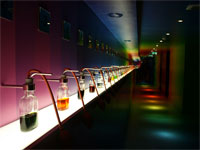
The liqueur and gin company Bols is headquartered in Amsterdam, and has a sort of hands on museum of their wares. You can sniff all their flavours, see how the Ginever is made, and at the end of the day get a liqueur of your choice and a "chance" to buy some liquor in their shop - I chose to buy a heavy (for the luggage) stone bottle of high quality ginever, which didn't go down well with the management - these acts of wanton badness just seem to come over me.

Click on any thumbnail photo to get a larger version
 |
 |
 |
 |
 |
 |
 |
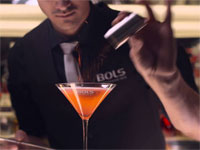 |
The House of BolsCocktail and Ginever Experience takes you on a journey through flavours, aromas, images, sound and film. The experience incorporates the Hall of Taste, where you will discover all 42 Bols liqueurs and how they are made, the Delfts blue room, the World of Cocktails ‘club’ and the mysterious Bols Ginever Room. The experience ends in the Mirror Bar, where bartenders mix your preferred Bols Ginever and liqueur cocktail for you. I don't think it was quite Chris, but I enjoyed it.
Rijksmuseum
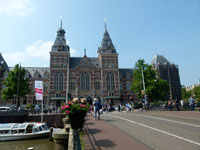
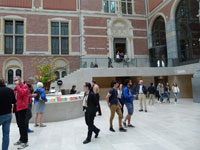
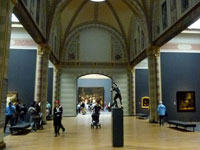
Anyone going to Amsterdam goes to the Rijksmuseum, and there looks at the Night Watch by Rembrandt. But there is much more to the Rijksmuseum than the Night Watch. We had two goes at it, once with a Tauck guide and full commentary, and after lunch by ourselves.
Like many world museums, you could spend days here and not see it all.
Click on any thumbnail photo to get a larger version
 |
 |
 |
 |
 |
 |
 |
 |
 |
 |
 |
 |
 |
 |
 |
Dwars Restaurant
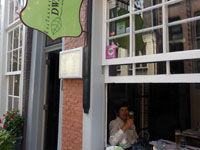
This little restaurant is tucked away in a side street near the Anne Frank House. We got there for two reasons: firstly I had worked out a walking route to take in Anne Frank's House and a dinner restaurant. Secondly it was recommended by our travel organiser. As it worked out, the Anne Frank House had queues that would have involved a two hour or more wait, so we skipped this and went to this restaurant, without a reservation, around 18.30. Which was just as well, as we got the last unbooked table, and many were turned away after us.
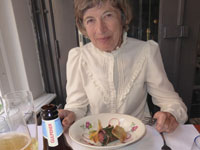
I never understand why people complain about speed of service, if you want fast food, then get a hamburger. Here they are courteous and serve at a pace that enables you to enjoy the quality of the food. We were here around 3 hours and enjoyed every minute of it, as one should with a good meal
We opted for the menu with the beer options - well I had the beer options, and Chris had a bit of them. The food was all fresh and home made. The beers were Dutch craft beers. The waiter explained the choice of beers with each course, and you opted for whichever took your fancy
The service was efficient and friendly. We opted to sit inside the restaurant, rather than on the street (though the street was a very quiet one)
Click on any thumbnail photo to get a larger version
 |
 |
 |
 |
 |
 |
A canal boat lunch
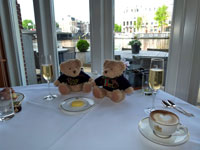
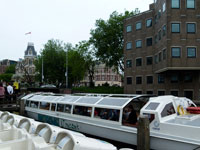
After the Rijksmuseum visit, Tauck took us on a lunch cruise round the canals of Amsterdam. A couple of pleasant hours and a decent lunch. The boys enjoyed it too
Click on any thumbnail photo to get a larger version
 |
 |
 |
 |
 |
 |
MS Treasures
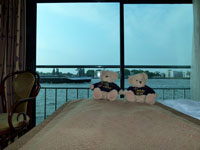
Finally aboard the MS Treasure we settled in, had the inevitable briefings, and the boys met the Hotel Director.
Click on any thumbnail photo to get a larger version
 |
 |
 |
 |
 |