Waterford
Be on the outer decks while Silver Wind heads up the river Suir. Then either visit the seventy acres of intensively planted woodland and the four acre walled garden at Mount Congreve, one of “the great gardens of the World” where 16 kilometers of walkways wait to be used at this estate overlooking the River Suir, or head out to Kilkenny Castle with its fifty acres of rolling parkland with mature trees. One can also visit the renowned House of Waterford Crystal.
Located in County Kilkenny, the port of Belview is not only Waterford’s tidal port, but also Ireland’s closest multi-modal port to mainland Europe. The port was moved from Waterford in 1992 and sits on the northern bank of the River Suir, some 4 miles downstream from Waterford’s Viking Triangle. Belview not only providers the most modern docking facilities for cargo and cruise ships, it also permits excellent access to the various attractions Waterford, Ireland’s oldest city, and Southern Ireland have to offer. See
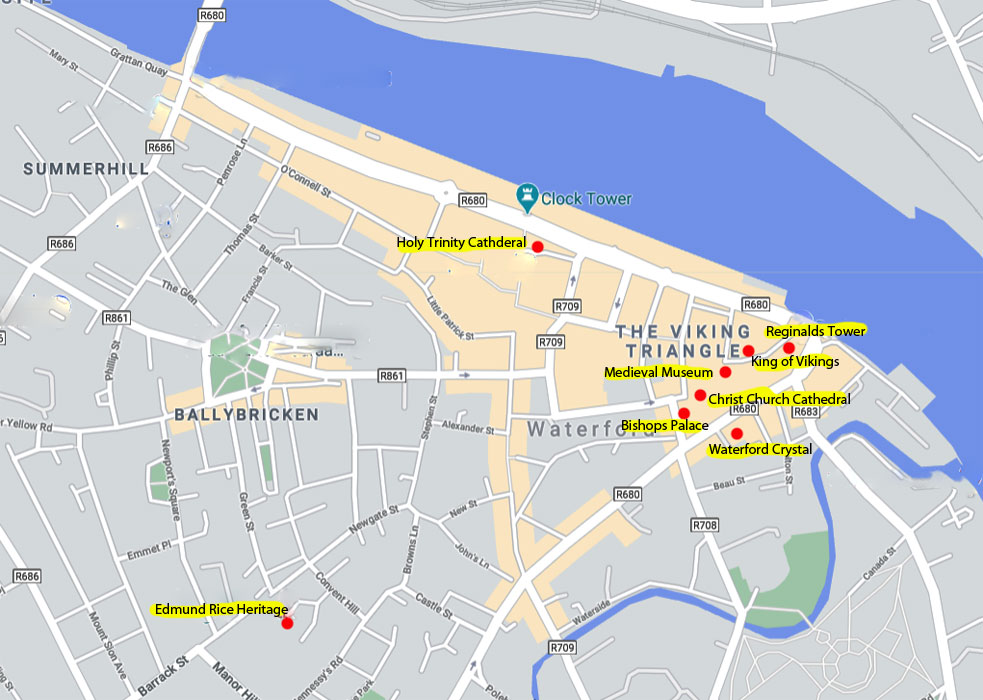
- Medieval Museum (Treasures of Medieval Waterford), The Mall,. Hours and prices as above. Descend by spiral staircase into the 1270 Choristers' Hall, which extends into the wine vaults - Waterford had extensive trade with Bordeaux, which was ruled by the English. Religious artifacts include a relic of the True Cross (it must be a true relic if Pope Paschal II deemed it so in 1110, but no wonder Europe was rapidly de-forested in that era) and a pilgrim badge (violently anti-semitic). There's a sumptuous gold brooch of 1210, a charter roll stating Waterford's precedence over a rival nearby port (which they destroyed just to be on the safe side), and a ceremonial sword presented by Edward IV. The Cloth of Gold clerical vestments were woven circa 1460 with Florence silk and embroidered in Bruges: they were hidden in the cathedral from Cromwell’s army in 1650, and only rediscovered 123 years later. They were in an ornate Spanish iron chest, also displayed. The "cap of maintenance" was presented by Henry VIII; the Great Parchment Book is the city records from 1356 to 1649. The Luker chalice is from 1595. Finally the Mayor's Treasury is a summary of civic history.
- Bishop's Palace (Treasures of Georgian Waterford), The Mall (next to Medieval Museum),. Hours and prices as above. Grand Georgian residence with decor and items mostly from that era, including a 1789 piece of Waterford Crystal and a Napoleon Mourning Cross. The Hucklebuck shoes are from 1963 (from pop group Royal Showband) yet resemble the attire of a Regency buck.
- Reginald's Tower, Parade Quay. Closed. It's named for Røgnvaldr, a common name among Viking rulers, so he may or may not be the fellow who founded Waterford in 914. The tower was probably built late 13th century - Prince (and later King) John began fortification of the city with stout walls and towers a century earlier. It's been variously a mint, a prison, a military bastion and munitions store, and the residence of the Chief Constable. It's nowadays part of the "Museum of Treasures" complex and normally displays the Viking era, but in 2020 it's closed for restoration
- Other towers: seven still stand: Semi-Lunar Tower, Beach Tower, Turgesius’s Tower, St Martin’s Gate, The Watch Tower, The Double Tower and The French Tower. Sections of the city walls remain, linking the towers, west crossing Patrick St and south in a loop across Parnell St and John's Lane.
- The French Church or Greyfriars Abbey is a ruin next to Reginald's Tower. It was built in 1241 and the bell tower added in the 15th century; the friary was dissolved in 1540.
- King of the Vikings is a virtual-reality museum next to the tower, open daily 11:00-17:00. Adult €10, child under 12 €5.
- Christ Church Cathedral is the C of I (Protestant) building in Cathedral Square next to the two museums. It was built in Georgian style 1773-79 replacing the 13th century Gothic cathedral, from which the Catholics had been ejected at the Reformation. When the old one was demolished, they found the remarkable medieval vestments now in the museum.
- Cathedral of the Most Holy Trinity is the RC building on the Quays. It was completed in 1793 on the site of a chapel when the Penal Laws against Catholic assemblies were relaxed. It's in Romanesque style resembling a particularly august bank.
- Edmund Rice Heritage Centre, Mount Sion, Barrack St, ☏ +353 51 874 390. M-F 09:00-17:00. Chapel, shrine and museum commemorating the work of the Blessed Edmund Ignatius Rice (1762-1844). Widowed young, he gave up his business and threw himself into the education of the city's impoverished youngsters. Others joined him and by 1803 Mount Sion was established as a school, monastery, and teacher-training centre, in an era when RC education was slowly recovering from the Penal days of "hedge schools". But as the initiative expanded, Rice as a layman had no authority in the RC church, and had to laboriously seek permission from the local bishop whenever one of his teacher-priest Brothers was to be relocated. In 1820 he obtained papal authority to manage these Christian Brothers, and the scheme extended geographically (eg to England) and to secondary education. A minority remained subject to the bishops under the earlier arrangements and these were called the Presentation Brothers. Both societies remain active internationally, but the Christian Brothers' regime in the 20th and 21st centuries was marked by systematic physical and sexual abuse of their pupils. Rice himself lived in retirement at Mount Sion and died there. In the 20th century a campaign began for his beautification. In 1976 a boy who seemed sure to die of a gangrenous colon had a relic of Rice placed at his bedside and recovered fully; post hoc ergo propter hoc and in 1996 Rice was declared a saint. Free.
- House of Waterford Crystal, 28 The Mall (opposite Medieval Museum). Mar-Oct daily, Nov-Feb M-F, 10:00-17:00. Waterford Crystal is the brand name of a fine flint glass, used in glass tumblers, chandeliers, decorative bowls, trophies and similar luxury wares. The brand is owned by WWRD (who also own Wedgewood and Royal Doulton), in turn owned by the Finnish company Fiskars. It's almost all manufactured abroad - the factory in Kilbarry, south edge of Waterford city, closed in 2009, in spite of a long sit-in by the workforce. Visits to the House are by guided tour, taking 50 min and demonstrating the glass-making process. Then, of course, you troop to the gift shop. Adult €13.50.
- Mount Congreve Gardens, Kilmeaden X91 PX05 (8 km west of city),. Apr-Oct Th-Su 11:00-17:30. 70 acres of woodland garden and a 4-acre walled garden, a riot of colour in summer. There's normally a combi-ticket with the city museums, but it's not available in 2020. The Georgian mansion isn't open to visit. Adult €7, conc €6, child €3.
- Kilmeadan Castle is the stump of a tower house built late 17th C, glimpsed from the Greenway between Mount Congreve and the WSVR station (see below). It's not worth thrashing through the undergrowth for a closer view.
- Fairbrook House is an old wool mill turned into an art-space and gardens. It's open May-Sept W-Su, adult €7, no dogs. It's 1 km west of Kilmeadan along Greenway, or follow N25 from Carrick Road Roundabout.
- Curraghmorehouse is a palatial grand mansion, mostly 18th / 19th century, the home of the Marquess of Waterford. It can only be visited by pre-arranged group tour; its grounds sometimes hold events
Lisbon to London to London trip