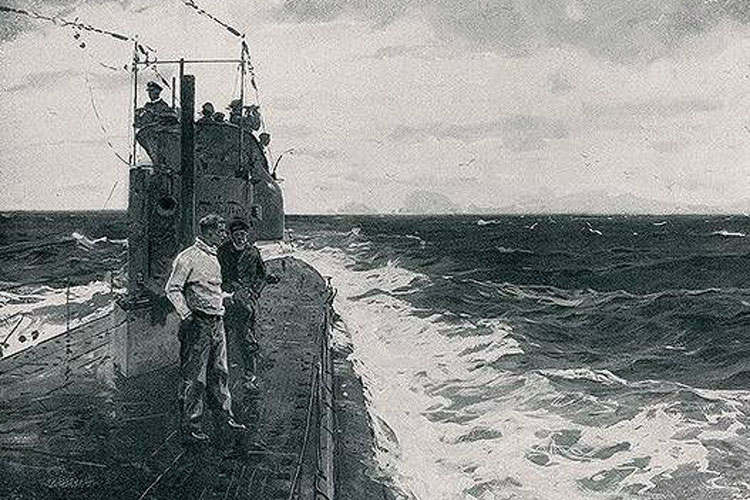
In 2008 National Trust for scotland produced a detailed report on the conservation of the Gun Site on St Kilda. The painting above is by Claus Bergen, a German artist
Various concerns repeatedly arose about servicing St Kilda through the 19th century including housing, the provision of a pier, and communications. The lack of communications eventually resulted in the construction of a wireless station with two 75’ masts and a 1.5kW Marconi wireless set in the Factor’s House, provided courtesy of the Daily Mirror in July 1913. But it did not function before the outbreak of WW1
On 23rd January 1915, the set was still in packing cases in the Factor’s House. The outbreak of war in August 1914 gave the station a reprieve as the Admiralty asked Marconi to re-open it. St Kilda was to be manned as a W/T Station (wireless telegraph) which formed part of a network of W/T stations and ships that patrolled and protected the whole west coast from the Mull of Kintyre to Cape Wrath. Area 1 was patrolled from Stornoway. There were only four W/T (wireless telegraph) stations in Area 1: St Kilda, Stornoway, Aultbea and Lochboisdale.
The St Kilda radio station was re-opened by a new naval garrison which arrived on the armed trawler Amsterdam and consisted of Captain Frank Athow (RMLI), two petty officers, twelve ratings and a batman. Temporary accommodation was provided in the Factor’s House and the street while their huts were erected. Athow had great difficult landing his team and equipment. The original and more powerful Daily Mirror wireless transmitter was retained in the Factor’s House which was also occupied by Mrs ME MacLennan, the nurse and midwife . Their orders ensured that the Daily Mirror set would be used with the original masts, powered by a petrol generator. The Navy’s weaker Marconi set was set up in two sheds as a back up, possibly sited ‘between the masts’. Captain Athow left St Kilda on the 20th May 1915 on a trawler for Oban, after he was recommended for dismissal by Wardle of HMS Calyx
By this time, the garrison consisted of a Warrant Telegraphist, a Chief Petty Officer, a Petty Officer Telegraphist, three W/T learners, four signalmen and four able seamen. The St Kilda armament was hardly an arsenal, and consisted of two Webley Revolvers with 600 rounds of ammunition and twelve Lee Enfield rifles with 800 rounds. Facilities consisted of two barrack huts, a store hut, a cook house, food store, latrine and ablutions block. These seven huts (plus two wireless huts) are difficult to pinpoint in photographic records. In late July 1915, permission was granted for telephone wires to be laid up to the hill top and the system eventually involved three look outs with cables laid down to the W/T station.
Writing on 10th August 1915, Rear Admiral Tupper described how he ‘visited both look-out places whilst at St Kilda and they are excellent both having a stone hut with telephone inside, also a telescope and they connect up with the W/T station. Climbing up to them is very hard work, the gradients being very steep. I got the natives to lay the telephone cables and entrench them as their contribution to the War and it has been very well done.’The military occupation was continuing to have a powerful effect on the islanders: during this period, St Kilda was served by a number of trawlers, requisitioned yachts and whalers. As well as regularly bringing supplies, mail and equipment, the trawlers allowed St Kildans to visit the Hebrides for short periods – something which had probably never been possible before: It was an entirely different world to them and we would listen in awe at the tales they told on their return’
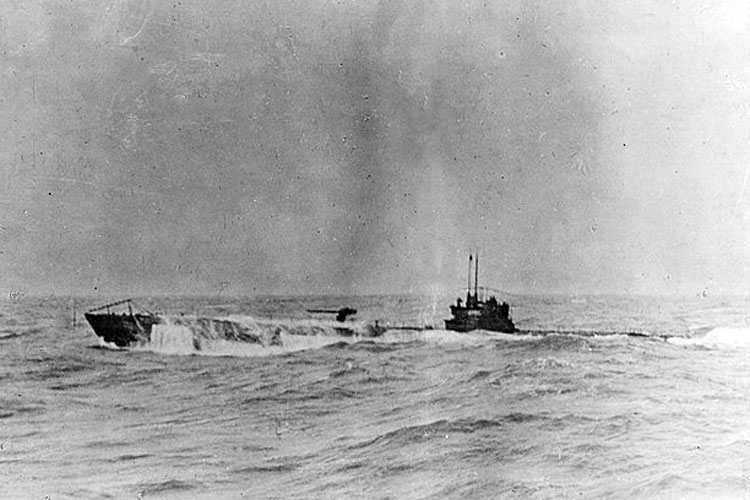
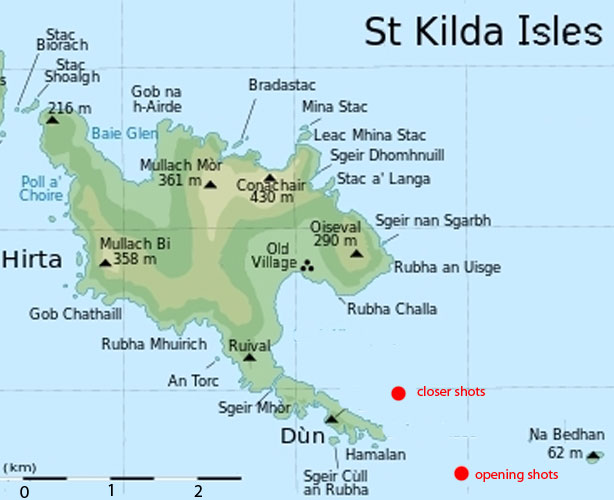
By the later part of war, the garrison may have been common knowledge, if only because the transmitted warnings to Malin Head and Lochboisdale could be easily intercepted by the Germans. At 0750 hours on 15th May, the station reported a submarine hove to by Boreray which later submerged, resurfacing at 09.58 at the entrance to Village Bay. The submarine, almost 250ft in length, nosed into the bay and, after advising the inhabitants to take shelter, commenced shelling just before 11am. The wide spread of shelling seems to reflect the fact that there were two radio masts by the Factor’s House (those erected by the Daily Mail) but also that the Germans thought that other buildings were a power house or barracks. The shelling damaged the Mackinnon’s house (No. 1), the Factor’s House, the Church, the Manse byre, the Store, two boats and some of the temporary huts .
The Kriegstagebuch (War Diary) of U-90 described firing on St Kilda on May 15th 1918 . The U-Boats log uses submarine time which was one hour ahead of local St Kilda time) and the U-boat records that at
U-90 under the command of Kapitänleutnant Walter Remy while on the way out to a patrol area was responsible for the shelling. U-90 was a Type ‘Mittel U’ U-boat of the German Imperial Navy, built by Kaiserliche Werft in Danzig and launched on 12th January 1917, undertaking 7 patrols between 10th September 1917 and 11th November 1918. It was surrendered on 20thNovember 1918 and broken up at Boness on the Firth of Forth.
On 31 May 1918, only 16 days after the attack on St Kilda, U-90 torpedoed and sank the largest ship of its career the USS President Lincoln. President Lincoln was a former Hamburg America Line steamer of the same name seized by the United States and employed as a troop transport. From the US Navy crew that abandoned the sinking President Lincoln, U-90 captured Lieutenant Edouard Izac taking him prisoner, and eventually taking him to Germany. Amazingly, on the way back from this patrol, U-90 stopped at North Rona on 5th June 1918 and took seven sheep Izac later wrote a book about his experiences while captured
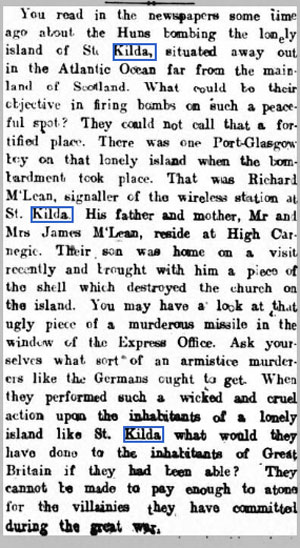
The attack on St Kilda in May 1918 was the last of fifteen attacks on the coast of Great Britain by German naval Forces during WW1. This excerpt from a communication between the Rear Admiral, Stornoway and the Secretary of the Admiralty details the damage. Damage was considerable – the islander’s storehouse, church and three of their houses, parts of one of the wireless sets, seven military huts, and the nurse’s house (used as wireless office). Of these it was the late 18th century storehouse that was put out of use permanently. Despite the efforts of the owners to recoup compensation, it remained a ruin until the late 1980s when it was restored by the National Trust for Scotland.
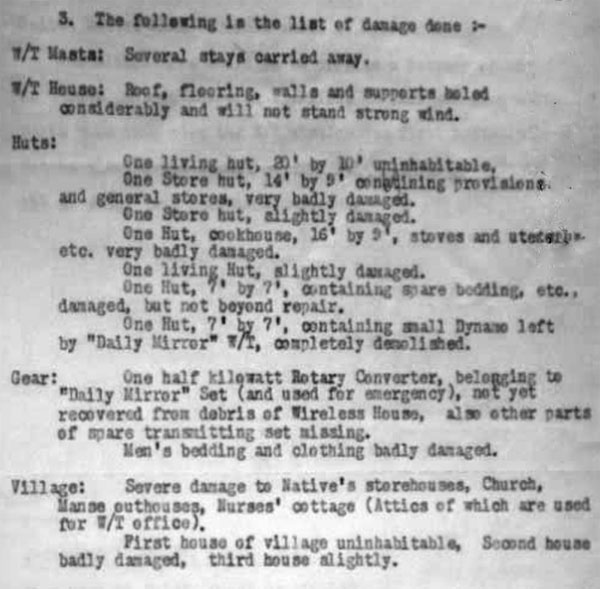
Immediately after the attack on St Kilda, two auxiliary patrol vessels were permanently stationed in the bay. On 20th June, carpenters were sent out to repair two damaged huts and erect another two. Despite lengthy correspondence on behalf of the islanders this never resulted in any compensation23. Meanwhile discussions moved ahead on how to fortify St Kilda; the armed trawlers based at Stornoway were over-stretched so a permanent defence was deemed the best option and a gunlayer and rangefinder were seconded to the garrison (though perhaps not actually sent there) as early as 28th May 1918
The commander of U19 Johannes Spiess, describes in his book "Seven Years in a Uboat"that he sent men ashore at both St Kilda and North Rona get sheep meat and eggs - but there is no record of the inhabitants seeing them.
Never having seen action, the gun seems an anachronism on St Kilda. But it is significant in some respects. Firstly, having been set up in such a remote location it remains one of only three examples of in situ World War 1 gun emplacements in Scotland, the others surviving at another remote location at Vementry, Shetland. The St Kilda inhabitants were in fact paid by the government to maintain the gun after the navy left, but of course that maintenance stopped when the island was evacuated.

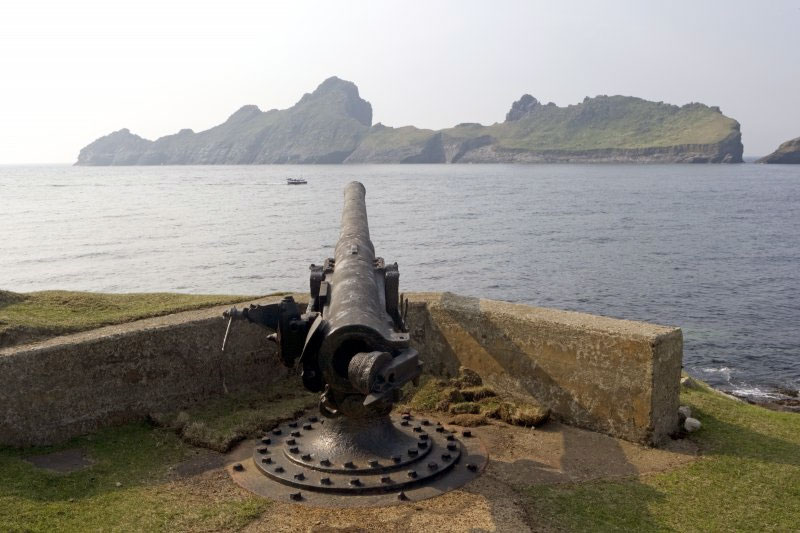
4-inch Mark III QF gun was erected on a promontory overlooking Village Bay, but it never saw action against the enemy
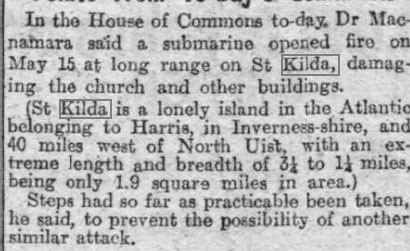
The event was not reported in the British press until Oct 1918, when a question was asked in Parliament