
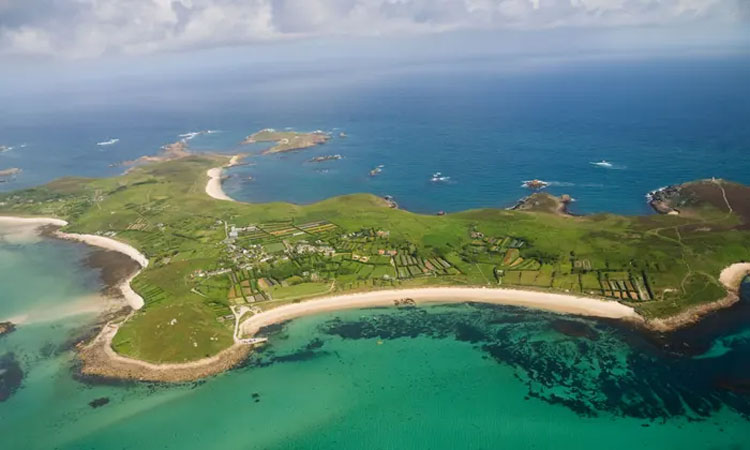
Scattered 30 miles offshore from England’s most south-westerly point – Land’s End – the Isles of Scilly are home to rich wildlife, and green land sloping to powdery white beaches. The Isles of Scilly’s biggest island harbours around 1,600 people – roughly three-quarters of the total population - and is one of five occupied islands. Isolated and serene, life here hums along at its own pace in this archipelago's bubble, which enjoys the UK’s mildest climate, and some of its most spectacular beaches.
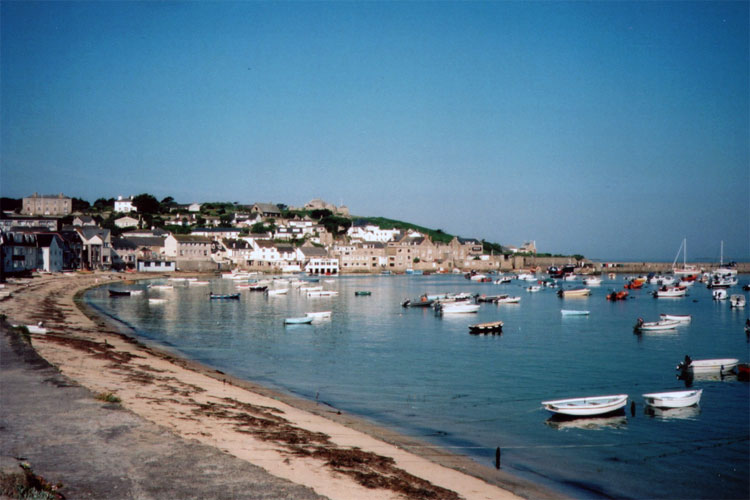
Hugh Town is the centre of St Mary’s, and you’ll be warmly welcomed by the incredibly tight-knit local community. A peaceful place, watch out when the waters are suddenly parted by the competition of gig racing – the island’s sporting pride and joy - which sees teams competing in colourful rowboats. Elsewhere, catch sight of Atlantic seals and seabirds like puffins and fulmars, along nine miles of coastline. You can also spot the ghostly shipwrecks strewn around the island’s waters, and the 140 islands and skerries that have made treacherous sailing historically.
There's a dense collection of historical sites that belies the islands’ small size – from a former prime minster’s grave to star-shaped fortresses. Tresco Abbey Garden is one of the UK’s most vibrant gardens, with diverse plants bathing in the warmer climate and over 300 species on display. Taste the rewards of the mild weather with a glass of wine from England’s most south-westerly vineyard.
St Marys, Isles of Scilly
 |
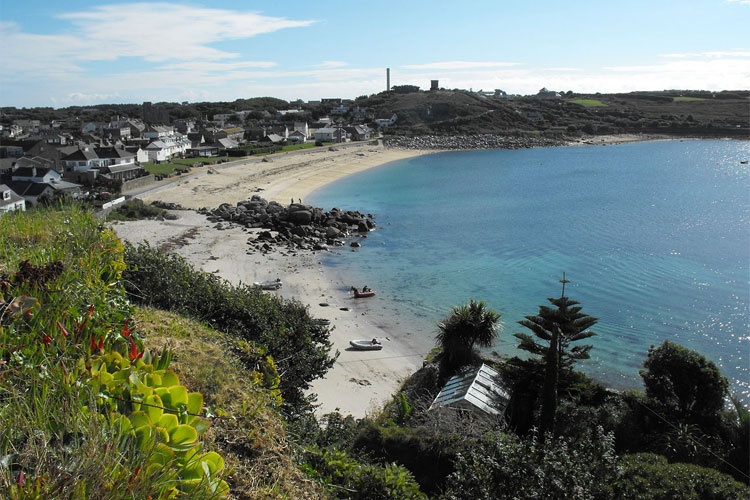 |
St Mary's has an area of 2.54 sq mi — 40 percent of the total land area of the Isles of Scilly. With a population of 1,723 (out of a total population for Scilly of 2,203) . The majority of St Mary's residents live in the western half of the island, with Hugh Town alone having a population of 1,097. The main settlement, Hugh Town, was sold to the inhabitants by the Crown in 1949 (it had belonged to the Duchy of Cornwall — which still owns much of the rest of the island). Other settlements on the island are Old Town, Porthloo, Pelistry, Trenoweth, Holy Vale, Maypole, Normandy, Longstone, Rocky Hill and Telegraph. The island became the home of British Prime Minister Harold Wilson and his final resting place after his death in 1995. His grave is at the cemetery at Old Town Church.
In 2005 there were 619 cars and vans on St Mary's; the island also has taxis and a conducted bus tour. The helicopter service from Penzance stopped in 2012. The means of connecting to mainland Britain is now only by a fixed wing aircraft from Lands End and by the Scillonian III passenger ferry, supported by the Gry Maritha cargo vessel. The other islands are linked to St. Mary's by a network of inter-island launches.
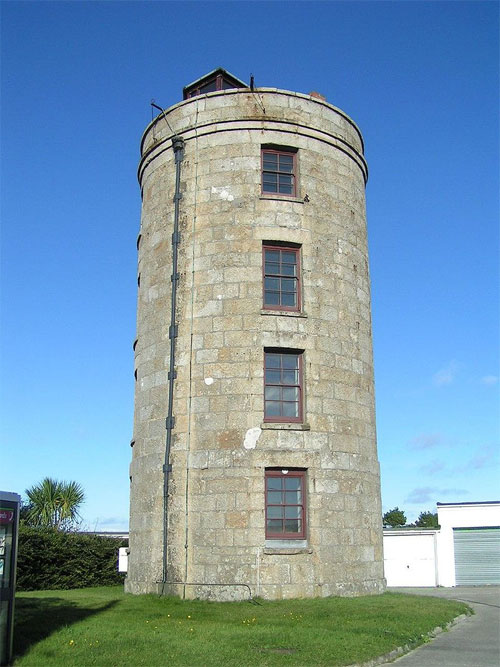
The tower on Newford Down, now known as Telegraph Tower, was built in 1814 to serve as an Admiralty Telegraph Station, but it had closed by 1816.The building then reverted to the custody of the landowner - the Duke of Leeds. In 1831 the site was taken over by the Coastguard as a subsidiary to the main station situated on the Garrison. In 1903 a wireless mast and receiving office were built nearby, and in 1908 a telegraph house was erected on the tower's roof. The wider site was developed into a modern radio transmitting and communications site by the late-C20.The tower is now a private residence.It was at this tower about 1898 that Guglielmo Marconi heard wireless signals transmitted from Porthcurno, a distance of 30 miles. It was used by Radio Scilly for broadcasting.
Note: To strengthen Scilly’s defences Major Daniel Lyman proposed the construction of three gun towers in 1803, each armed with a 32-pounder carronade on top. The presence of three towers on St Mary’s, in the heart of the Garrison, on Buzza Hill and at Newford Down, has led some writers to link them to Lyman’s proposal. However, his proposal was never enacted, and the three towers have different origins.
Harry's Walls are the remains of an unfinished artillery castle situated on a hilltop to the north-east of Hugh Town. It was begun in 1551 as part of a major phase of fortification on the Isles of Scilly, undertaken to counter threats from the French. It was left unfinished because the site was recognised to be unsuitable.

Giant's Castle is an Iron Age cliff castle on the coastal path between the airfield and Porth Hellick Bay.

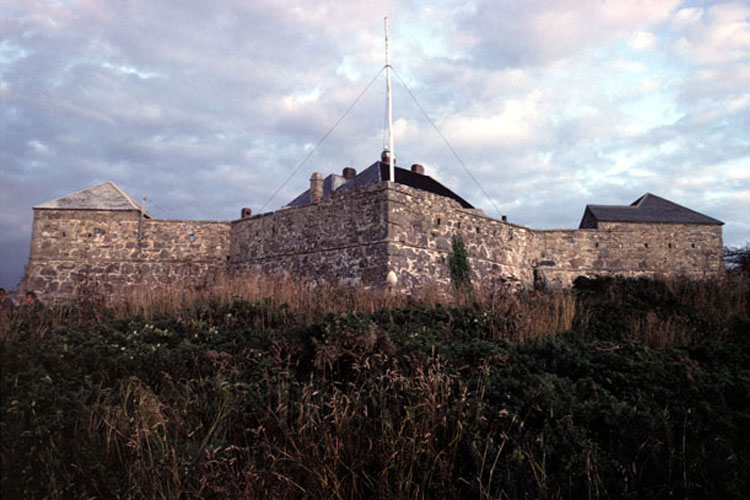
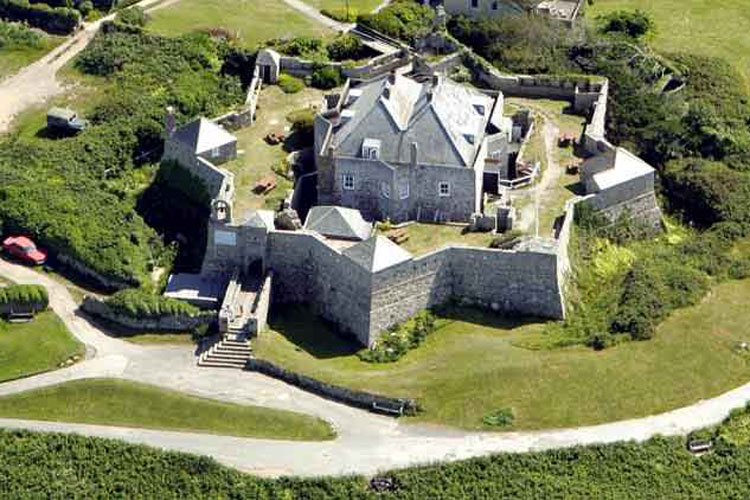
Star Castle is at the centre of a fortification system around the west side of St Mary’s known as the Garrison. The walls of the castle take the shape of an eight-pointed star. It comprises an outer wall around the outcrop of Hew Hill, protecting the town and the castle, with strategically placed gun batteries at regular intervals around the outer wall, allowing covering fire at all angles. A redundant windmill was converted after 1831 into Garrison Tower as a lookout tower for HM Coastguard.
The Star Castle was built in 1593 by the Surveyor of the Royal Works and mapmaker Robert Adams (d.1595), under the direction of Francis Godolphin, following the Spanish Armada of 1588.Fearing another Spanish invasion, in May 1593 Queen Elizabeth I ordered the construction of a fort and two sconces as a lookout for any intruder ships. In 1740 Master Gunner Abraham Tovey transformed the Garrison building walls with gun batteries, including Colonel Boscawen's Battery,in a circular shape following the coast line of The Hoe. Star Castle is now a hotel.
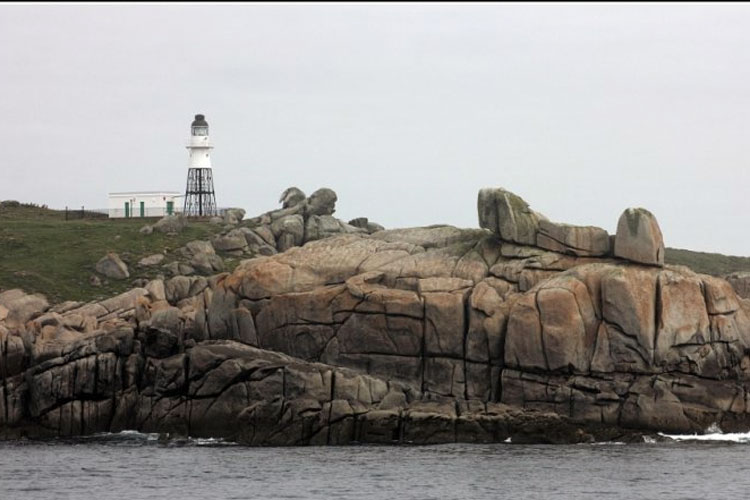
The 14 metre metal tower lighthouse on Peninnis Head was built in 1911 as a replacement for the 1680 lighthouse in the centre of St Agnes. The lighthouse was converted from acetylene gas to electricity in 1992 and the original range of 17 nautical miles was reduced to nine in 2011.The headland is within the Isles of Scilly Area of Outstanding Natural Beauty and part of the Heritage Coast. It is also a Geological Conservation Review site for its Quaternary geomorphology and was first designated a Site of Special Scientific Interest (SSSI) in 1971 for both its biological and geological interests.
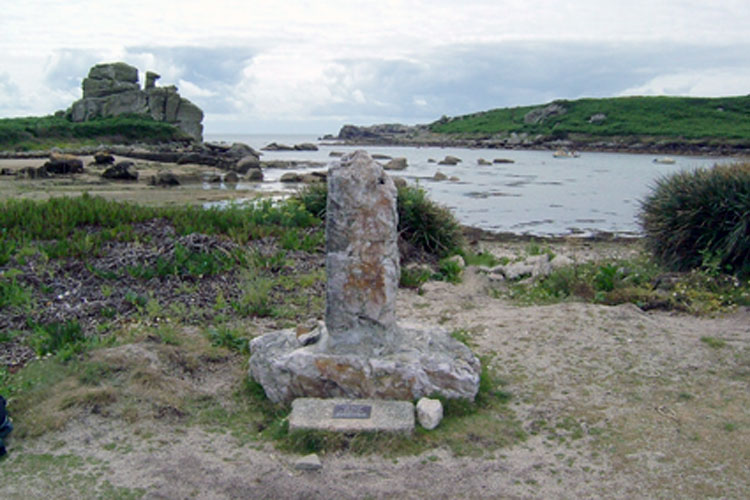
Porthellick Cove contains a memorial to mark the spot where the body of Admiral Sir Cloudesley Shovell was washed ashore after the 1707 Scilly naval disaster. This was one of the greatest maritime disasters in British history, when four ships with nearly 2,000 sailors were lost.
Tresco, Isles of Scilly

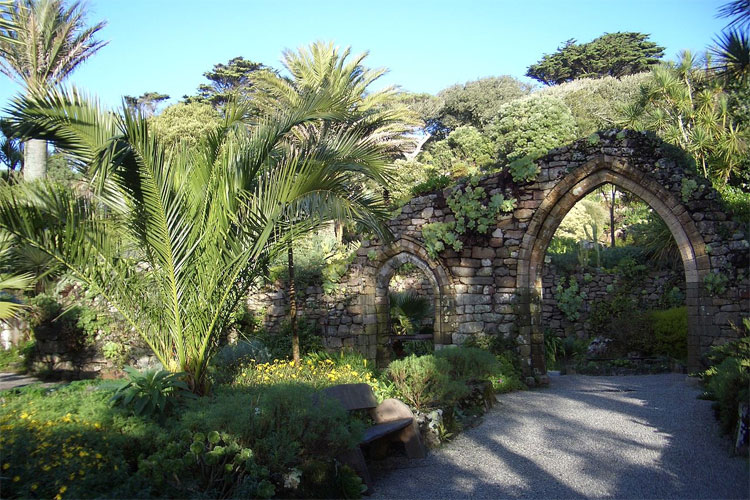
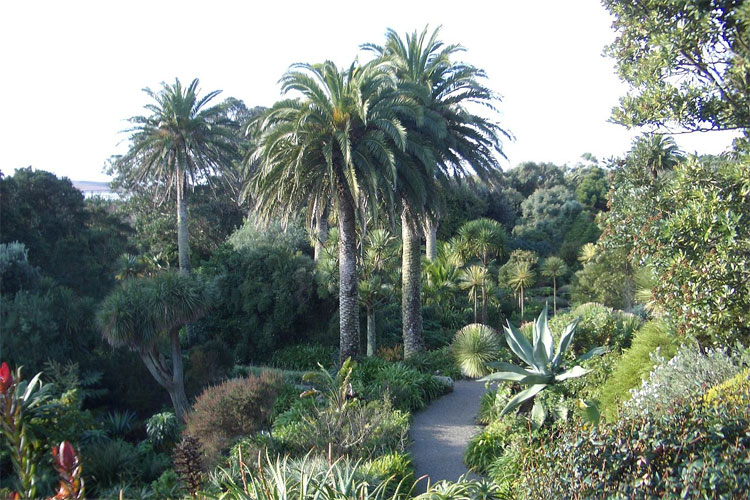
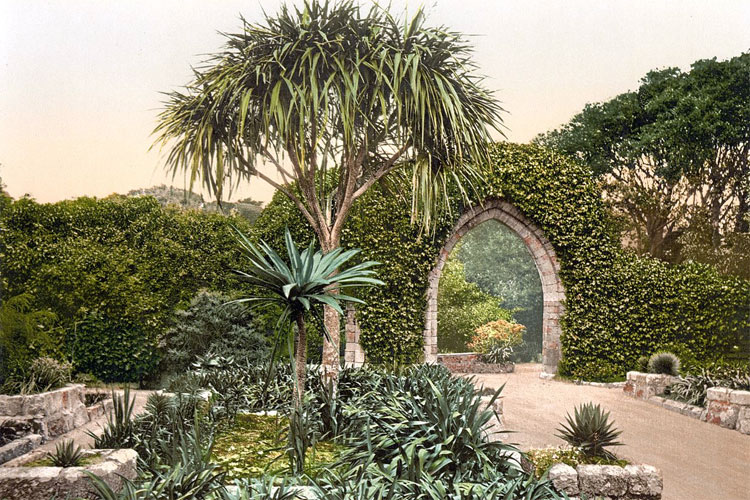
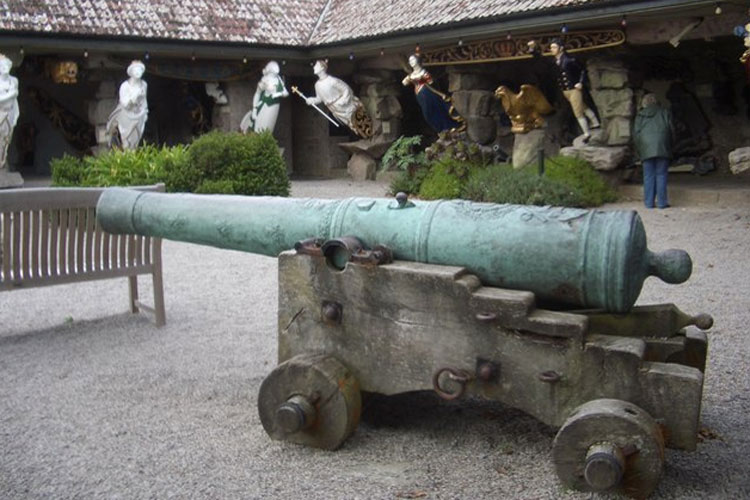
Tresco is the second largest of the Isles of Scilly. measuring about 2 miles by 1 mile. For many visitors Tresco is the most attractive of the Isles of Scilly. This is especially due to its Abbey Garden, which is home to thousands of exotic plant species from around 80 different countries. Plant collector Augustus Smith began the gardens in the 1830s on the site of an old Benedictine Abbey by channeling the weather up and over a network of walled enclosures built around the Priory ruins. He had three terraces carved from the rocky south slope and maximised Tresco’s mild Gulf Stream climate. Even in mid-winter there still are hundreds of plants flowering here. Another surprising attraction at the Abbey Garden is the collection of figureheads from ships that wrecked among the Isles of Scilly.
The island is administered for the Crown by the Duchy of Cornwall and is leased to the Dorrien-Smith estate which runs it as a timeshare business. The Dorrien-Smith family (descended from Augustus Smith) held the position of Lord Proprietors of the Scilly Islands between 1834 and 1920.
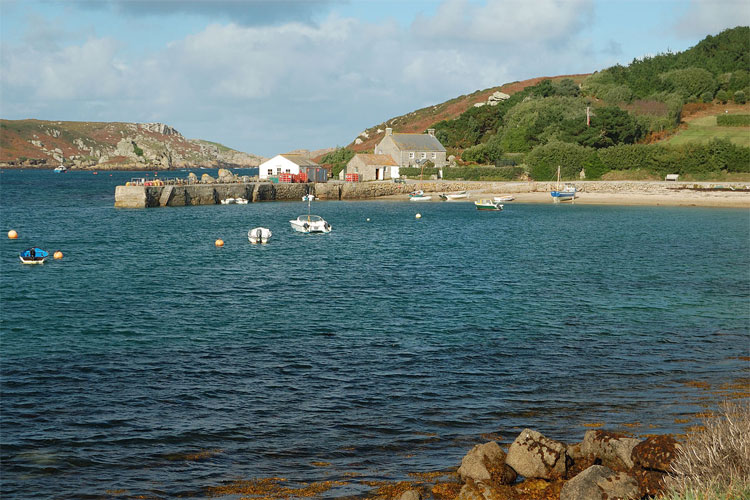
The main settlements are New Grimsby and Old Grimsby in the central part of the island. Combined, their facilities include a convenience store (with a post office sub-branch), an art gallery, a pub, and two café/restaurants, all of which are owned and run by the Tresco Estate. At the south of the island are the sub-tropical Tresco Abbey Gardens, including the Valhalla Figurehead Collection, and Tresco Heliport. To the north of New Grimsby are King Charles's Castle and Cromwell's Castle.
Tresco is a car-free island. Farm tractors with passenger trailers are used to transport overnight visitors to and from Tresco Heliport and from the various quays, and a few golf carts are available for disabled visitors.
The 17 acre Tresco Abbey Gardens were established by the nineteenth-century proprietor of the islands, Augustus Smith, originally as a private garden within the grounds of the home he designed and built. The gardens are designated at Grade I in the Register of Historic Parks and Gardens.
Augustus Smith chose Tresco as the site of his home because the site was more or less central in relation to the rest of the islands. It is also close to the original abbey ruins, is near a fresh water pool and overlooks the sand dunes and beach at Carn Near. The area at the time was barren land and the original building, designed by Smith and started in 1835, was small in comparison to the current building. He made additions to the house in 1843 and 1861. The Grade II listed house consists of roughly coursed granite with ashlar dressings and a slate roof. Some of the timbers from the 1861 wreck of the Award were used for the paneling and roof of the new dining room, as well as paneling of the rooms. His successor, Thomas Algernon Smith-Dorrien-Smith added the tower in 1891.
Within the gardens are the remains of a Benedictine abbey founded in 964 AD, although the majority of what remains today comes from the Priory of St Nicholas founded by monks from Tavistock Abbey in 1114. There were hardly any trees on the island and the gorse did not provide enough protection so he planted shelterbelts. The first were mainly deciduous trees such as, elm , sycamore , oak ) and poplar , and later he planted Monterey cypress and Monterey pine which are fast growing and suited to coastal conditions.
A large expansion to the collection was undertaken by Arthur Algernon Dorrien-Smith in the early years of the 20th century. He made many trips to South Africa looking for suitable trees and plants. He went on the 1907 Sub-Antarctic Islands Scientific Expedition, which had as its primary object magnetic observation in the Auckland and Campbell Islands. Following the expedition he travelled widely in New Zealand, as well as making a shorter visit to Australia. In 1909 he again visited Australia, New Zealand and the Chatham Islands. By this time he had amassed a total collection of plants and seeds of about 2280 specimens. Because of the mild winter climate, the long hours of summer sunshine, and the high walls and hedges around the garden protecting it from the Atlantic winds, the garden is now home to exotic plants from all over the world: the Mediterranean, South America, South Africa and Australasia.
 |
 |
 |
 |
 |
 |