
The ship had encountered ice and also polar bear during the night and so was an hour behind schedule when it anchored at Beechey Island after 8 .
So we were able to have breakfast in the dining room. Around 10 am we went a shore and saw the graves of the three members of the Franklin expedition who had died in the 1845/1846 wintering the Erebus and the Terror had spent here. It was very cold and trying to snow.
It is the site of several very significant events in the history of Arctic exploration. In 1845, the British explorer Sir John Franklin, commanding a ill-fated search for the Northwest Passage aboard HMS Erebus and HMS Terror, chose the protected harbour of Beechey Island for his first winter encampment. The site was not rediscovered until 1850, when British and United States search vessels anchored nearby.
In 1850, Edward Belcher used the island as a base. There are memorials to Franklin and other polar explorers and sailors on the island, including to the French naval officer Joseph René Bellot, who died aged 27 falling into the Wellington Channel, northwest of Beechey Island. In 1903, paying respect to Franklin, Norwegian explorer Roald Amundsen stopped at the island at the beginning of his successful voyage through the Northwest Passage. In 1975, Beechey Island was declared a Territorial Historic Site by the government of the Northwest Territories. Since 1999, it has been part of the newly created Canadian territory of Nunavut.
Beechey Island is best known for containing three graves of Franklin expedition members, which were first discovered in 1850 by searchers for the lost Franklin expedition. The searchers found a large stone cairn, along with the graves of three of Franklin's crewmen – Petty Officer John Torrington, Royal Marine Private William Braine, and Able Seaman John Hartnell – but no written record nor indication of where Franklin planned to sail the next season. In 1852, Commander Edward A. Inglefield arrived at Beechey, along with a physician Dr Peter Sutherland. John Hartnell's grave was opened, damaging his coffin, and Hartnell's memorial plaque on the coffin lid was removed. During a later expedition, a searcher named Thomas Morgan died aboard the vessel North Star on May 22, 1854, and was buried alongside the three original Franklin crew members.
For a larger photo, click on the thumbnail photo below
 |
 |
 |
 |
|
 |
 |
 |
In the 1980s, during two separate expeditions to Beechey, Canadian forensic anthropologist Dr. Owen Beattie examined the three bodies and found them (externally) remarkably well-preserved. Autopsies determined that lung disease and lead poisoning were among the probable causes of death; the lead appeared to come from the thousands of lead-soldered tins of provisions with which the Franklin expedition had been supplied (although later studies would suggest that the unique water distillation system used by the ships could have been the major source of lead poisoning). Later research, however, found through hair sample comparisons between the Beechey remains and those of expedition assistant surgeon and naturalist Harry Goodsir (who died on the expedition a year later, and would therefore be expected to have yet further exposure, under the lead poisoning hypothesis) that the lead in the three men's remains, while indeed present at high levels now recognized as deleterious, was no higher than Goodsir's, and thus evidently mostly the result of exposure prior to the expedition (due to high everyday lead exposure common in the 19th century), and consequently was unlikely to be solely responsible for their deaths.
We board zociacs again to move the mile or so along the shore to the remains of Northumberland House erected in 1852-1853 by the crew of HMS North Star under the command of W.J.S. Pullen. This was one of five ships of the British Admiralty's final effort to trace the expedition of Sir John Franklin led by Sir Edward Belcher. The building was constructed from masts and other wood salvaged from a wrecked whaler. It was built in case the missing members of Franklin's expedition should return to Beechey Island even though this was 7 years after they had last been seen. In May 1854 Belcher ordered 4 of the 5 ships to be abandoned as they were ice-bound, the fifth, the Resolute was retrieved by an American whaler. Belcher was court martialed on return to England for the loss of these ships but acquitted.

For a larger photo, click on the thumbnail photo below
 |
 |
 |
 |
 |
 |
 |
 |
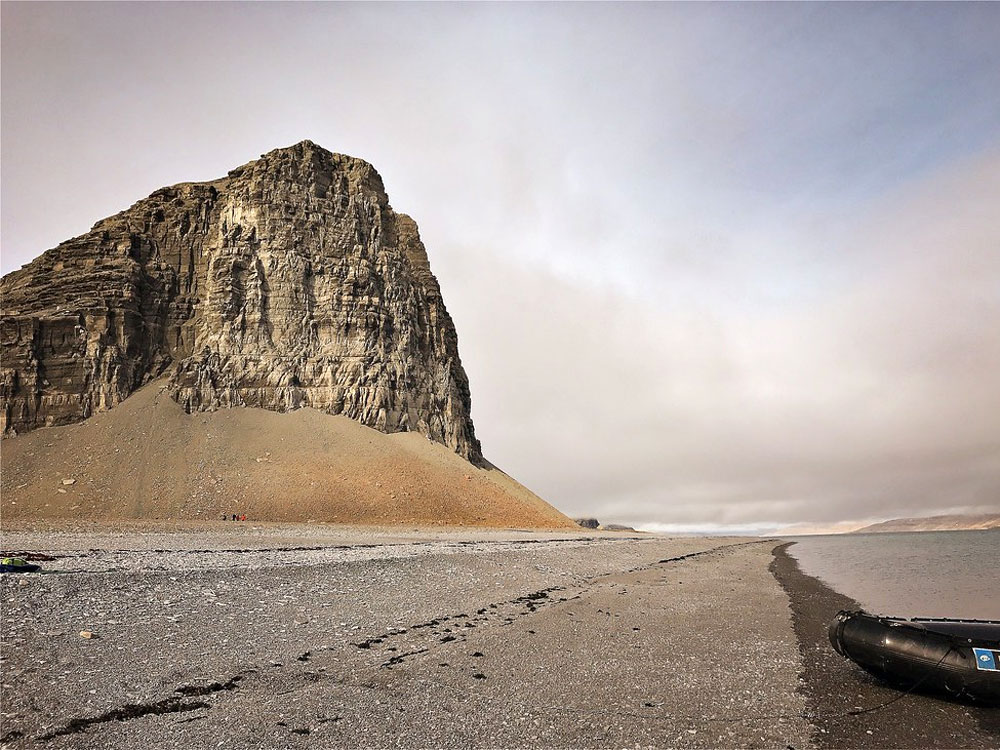
We were back on board in time for a late lunch in the restaurant and then Chris had a siesta. We thought we would not go ashore again till well after 5 pm but in fact we were called before 4 pm to Zodiac ashore at Radstock Bay,. Radstock Bay is a scenic anchorage dominated by the sheer cliffs of Caswall Tower, an imposing isolated peak, is at the western end of Devon Island, Canada, the largest uninhabited island in the world, situated in the middle of the Canadian Arctic on the route of the Northwest Passage
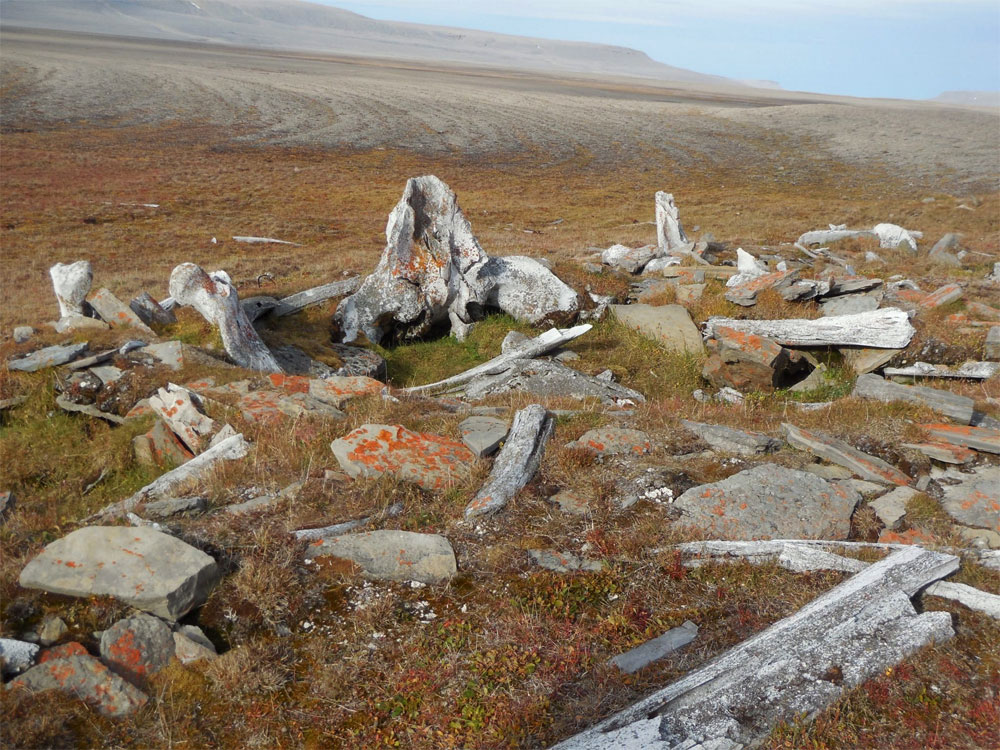
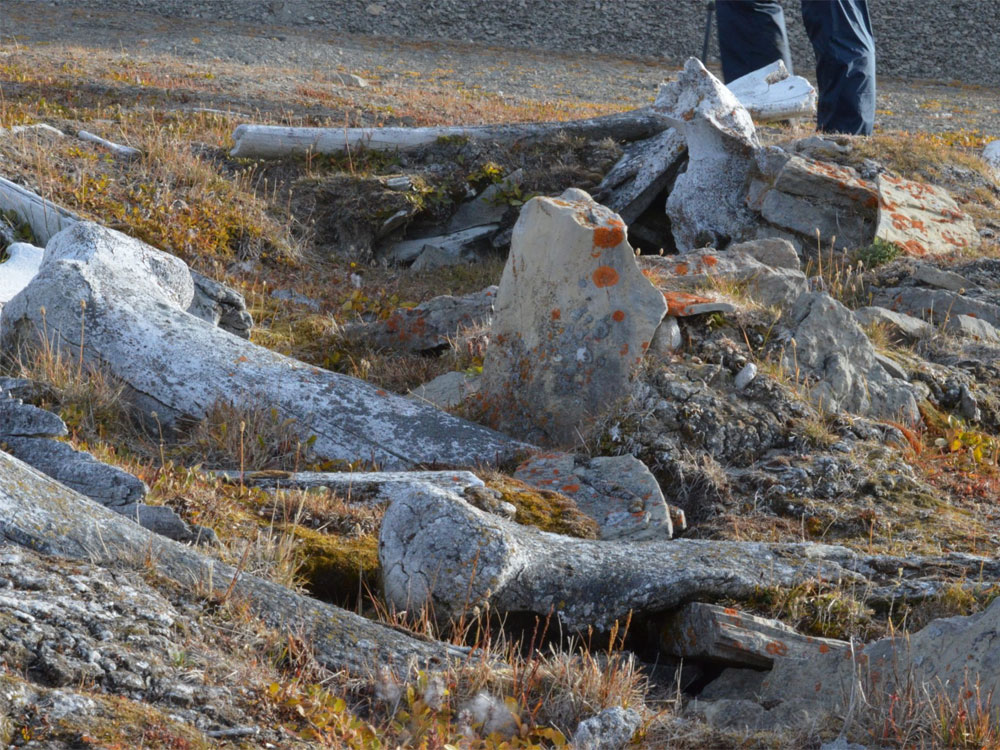
There we saw remains of ancient Thule houses from some 1400 years ago. There was also a fair walk along a beach to reach the Caswall Tower cliffs .

For a larger photo, click on the thumbnail photo below
 |
 |
 |
 |
 |
 |
 |
 |
We then returned to the ship for a shower , having a cocktail in the Dolce Vita bar and then a talk by the captain on the ice the ship had encountered the previous night and then dinner with Marianne., The customer relations manager and Joanna, the future cruise consultant. We started the meal with some of our thoughts on the shortcomings of Silver Sea which of course they both vigorously defended, but then continued and more amiable conversations. Then we had a coffee and drink in the panorama lounge before heading for bed via deck eight, where there was a parka party in progress. But at least it has stopped snowing.
