
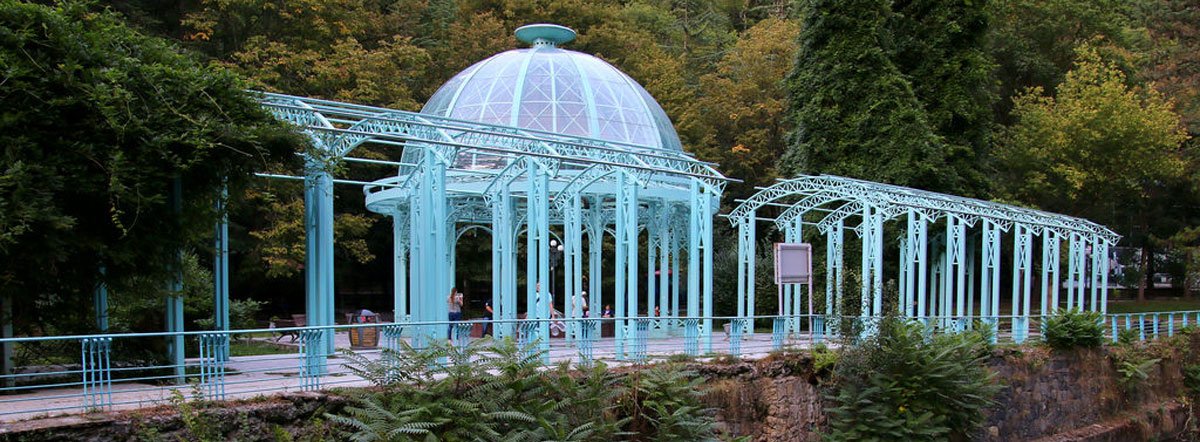
Borjomi is a resort town in south-central Georgia with a population of 10,000. The town is noted for its mineral water industry (which is the number one export of Georgia), the Romanov summer palace in Likani, and the World Wide Fund for Nature-site Borjomi-Kharagauli National Park. It was "old fashioned" in a nice sort of way. We walked up through the gardens and the fun fair (it did not look ecologically themed to me). Had a glass of warm spring water from one source and a glass of cold spring water from another source. There were a lot of people there, mostly Georgian tourists, and we did not see many Western Europeans
Borjomi mineral water is particularly well known in those countries which were part of the former Soviet Union; the bottling of mineral water is a major source of income for the area. Because of the supposed curative powers of the area's mineral springs, it is a frequent destination for people with health problems. Borjomi is also home to the most extensive ecologically-themed amusement park in the Caucasus.
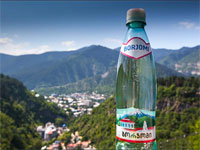
Borjomi is a naturally carbonated mineral water. The artesian springs in the valley are fed by water that filters from glaciers covering the peaks of the Bakuriani mountains at altitudes of up to 2,300 m. The water rises to the surface without pumping and is transported by pipes to two bottling plants in the town of Borjomi. The Borjomi springs were discovered by the Imperial Russian military in the 1820s. They were made famous throughout the Russian Empire, making Borjomi a popular tourist destination. The history of the brand is closely associated with the Russian imperial dynasty of Romanov. By the 1890s, Borjomi was bottled in the Georgian estates of Grand Duke Mikhail of Russia. After the Russian Revolution of 1917 and subsequent Soviet takeover of Georgia, the Borjomi enterprise was nationalized and the water was made into a top Soviet export.
After the Russian annexation of Georgia, the Borjomi area began to revitalize. The town and its surroundings were placed under the Russian military authorities. Borjomi began receiving soldiers in the 1820s. Buildings and baths began going up in the 1830s. Early in the 1840s, when the Russian Viceroy of the Caucasus Yevgeny Golovin brought his daughter down to partake of the cure, he expedited the official transfer of the waters from the military to civil authorities. The viceroy Mikhail Vorontsov, fascinated by local landscape and mineral waters, made Borjomi his summer residence and refurnished it with new parks.
Its warm climate, mineral water springs, and forests made Borjomi a favourite summer resort for the aristocracy, and gave it its popular name of "the pearl of Caucasus". In the 1860s, new hotels were built, and an administration for mineral waters was established. In 1871, Borjomi was bestowed upon the royal family member, Grand Duke Mikhail Nikolayvich, then the viceroy of the Caucasus. In the 1890s, Mikhail’s son, Nikolay, built a park and a chateau at Likani, at the western end of Borjomi.
The bottled mineral waters began to be extensively exported. The town grew significantly at the expanse of Russian migrants and, in 1901, the number of ethnic Russian inhabitants (2,031) outstripped the native Georgians (1,424) for the first time. Following the Red Army invasion of Georgia in 1921, the Soviet regime confiscated all aristocratic mansions and turned them into sanatoria, frequented by the Communist party elite. Despite significant damage caused by a flood on April 18, 1968, Borjomi continued to grow throughout the Soviet era. The post-Soviet years of political and economic crisis hindered development of the area, but it remained a popular destination for internal tourism. In the 2000s, a growing government and private investment into tourism and municipal infrastructure helped Borjomi recover from a decade of decay.
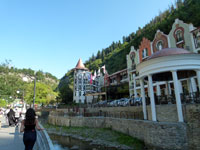
I thought the most striking of the old building was the turquoise colour building at the entry to the park. It turned out to be a 4 star hotel, and is where we should have stayed for the night, rather than drag 40 minutes up the mountain to Bakuriani and back the next morning. The building is a XIX-century house, built by the consular of Iran in Russia, Mirza-Reza Khan, as a summer house with spa facilities. Nowadays it is considered as the unique cultural monument.
Click on any of the thumbnails to get a bigger version of the picture
 |
 |
 |
 |
 |
 |
 |
 |
 |
 |
 |
 |
 |
 |
 |
 |
 |
 |