

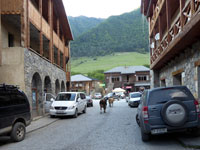
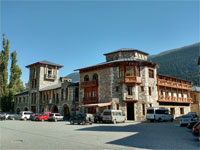
Mestia is in the Svaneti region. The region has a population of 14,000 (2,600 in the town itself). It was granted the status of a townlet in 1968. The population is mostly Svans, a cultural and linguistic subgroup of the Georgians. Despite its small size, the townlet was an important centre of Georgian culture for centuries and contains a number of medieval monuments, such as churches and forts, included in a list of UNESCO World Heritage Sites.
The townlet is dominated by stone defensive towers of a type seen in Ushguli ("Svan towers"). A typical Svan fortified dwelling consisted of a tower, an adjacent house and some other household structures encircled by a defensive wall. Svan Towers are the symbol of Svanetia. Nowhere in the world is there an analogue of these unique defensive structures of the early Middle Ages epoch. Historically the existence of the towers is explained by the necessity of protection against enemy and natural disasters. Therefore each house had a similar tower which served for the families as a refuge in case of war.
Alarm signalization was the other function of Svan towers. They were used as sentry posts. In case of approaching danger a fire was lit on the main tower. As soon as this flame was noticed on the nearest tower they lit a fire there as well. This process was repeated on and on until the entire gorge was instantly ready to fight. All Svansky towers look absolutely identical - a square (5 х 5m) tapered stone structure of 25 m height. Each tower has four or five levels with a windowed upper part. A tower was built on a slope with its edge on this slope. The massive hemisphere of the tower basis made it sturdy enough to withstand cataclysms. The biggest number of Svan towers ( a few dozen) have survived in Mestia and Ushguli. The youngest one is at least two hundred years. Now the towers are not used, their wooden floor partitions collapsed a long time ago, so it is impossible to climb most of them.

Click on any of the thumbnails to get a bigger version of the picture
 |
 |
 |
 |
 |
 |
 |
 |
 |
 |
We had the opportunity to climb one of the very few towers open to tourists, but having got to the first floor, I decided that "no vale la pena" to struggle up the precipitous and dangerous ladder ascent.
We also saw one of the original (dark inside) houses with its original furniture
Although the reason for the towers has been lost in time, my feeling is that they were more to protect a family from blood feuds with its neighbours, than for serious defence against an invading army

Click on any of the thumbnails to get a bigger version of the picture
 |
 |
 |
 |
 |
 |
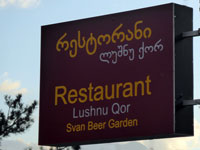
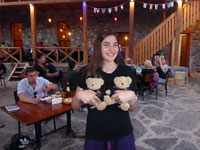
Restaurant Lushnu Qor
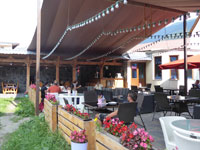
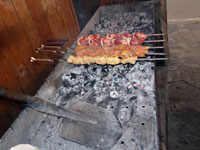
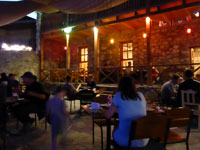
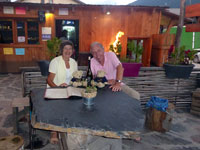
A German owned restaurant offers better than average service, and good food from a barbecue. To find it we walked out of town away from the main square to the edge of the town. Look for the beer garden and find yourself a table.
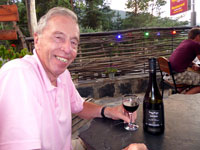
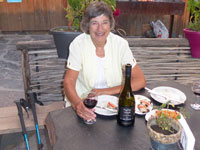
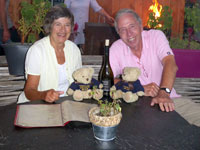
The two nights we ate there the place was pretty full all the time, but we managed to find a table both nights. , and a decent selection of wine and beer We had a good grilled chicken skewer, washed down with a bottle of decent Georgian wine The service was both efficient and friendly. They also own a guest house in town. A really nice restaurant that is worth visiting
Click on any of the thumbnails to get a bigger version of the picture
 |
 |
 |
 |
 |
 |
 |
 |
Mestia Ethnographic Museum was established in 1936. This small mountain museum located in a traditional Svan tower has the richest exposition equalling collections of any European museum. There you will see valuable gold and silver items collected at various times: icons, ornaments, stamping, hunting accessories, military armor, coins and many other masterpieces of applied art. All these treasures were voluntary offered by parishioners in favour of churches (according to the ancient tradition of highlanders of Georgia). The special place is occupied by the richest collection of ancient Georgian manuscripts of the 9 th – 11 th centuries.

Click on any of the thumbnails to get a bigger version of the picture
 |
 |
 |
 |
 |
 |
 |
 |
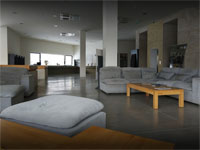
Guesthouse Ushba
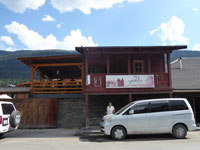
This is a guest house rather than a hotel. During our stay the owners themselves were away on holiday, and the place just did not run properly. The staff were unsupervised, and clearly not keen to bother with guests.
On a three night stay our room was not serviced at all
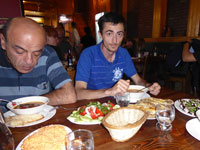
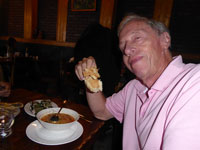
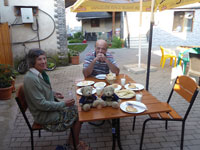
Dinner was mountainous quantities of tourist food of medium quality - after the first night we found a better restaurant in town. Breakfast was mountainous quantities of food which was recycled from one table to the next - for example we got a plate oeight cold fried eggs left by a group who had eaten earlier. I did enjoy their pancakes though, which were freshly cooked.
Our room had a pleasing balcony, was at the back of the hotel, and overlooked the river - great views. A lack of curtain in the shower made showering a messy process that filled the bathroom with water.
If I ever stayed in Mestia again, I would choose a different hotel.
Click on any of the thumbnails to get a bigger version of the picture
 |
 |
 |
 |
 |
 |