Zugdidi is a city in the Western Georgian historical province of Samegrelo. The city is located 318 kilometres west of Tbilisi, 30 km from the Black Sea coast, at an elevation of 100–110 metres above sea level.
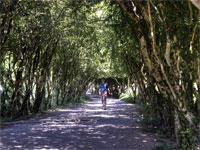
Zugdidi Botanical Garden was established in the 19th century by the Prince of Mingrelia David Dadiani and Queen Ekaterine, near the residential palaces. The garden covers 26 hectares and now has over eighty genus of exotic plants introduced from southeast Asia, India, Japan, Mediterranean and the Americas.
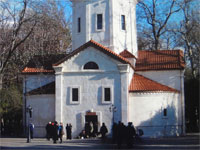
David Dadiani, ruler of Samegrelo, began the construction of a decorative garden in 1840. That year, he fenced in a forest area surrounding the palace, which was he considered his "Baghdad Palace" and set up a specialist institution for horticultural sciences. Soon care and its management of the estate passed to his wife, Ekaterina Chavchavadze-Dadiani. Ekaterina was enthusiastic about her work, and in a short time had stocked the garden with a great variety of native and exotic plants. The attached Church was built in 1838 as the personal church of the Dadiani family.
In 1922, the People's Commissariat of Education appointed Georgian scientist A. Chanturia as director of the garden. The New Director of the Botanical Garden decried the dire state of the garden. He sent Professor Sosnovski, to describe and account for trees and shrubs, fenced the garden area with a living fence, cleaned and restored some of the alley, planted box-curbs and so forth.
Control of the garden changed hands a few times, before it fell in Zugdidi City Council, who turned it into a culture and leisure park hosting a varieties of events, entertainment, and attractions, but the care and development of the plant collection was neglected.
Finally, in 1970, by a resolution of the Georgian SSR Council of Ministers in 1970, Zugdidi Botanical Gardens in Central Park was given to the Academy of Sciences and was renamed the "Georgian SSR Academy of Sciences, Central Botanical Garden Branch."
A short period of time-consuming work brought the garden to conditions suitable for scientific research work. 350 new species and sakheskhvaobis saplings were added to the garden nursery, which will soon be moved to permanent areas in the park.
In 2005, the Government of the Dadianis Palace Garden allocated money for reconstruction.
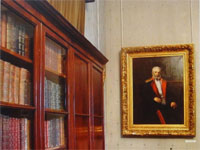
When we were there there was no sign of much money being spent. The grass in front of the palace had been allowed to grow too tall before being cut, and the hedges were in poor condition. The staff on the reception desk for the palace museum were straight from Soviet central casting
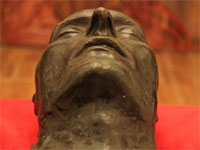
Perhaps the oddest exhibit was a Napoleon death mask. You might ask, what does Paris, New Orleans, Havana and Zugdidi, in western Georgia, have in common? These four cities house a unique treasure that’s of world importance – they each have one of four genuine copies of the death mask of former French emperor Napoleon Bonaparte. In truth it is difficult to determine who actually has the real original death masks, and indeed how many there are, but this one appears to be an original
Napoleon's original death mask was created on May 7, 1821; a day and a half after he died. The method to create a death mask was simple; a mixture of wax or plaster was carefully placed over the French leader’s face and removed after the form had hardened. From this impression, subsequent copies were cast. Mystery and controversy surrounds the origins and whereabouts of the most original cast moulds but there are only four genuine death masks known to exist – and one was housed in Georgia. Over the years experts said there were many stories of how the death mask might have arrived in Georgia. According to the most popular version, this death mask of Napoleon was inherited by Napoleon’s nephew Achille Murat; the grandson of Caroline Bonaparte and Marshal Joachim Murat. When Napoleon’s nephew grew older, he married one of the daughters of the Dadiani family, the Princess of Samegrelo Salome Dadiani, and moved to Georgia and brought with him all of his family relics. As well as Napoleon’s death mask, other belongings of the former French Emperor are still kept in the Zugdidi Historical Museum today.
Click on any of the thumbnails to get a bigger version of the picture
 |
 |
 |
 |
 |
 |
 |
 |
 |
 |
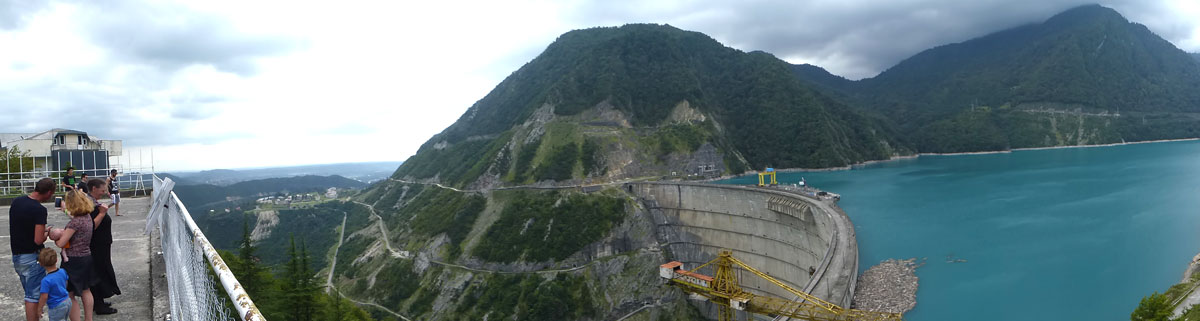
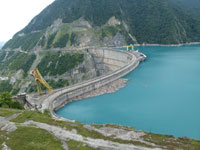
On from Zugdidi we skirted the border with Russian occupied Abkhazia, and past the The Enguri Dam. This is a hydroelectric dam on the Enguri River. Currently it is the world's second highest concrete arch dam with a height of 270 metres . It is part of the Enguri hydroelectric power station (HES) which is partially located in Abkhazia.
Construction of the Enguri dam began in 1961. The dam became temporarily operational in 1978, and was completed in 1987. In 1994, the dam was inspected by engineers of Hydro-Québec, who found that the dam was "in a rare state of dilapidation". In 1999, the European Commission granted €9.4 million to Georgia for urgent repairs at the Enguri HES, including replacing the stoplog at the arch dam on the Georgian side and, refurbishing one of the five generators of the power station at the Abkhazia side. In total, €116 million loans were granted by the EBRD, the European Union, the Japanese Government, KfW and Government of Georgia. In 2011 The European Investment Bank (EIB) loaned €20 million in order to complete the rehabilitation of the Enguri hydropower plant and to ensure safe water evacuation towards the Black Sea at the Vardnili hydropower cascade.
The Enguri hydroelectric power station (HES) is a cascade of hydroelectric facilities including, - in addition to the dam - diversion installation of the Enguri HES proper, the near-dam installation of the Perepad HES-1 and three similar channel installations located on the tailrace emptying into the Black Sea. While the arch dam is located on the Georgian controlled territory in Upper Svanetia, the power station is located in the Gali District of region Abkhazia of Georgia. Its average annual capacity is 3.8 TWh, which is approximately 46% of the total electricity supply in Georgia as of 2007.
Enguri’s structure poses unique political challenges. At 271 meters, it is the world’s sixth-tallest dam. It has its reservoir in Georgia proper, but the concrete tunnel (bored 500 feet deep in a mountain ridge) channels water to a series of power stations that lie in Abkhazia, which broke away from Georgia in the early 1990s. Abkhazia has declared itself an independent state, but only Russia and a few other states recognize it as such. The tunnel pours water from a height of 400 feet into turbines at the power stations
Georgia accepts the responsibility for supplying electricity to Abkhazia – considering it a basic governmental service that it is obliged to provide to its entire territory – but has long used an informal understanding of limiting that obligation to 40 percent of Enguri’s overall annual output. “Abkhazia is an inseparable part of Georgia, and, therefore, we have an inevitable obligation to supply electricity to Abkhazia – as we do to all our citizens. But unfortunately, we have no control over how electricity is used there,” says Davit Sharikadze, a senior Energy Ministry official. “Our attitude is: please use it wisely and carefully.”
Increasingly though, Abkhazia’s annual use exceeds the 40 percent guideline, especially in winter because many Abkhazia households rely on electricity to generate heat. But the Enguri dam reservoir also tends to be at its lowest in winter, sometimes producing just 10-15 percent of its total capacity. Abkhazia has not gone through the privatization process that Georgia has: there still is no metering for electricity usage, and thus most of Abkhazia make token payments to the local power company, which does not share revenue with Georgia. As a result, energy usage is far less efficient: Abkhazia’s roughly 250,000 inhabitants use almost as much electricity as the far glitzier Georgian capital of Tbilisi, with six times the population.
The facility's arched dam, located at the town of Jvari, was inscribed in the list of cultural heritage of Georgia in 2015.
Click on any of the thumbnails to get a bigger version of the picture
 |
 |
 |
 |
 |
 |
 |
 |
And so up to Mestia in remote Svaneti region