
The Tatev Monastery is a 9th-century Armenian Apostolic monastery located on a large basalt plateau near the Tatev village in Syunik Province in southeastern Armenia. It is on the tentative list for UNESCO . The setting is breathtaking
The monastic ensemble stands on the edge of a deep gorge of the Vorotan River. Tatev is known as the bishopric seat of Syunik and played a significant role in the history of the region as a centre of economic, political, spiritual and cultural activity. In the 14th and 15th centuries, the monastery hosted one of the most important Armenian medieval universities, the University of Tatev, which contributed to the advancement of science, religion and philosophy, reproduction of books and development of miniature painting. Scholars of the Tatev University contributed to the preservation of Armenian culture and creed during one of its most turbulent periods in its history.
Wings of Tatev, a cableway from Halidzor village to Tatev was opened in October 2010.
The Tatev plateau has been in use since pre-Christian times, hosting a pagan temple. The temple was replaced with a modest church following the Christianisation of Armenia in the 4th century. Development of the Tatev Monastery began in the 9th century when it became the seat of the bishop of Syunik. In the beginning of the 11th century, Tatev hosted around 1,000 monks and a large number of artisans. In 1044, armed forces of neighbouring emirates destroyed the St. Gregory Church and its surrounding buildings, which were reconstructed soon after that. In 1087, the church of St. Mary was built to the north of the complex. The monastery suffered significant damage during Seljuk invasions in the 12th century and the earthquake in 1136. In 1170, Seljuk Turks plundered the Monastery and burnt some 10,000 manuscripts.
The Monastery was rebuilt through the efforts of Bishop Stepanos near the end of the 13th century. The Monastery was granted an exemption from taxes during Mongol rule. It regained its economic strength with the assistance of the Orbelian family. Its influence grew further when, in 1286, the Orbelians assumed control of the monastery, Stepanos Orbelian was consecrated metropolitan and succeeded in reuniting a number of surrounding dioceses within its realm. With the establishment of the university in the 14th century Tatev became a principal centre of Armenian culture. During Tamurlane’s campaigns into Syunik (1381–1387), Tatev was looted, burnt, and dispossessed of a significant portion of its territories. The Monastery received an additional blow during Shah Rukh’s invasion in 1434
The monastery was reborn in the 17th and 18th centuries; its structures restored and new ones were added. It was looted again during the incursions of Persian forces led by Aga Mahmet Khan in 1796. In 1836, Czarist Russia put an end to the metropolitan authorities of Tatev through the imposition of Pologenia, and Syunik became part of the Diocese of Yerevan
On 26 April 1921, the 2nd Pan-Zangezurian congress, held in Tatev, announced the independence of the Republic of Mountainous Armenia. The state included the regions of Tatev canyon, Sisian and Gndevaz. The city of Goris became the capital of the unrecognised state with Garegin Nzhdeh as its supreme commander. The monastery was seriously damaged after an earthquake in 1931, the dome of the Sts. Paul and Peter church and the bell tower were destroyed. In latter years the Sts. Paul and Peter church was reconstructed, but the bell tower remains destroyed up to today.
Click on any of the thumbnails to get a bigger version of the picture
 |
 |
 |
 |
 |
 |
 |
 |
 |
 |
 |
 |
 |
 |
 |
 |
 |
 |
||
| early photos before earthquake |
Tatevi Anapat Hermitage/Monastery
The 9th century Tatev Monastery has an underground tunnel connecting it to a 17th century monastery in the valley. I have my doubts on this as it was a long way to tunnel.
Preserved on the right bank of Vorotan River are the ruins of the shelter of the Kharants hermits (Great Hermitage of Syunik). It was founded by monks in 1608–1613. The terrible earthquake of 1658 forced the hermits to leave the community and build a new one several kilometres from Kharants – the monastery complex, the Great Hermitage of Tatev.
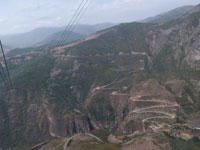
The Hermitage of Tatev is visible from the cabin windows on the Wings of Tatev cableway. A steep switchback road descends to the Hermitage from Tatev Monastery.
 |
 |
Wings of Tatev - Aerial Tramway
Wings of Tatev is a 5.7 km cableway between Halidzor and the Tatev monastery in Armenia. It is the longest reversible aerial tramway built in only one section, and holds the record for Longest non-stop double track cable car. A few provisos there, but it is very long and very impressive
Construction was finished in October 2010. Total ride time from Halidzor station to Tatev monastery is about 12 minutes; a much shorter trip than the 40 minute ride along the steep serpentine road that follows the Vorotan gorge. We got there by bus and returned by tramway. It was instructive to see both ways of getting to the monastery
Flying over the gorge, the aerial tramway cabin reaches its maximum height of 320 meters. When the first cabin reaches the Tatev station, the second one arrives at the Halidzor station. After the Wings are reloaded, the movement starts again in the opposite direction. Each cabin accommodates 30 passengers and one steward. The ropeway can accommodate about 240 passengers per hour. Powerful pillars divide the ropeway into four sections. The longest section is 2.7 km and overlooks the Tatev monastic complex.
As of December 2017, the Tatev Gateway Project has involved an investment of more than USD 22 million. USD 16 million of this amount has been used for the construction of the aerial tramway; over USD 1 million – for the construction of Tatevatun Restaurant; USD 1.5 million – for the development of infrastructures; and about USD 670,000 for the site improvement.
Tatev Gateway is a non-commercial project; the entire profit from the project is invested in the restoration of Tatev Monastery and the development of the local community. That being said, it can only make a profit, as far as I can see, if the investment is treated as a donation, which given the way it is funded, must be the case.
It carried 135,000 passengers last year

Click on any of the thumbnails to get a bigger version of the picture
 |
 |
 |
 |
 |
 |
 |
 |
 |
 |
 |
 |
From exiting the aerial tramway, we resumed the road journey to Dilijan