 |
 |
After the frisson of excitement on the Tatev Aerial Tramway we were ready for lunch. I never found out the name of the restaurant, as my reading of Armenian never reached pass mark level.
Click on any of the thumbnails to get a bigger version of the picture
|
|
After that there was a steep winding alpine road over the Vardenyats Pass
Vardenyats Pass


Vardenyats Pass is a high mountain pass at an elevation of 2.410m. The pass climbs through the Vardenis Mountains and provides access to Lake Sevan. The road over the pass is asphalted. The road encompasses miles of stunning views through twisty hair pin corners, high elevations and steep grades. The winding mountain road and hairpin turns provide breathtaking views of the surrounding steep rocky hill sides and lead to the highland steppe just beyond the pass. Near the summit there’s an ancient Silk Road guest house called Selim or Oberlian's Caravensarai.
Click on any of the thumbnails to get a bigger version of the picture
 |
 |
Oberlians Caravanserai
It was built along the Vardenyats Mountain Pass (also known as the Selim Mountain Pass) in 1332, by Prince Chesar Orbelian to accommodate travelers and their animals as they crossed from, or into, the mountainous Vayots Dzor region. Located at the southern side of Vardenyats Mountain Pass at a height of 2410 meters above sea level, Orbelian's Caravanserai is the best preserved caravanserai in the entire country. Ruins of a small chapel may still be seen adjacent to the vestibule, across the road from a spring.
The only entrance to the caravanserai is at the rectangular vestibule adjacent to the main hall of the structure. It has a gabled stone shingle roof that rests on three arches. On the eastern side, these arches rest upon the edges of the windows. The southern wall of the vestibule and the entry wall façade are the few locations in the caravanserai where there is any ornamentation. The entry has decorations around the half-rounded lintel, with high-reliefs of a winged animal to the left, and a bull to the right, above the lintel. The only other decorations may be found around each of the oculi in the hall, which each have a unique design. There are two inscriptions found on the vestibule, one is written in Persian and the other is written in Armenian.
The caravanserai is constructed of blocks of basalt. It has a single hall divided into three naves, with seven pairs of polyhedral pillars. Animals rested in the narrow aisles to the left and right of the main hall. Between the pillars were stone troughs for the animals, and in the corner of one of the halls was a pool of water. Travelers slept in a separate room built at the end of the narrow aisles on the western side of the caravanserai. The roof above the three-aisled hall had three parallel vaults with an oculus in each. The vaults were supported by arches that stretched from pillar to pillar along the aisles, and traversed from the pillars to the walls. Oculi placed in the middle of each of the vaults served the purpose of letting in sunlight and fresh air, while also letting out smoke. The caravanserai was restored from 1956-1959.
While we were there, a tourist who had climbed onto the roof to take photos, got stuck and it took him several minutes to find a safe way back to ground level
Click on any of the thumbnails to get a bigger version of the picture
 |
 |
 |
 |
 |
 |
 |
 |
The other side of the pass takes us down to Lake Sevan, which were able to see on and off for an hour or more.
Noratus Cemetery

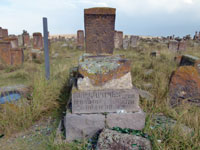
Noratus cemetery is a medieval cemetery with a large number of early khachkars located in the village of Noratus, Gegharkunik marz near Gavar and Lake Sevan, The cemetery has the largest cluster of khachkars in Armenia.
The oldest khachkars in the cemetery date back to the late 10th century. During the revival of the khachkar tradition in the 16-17th centuries many khachkars were built under the yoke of the Safavid Empire when oriental influences seeped into Armenian art. Three master carvers from this period carved khachkars in Noraduz. The cemetery is spread over a seven hectare field containing almost a thousand khachkars each of them depicting unique ornamentation. The majority of the khachkars are covered by moss and lichen.
Several tombstones in the cemetery depict carved scenes of weddings and farm life. Adjacent to the old cemetery a new modern cemetery has been built separated by a long fence. One of the khachkars from the cemetery was donated to the British Museum in 1977 by Catholicos Vazgen I.
Quite bizarrely a group of local women pursue the small number of tourists through the graveyard, hawking socks and other knitted goods. When I suggested to our guide that this was disrespectful of a cemetery, she got them to move back to the gate.They seem to feature in a number of articles on the graveyard.
Click on any of the thumbnails to get a bigger version of the picture
 |
 |
 |
 |
 |
 |
 |
 |
Sevanavank Monastery


Sevanavank is a monastic complex located on a peninsula at the northwestern shore of Lake Sevan, not far from the town of Sevan.
Initially the monastery was built at the southern shore of a small island. After the artificial draining of Lake Sevan, which started in the era of Joseph Stalin, the water level fell about 20 metres, and the island transformed into a peninsula. Due to easier accessibility (once it became a peninsula), Sevanavank is one of the most visited tourism sights in Armenia.
According to an inscription in one of the churches, the monastery of Sevanavank was founded in 874 by Princess Mariam, the daughter of Ashot I (who became a king a decade later). At the time, Armenia was still struggling to free itself from Arab rule. The monastery was strict as it was mainly intended for those monks from Etchmiadzin who had sinned. Jean-Marie Chopin, a French explorer of the Caucasus, visited there in 1830 and wrote of a regimen restraining from meat, wine, youth or women. Another explorer visited the monastery in 1850 and wrote of how manuscripts were still being copied manually.
Click on any of the thumbnails to get a bigger version of the picture
 |
 |
 |
 |
 |
 |
 |
 |
Bun Shop
Providentially there was a boulangerie right by the car park for the Monastery, and they had these really nice filled cakes. Well I thought that they were really nice, some thought them excessive
 |
 |
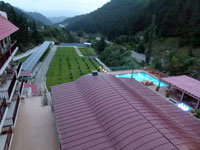
Best Western Paradise Hotel
This is a hotel that gets the bulk of its business from large tour buses. There are no other restaurants nearby, so you do not have any real alternative to their restaurant
We had a top floor room here which was roomy, without being luxurious. Staff were pleasant, without being particularly anxious to please.
The small indoor pool was fine, but no staff in attendance.
Breakfast was in an odd dining room which appeared to be set up for large functions rather than individual guests. The breakfast buffet was what one would expect of this sort of hotel - adequate without being memorable
There was a top floor terrace, beyond the reach of the lift, which was a good place to sit - though the nearby main road did cause a lot of noise from lorry traffic
Click on any of the thumbnails to get a bigger version of the picture
 |
 |
 |
 |
 |
 |
Next morning back on the road we stopped at Dilijan, but there was little to see
Dilijan
Click on any of the thumbnails to get a bigger version of the picture
 |
 |
 |
 |