
Yerevan, is the capital and largest city of Armenia as well as one of the world's oldest continuously inhabited cities. Situated along the Hrazdan River, Yerevan is the administrative, cultural, and industrial centre of the country. It has been the capital since 1918, the thirteenth in the history of Armenia, and the seventh located in or around the Ararat plain.
The city also serves as the seat of the Araratian Pontifical Diocese; the largest diocese of the Armenian Apostolic Church and one of the oldest dioceses in the world.
The history of Yerevan dates back to the 8th century BC, with the founding of the fortress of Erebuni in 782 BC by king Argishti I at the western extreme of the Ararat plain. Erebuni was "designed as a great administrative and religious centre, a fully royal capital." Towards the end of the ancient Armenian Kingdom, new capital cities were established and Yerevan declined in importance. Under Iranian and Russian rule, it was the centre of the Erivan Khanate from 1736 to 1828 and the Erivan Governorate from 1850 to 1917, respectively.
After World War I, Yerevan became the capital of the First Republic of Armenia as thousands of survivors of the Armenian Genocide in the Ottoman Empire arrived in the area.
The city expanded rapidly during the 20th century as Armenia became part of the Soviet Union. In a few decades, Yerevan was transformed from a provincial town within the Russian Empire to Armenia's principal cultural, artistic, and industrial centre, as well as becoming the seat of national government.
According to the official estimate of 2016, the current population of the city is 1,073,700. Of the notable landmarks of Yerevan, Erebuni Fortress is considered to be the birthplace of the city, the Katoghike Tsiranavor church is the oldest surviving church of Yerevan and Saint Gregory Cathedral is the largest Armenian cathedral in the world, Tsitsernakaberd is the official memorial to the victims of the Armenian Genocide, and there are several opera houses, theatres, museums, libraries, and other cultural institutions. Yerevan Opera Theatre is the main spectacle hall of the Armenian capital, the National Gallery of Armenia is the largest art museum in the Republic of Armenia and shares a building with the History Museum of Armenia, and the Matenadaran repository contains one of the largest depositories of ancient books and manuscripts in the world.
Click on any of the thumbnails to get a bigger version of the picture
 |
 |
 |
 |
 |
 |
 |
 |
 |
 |
 |
 |
 |
 |
 |
 |
 |
 |
 |
 |
The Cascade
This is a giant stairway made of limestone in Yerevan. It links the downtown Ketron area with the Monument neighbourhood. The construction of the cascade started in 1971 and was partially completed in 1980. Inside the Cascade, underneath the exterior steps, are seven escalators that rise along the length of the complex. There are also exhibit halls connected to some of the landings along the escalators which compose the Cafesjian Museum of Art. The exterior of The Cascade features multiple levels adorned with fountains and modernist sculptures from the Cafesjian collection. The stairs afford walkers unobstructed views of central Yerevan and Mount Ararat. At the base of the Cascade is a garden court yard with statues by contemporary sculptures such as Botero. There are a number of cafes and restaurants on both sides of the Cascade frequented by locals and tourists. Classical and jazz concerts often take place at the Cascade during spring, summer and early autumn, with spectators sitting on the steps.
Genocide Museum
The Armenian Genocide memorial complex is Armenia's official memorial dedicated to the victims of the Armenian Genocide, built in 1967 on the hill of Tsitsernakaberd in Yerevan. Every year on April 24—the Armenian Genocide Remembrance Day—thousands of Armenians gather at the memorial to commemorate the victims of the genocide.
Commemorating the massacre of Armenians in the Ottoman Empire from 1915 to 1922, this institution offers a powerful museum experience similar to that of Israel's Yad Vashem (Holocaust Museum). Designed by architects Arthur Tarkhanyan and Sashur Kalashyan, working with artist Hovhannes Khachatryan, the two-storey exhibition space is built into the side of the hill so as not to detract from the monument above. The story of this horrific historical event is told through photographs, documents, newspaper reports and films.
From the museum, a broad pathway flanked by a 100m-long wall engraved with the names of massacred communities leads to the memorial, which was built in 1967. It consists of a 40m-high spire next to a circle of 12 basalt slabs leaning over to guard an eternal flame. The 12 tilted slabs represent the lost provinces of western Armenia, land lost to Turkey in a post-WWI peace deal between Ataturk and Lenin, while the spire has a fine split dividing it into larger and smaller needles, the smaller one representing western Armenia. In the grounds there is a stand of trees planted by foreign leaders who use the term genocide to describe the events that occurred. The complex is on Tsitsernakaberd Hill (Fortress of Swallows) across the Hrazdan Gorge from central Yerevan.
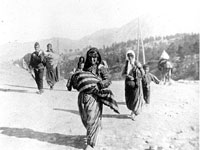
The Armenian Genocide was the Ottoman government's systematic extermination of 1.5 million Armenians, mostly citizens within the Ottoman Empire. The starting date was in April 1915, the day that Ottoman authorities rounded up, arrested, and deported from Constantinople (now Istanbul) to the region of Ankara 235 to 270 Armenian intellectuals and community leaders, the majority of whom were eventually murdered.
The genocide was carried out during and after World War I and implemented in two phases—the wholesale killing of the able-bodied male population through massacre and subjection of army conscripts to forced labour, followed by the deportation of women, children, the elderly, and the infirm on death marches leading to the Syrian Desert. Driven forward by military escorts, the deportees were deprived of food and water. Most Armenian diaspora communities around the world came into being as a direct result of the genocide. Raphael Lemkin was moved specifically by the annihilation of the Armenians to define systematic and premeditated exterminations within legal parameters and coin the word genocide in 1943.
The Armenian Genocide is acknowledged to have been one of the first modern genocides, because scholars point to the organized manner in which the killings were carried out. It is the second most-studied case of genocide after the Holocaust. Turkey denies the word genocide is an accurate term for these events. In recent years, Turkey has been faced with repeated calls to recognize them as genocide. As of 2018, 29 countries have officially recognized the mass killings as genocide, as have most genocide scholars and historians.
Undoubtedly the Turks killed a great many Armenians. The sequence of events is very complicated, and there is spin by both sides as to what happened. The net effect is that today ; on one side the worldwide recognition of the Genocide is a core aspect of Armenia's foreign policy; and on the other side Turkey refuses to accept that a genocide took place, let alone apologise for it. Until Armenia and Turkey sort out the past, it is unlikely that they can move on in their relations. The Turkish-Armenian border has been shut since 1993. Officially, Turkey closed the border in response to Armenia's war and occupation of territory belonging to neighbouring Azerbaijan, a close Turkish ally and supplier of natural gas and energy. Despite efforts by international mediators in 2009 that resulted in a framework agreement signed by Yerevan and Ankara, the militarised border has remained firmly closed. The Russian Federation has military garrisons in Armenia and guards its borders under an agreement that ensures a constant military presence through 2045.

Click on any of the thumbnails to get a bigger version of the picture
 |
 |
 |
 |
 |
 |
 |
 |
 |
 |
 |
 |
 |
 |
 |
 |
 |
 |
Grand Hotel Yerevan
I booked this hotel because it was a member of Small Luxury Hotels, which we have found wonderful places to stay all over the world. But this place was not small and could be mistaken for the Hilton at LHR terminal 4 that we stayed in a few weeks ago - the same layout with many rooms opening onto an internal courtyard

The staff were not up to SLH standards either. Check in was rushed and gabbled. At breakfast we could not get any of the myriad of waiters to bring us coffee - I eventually had to go to reception to get service, and was told it was my fault!
There was a pleasant swimming pool on the roof, but service was Soviet style - slow, inefficient and humourless.
I do not think I would stay here again.
Click on any of the thumbnails to get a bigger version of the picture
 |
 |
 |
 |
 |
 |
Tufenkian Hotel Yerevan
This hotel looked better from the outside than from the inside. The bedrooms were nothing remarkable, there was a small pool, and the breakfast was on the less than generous buffet side.

We had problems checking in. You cannot operate the lift without your room key - ours did not work, the doors closed and we were left, rather frighteningly, in the dark until I found a way of opening the lift door. I got the receptionist to replace the key card, which was done with little charm. Then we went through the same problem with the other key card - the receptionist accused me of demagnetizing it with my mobile - I did not have a mobile and I had only just arrived so had no time to grot the key card.
There were only towels for one guest - given the problems another reviewer had on being charged for a missing towel, I asked reception to get us towels for 2. Two hours later the towels had not arrived, and I again had to ask the less than helpful receptionist. The hotel does not have good receptionists.
Breakfast was acceptable without being good. But the outside seating was a pleasant place to sit, even though it was difficult to get any service there.
There is a small outdoor pool.
A manager on duty was lacking. Given the amount that the owner has spent on doing up the building, it would seem sensible to have a duty manager for guests to talk to. Certainly more sensible than having a PR manager offering platitudes to reviewers with problems
Click on any of the thumbnails to get a bigger version of the picture
 |
 |
 |
 |
 |
 |
 |
 |
 |
 |
 |
 |
We enjoyed Cafe Garun, where we went most evenings we were in Yerevan, for a light supper (well cakes and a smoothie anyway). We stopped by here 4 or 5 times. It is more of a cafe than a restaurant. The interior is modern and welcoming. The are a small number of tables downstairs and upstairs We had various combinations of their very good fruit tarts - fresh fruits and excellent pastry. Tarts are on display in a cabinet, so you just have to point. There is a smoothie menu in English offering 25 or so different smoothies and fresh fruit drinks. All are freshly made, and you can see them making them The staff are welcoming and, even though they did not speak English, were very helpful
There were other restaurants that the tour operator took us to for lunch, but they are best forgotten (it will take time to forget)
Click on any of the thumbnails to get a bigger version of the picture
 |
 |
 |
 |