

It is believed to have been used by the Incas as an administrative and control site on the main road from the coast to the highlands. The Incas had these control points every so many kilometres along the road. This site is located just inland from the coast in the Pisco River Valley, close to the town of Pisco. At the time of the Spanish conquest of Peru in 1532, the Incas had built an empire stretching from the modern Ecuador-Colombia border to the Rio Maule in Chile, and from the Pacific Coast to the Argentinean Pampas. Sites such as Tambo Colorado and Lima La Vieja were used as regional Inca centres; ceremonial and administrative complexes designed to integrate the conquered coastal peoples of Chincha and Ica into their empire. It is not known by which Inca ruler the Chincha-Ica region was eventually conquered, but the available evidence suggests that this region was not integrated into the empire until the reign of Thupa 'Inka Yupanki sometime between 1470 and 1490.
The site owes its name to the abundant use of colours on the walls. Thanks to favourable (very dry) environmental conditions, many walls at Tambo, both internal and external, retain enough residual coloured paint to accurately reconstruct what the original wall painting would have been like. Colour here was often applied in horizontal strips of red, black, white, and yellow ochre atop stucco, and variation in colour would accentuate architectural features such as niches. Trapezoidal niches at Tambo have one or two recesses each, likely used for the placement of important objects. As with all Inca constructions, the overall dimensions of niche construction are standardized across the entire site.
The site consists of several structures around a large central plaza. The central plaza is shaped like a trapezoid with its largest side being 150 m long. The main structures are grouped together in a northern part and a southern part (Sector Norte and Sector Sur). These structures are known as the Northern palace and the two Southern Palaces, flanked by an Ushnu (raised ceremonial platform) and a building known as the Utilities Structure.
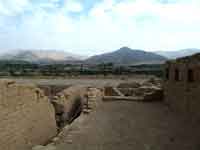
Tambo Colorado contains extensive standing architecture made primarily from adobe, with elements characteristic of classic Inca imperial architecture as well as others borrowed from local Chincha and Ica traditions. Along the main plaza is an Ushnu, a wide platform common at Inca administrative centres, which functioned as the throne for the Inca ruler. The site also contains intricate lattice work, single and double-framed niches, ornamental crests, and corbeled arches, constructed from stone and adobe.
Tambo Colorado was first studied by Max Uhle in 1901. He produced detailed maps of the site and its architectural remains and documented them with numerous photographs and notes. Two US professors carried out a new survey in 2000. This was the first major archaeological work at the site since Uhle's investigations. Comparing the state of Tambo Colorado today with the documents from Uhle, it is obvious that it has suffered considerable deterioration and damage during the past century. Humidity, windblown sand, vandals, and a recent road construction project have and continue to take their toll on the site. Tambo Colorado is in desperate need of conservation measures if it is to survive.
Click on any thumbnail photo to get a larger picture
 |
 |
 |
 |
 |
 |
 |
 |
 |
 |
 |
 |
The voyage on Silversea Explorer in South America