| Aug 7 |
Athens (Piraeus), Greece |
sail 19.00 |
|
| Aug 8 |
Santorini, Greece |
 |
Santorini is the most instantly recognizable island in the Aegean, the blue-domed churches and whitewashed buildings of Oia and Fira cascading down the inner cliff of a volcanic caldera formed by one of history's most catastrophic eruptions. The geological drama is the setting; the sunsets, the black sand beaches of Kamari and Perissa, the Minoan ruins at Akrotiri, and the local Assyrtiko wine are the substance. Santorini rewards early mornings and late evenings, when the light does what made it famous and the crowds have retreated to the cruise ships and the hotels. |
| Aug 9 |
Rhodes, Greece |
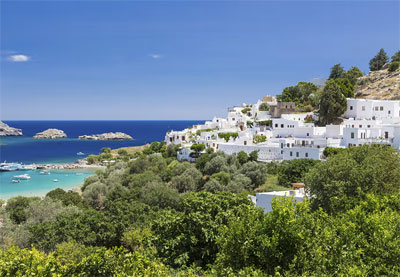 |
Rhodes is one of the most historically layered islands in the Mediterranean. The medieval Old Town a UNESCO World Heritage Site was built by the Knights of St. John in the 14th century and remains one of the best-preserved Crusader cities in the world, its Street of the Knights intact after seven centuries. Beyond the walls, the beaches of Lindos, the acropolis at Kamiros, and the island's turquoise coastline broaden the appeal considerably. |
| Aug 10 |
Bodrum, Turkey |
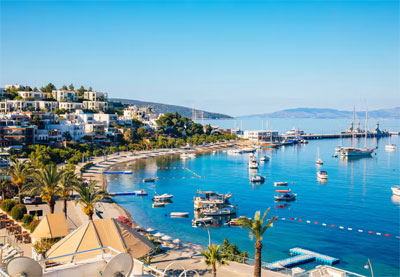 |
Bodrum is a compelling stop where the white houses act as a blank canvas for splashes of color provided by the climbing purple bougainvillea, subtropical gardens, and front doors that come in every shade of blue to match the sea. Bodrum is Turkey's coast at its most vibrant. It boasts a world-class marina, a favorite of super yachts, fine dining restaurants and bars, with Bodrum castle, Mausoleum of Halicarnassus, and Bodrum adding further depth to the experience, giving the call a strong sense of place. |
| Aug 11 |
At Sea |
 |
|
| Aug 12 |
Nafplion, Greece |
 |
Nafplion was Greece's first capital after independence and retains the elegance of a city that has always known its worth. The Venetian old town, with its neoclassical mansions, shaded squares, and seafront promenade, is one of the most beautiful in the Peloponnese. The Palamidi fortress above, reached by 999 steps, commands views across the Argolic Gulf. Bourtzi, a Venetian island fortress in the harbor, completes a waterfront of rare pictorial quality. Nafplion is where Athenians escape at weekends, which is recommendation enough. |
| Aug 13 |
Patmos, Greece |
 |
Patmos is a small Aegean island whose cultural significance far exceeds its size. Christians have made pilgrimage here for centuries to the Cave of the Apocalypse, a hillside grotto where St. John is said to have received the Book of Revelation in AD 95. The 11th-century Monastery of St. John the Theologian, built like a fortress above the port, houses illuminated manuscripts of exceptional rarity. Beyond its sacred character, Patmos is simply beautiful: clear water, whitewashed villages, and a quietness that centuries of monastic presence have somehow preserved. |
| Aug 14 |
Athens |
 |
Athens is one of the oldest cities in the world and the foundation on which Western civilization was built. The Acropolis, with the Parthenon at its summit, remains the defining image of the entire Greece, but the city below rewards just as much: the ancient Agora, the National Archaeological Museum, the Plaka neighbourhood's tavernas and neoclassical streets, and the view at dusk from Lycabettus Hill over a city of four million. Piraeus is the port that has served Athens since antiquity; the journey from quayside to the foot of the Acropolis takes less than half an hour. |
| Aug 15 |
Milos, Nisos Melos, Greece |
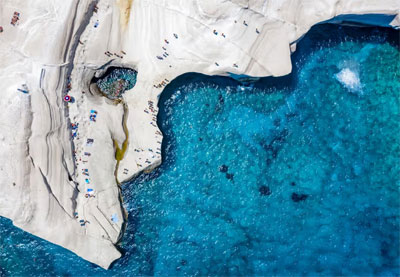 |
Milos is the most geologically theatrical island in the Cyclades, its coastline shaped by volcanic forces into colored cliffs, sea caves, and the famous multicolored fishing village of Klima, boats moored directly below boathouses painted in every warm shade. The Venus de Milo was discovered here in 1820, now in the Louvre; the island's museum holds the cast. The beaches, Sarakiniko's lunar white pumice, Tsigrado's hidden cove, Firiplaka's golden sand, are among the most varied and beautiful in Greece. |
| Aug 16 |
Gythion, Greece |
 |
Gythion is a small harbor town at the southern edge of the Peloponnese, its neoclassical houses climbing the slopes of Mount Kourmaros above a quayside of fishing boats and waterfront tavernas. The town claims Hercules and Apollo as its mythological founders; nearby Marathonissi, the ancient island of Cranae, is where Paris and Helen of Troy are said to have spent their first night together. The ancient theater, the archaeological museum, and the beaches of the Mani coast are all within easy reach. Gythion is an unpretentious Greek port that rewards a quiet morning ashore. |
| Aug 17 |
Katakolon (Olympia), Greece |
 |
Katakolon is a small Peloponnese port made remarkable by what lies forty-five minutes inland: ancient Olympia, birthplace of the Olympic Games. The sacred Altis precinct, the ruined Temple of Zeus, and the stadium where athletes competed from 776 BC form a site of rare historical resonance. The museum holding the original sculptures from the temple pediments is among the finest in Greece. The Olympic flame for every modern Games is still lit here, in the ruins of the Temple of Hera, before beginning its journey around the world. |
| Aug 18 |
Day at sea |
|
|
| Aug 19 |
Dubrovnik, Croatia |
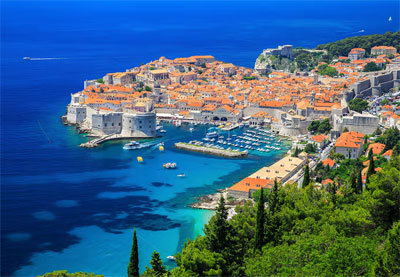 |
Dubrovnik's walls rise from the Adriatic with a confidence earned over centuries. Enclosing one of Europe's finest medieval old towns, the fortifications have protected this Croatian city through maritime history and modern conflict alike. The limestone streets of the Stradun, baroque churches, and terracotta rooftops form a skyline of rare beauty. Walk the walls for the panoramic sweep, explore hidden coves beyond the old town, or settle into a candlelit restaurant for Dalmatian wine and truffle pasta. Dubrovnik rewards every kind of traveler, at every hour of the day. |
| Aug 20 |
Split, Croatia |
 |
Split, Croatia, is built around and inside a Roman emperor's retirement palace, a circumstance that makes it unique among European cities and endlessly fascinating to walk through. Diocletian's Palace, constructed around 305 AD, was never abandoned; its halls, temples, and corridors were simply absorbed into the evolving medieval city, which now occupies every corner of the original walls. The result is a UNESCO World Heritage Site that is also a living neighborhood of cafes, apartments, and galleries. The Dalmatian sun makes most arrangements here look unreasonably good. |
| Aug 21 |
Zadar, Croatia |
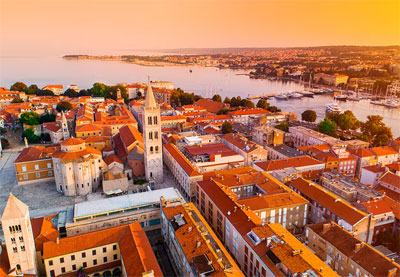 |
Zadar layers Roman remains, medieval churches, Venetian walls, and contemporary creativity into one of Croatia’s most engaging coastal cities. The old town projects into the Adriatic like a stone stage set, while modern landmarks such as the Sea Organ and Greeting to the Sun give the waterfront a playful, memorable edge. It is a place where history is abundant but never static, animated by light, music, and the easy confidence of Dalmatia; for cruise travelers, it offers an arrival rich in atmosphere, beauty, and a strong sense of place. |
| Aug 22 |
Rovinj, Croatia |
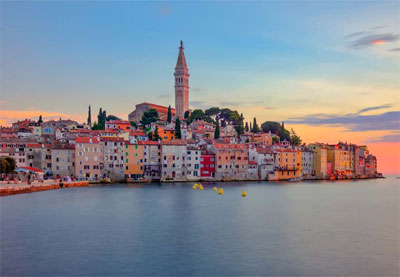 |
Rovinj rises from the Istrian coast on a small peninsula, its Venetian-era campanile and dense cluster of ochre and terracotta buildings reflected in the clear Adriatic waters of the northern Croatian coast. The old town's maze of cobbled streets, open-air fish restaurants, and galleries occupying former fishermen's houses give it an intimacy that larger Dalmatian cities cannot replicate. The surrounding seascape extends the pleasures of a landing beyond the harbor. Rovinj is, by some measures, the most beautiful small town on the Adriatic. |
| Aug 23 |
Koper, Slovenia |
 |
At Koper, the Mediterranean feels both elegant and storied, with sunlit harbors, fortified skylines, and a historic core that rewards slow exploration. Distinctive elements such as picturesque old town, coastal, and Ljubljana day trips give the destination depth as well as beauty. Whether you devote your time to monuments, local cuisine, or a simple walk through the harbor, the stop leaves a lasting sense of the Mediterranean at its most complete, leaving a quiet sense of discovery long after departure. |
| Aug 24 |
Fusina (Venice), Italy |
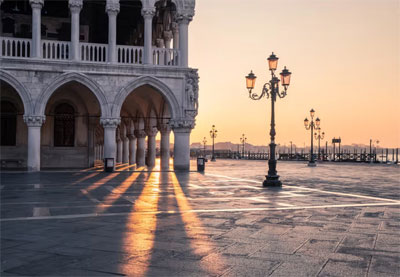 |
Arriving via Fusina, Venice still feels like an apparition: a city of domes, canals, and fading palaces suspended above the lagoon. From the Rialto and St. Mark’s to quieter backstreets where laundry stirs above narrow waterways, the city balances world-famous splendor with intimate moments of everyday life shaped by water and trade. Whether seen from a vaporetto, a gondola, or on foot, Venice remains one of travel’s rare places that fully justifies its legend, in a setting that rewards every unhurried moment. |
