
Saturday, January 4 Lima to Huaraz We got up at 5:15 and left the ship before 5.45 and located our luggage waiting for us on the quay. Although we had to battle a horde of porters who wanted to carry it foot the next few yards. We then had great difficulty finding the shuttle bus and was assured by someone that there was not a shuttle. But in the end we found it. Interestingly the 6 o’clock shuttle bus left at 5:50 with just four of us aboard. This went to the Plaza San Rosa and here we found after a few minutes our car and driver, Felix. Our guide, Dante arrived a few minutes later and we headed north out of Lima. It took some time to clear the favelas of the city, but then we were out into the desert. We stopped at a petrol station for a restrooms and then carried on for another hour or so arriving soon after 10:30 am at the archeological site of Caral.
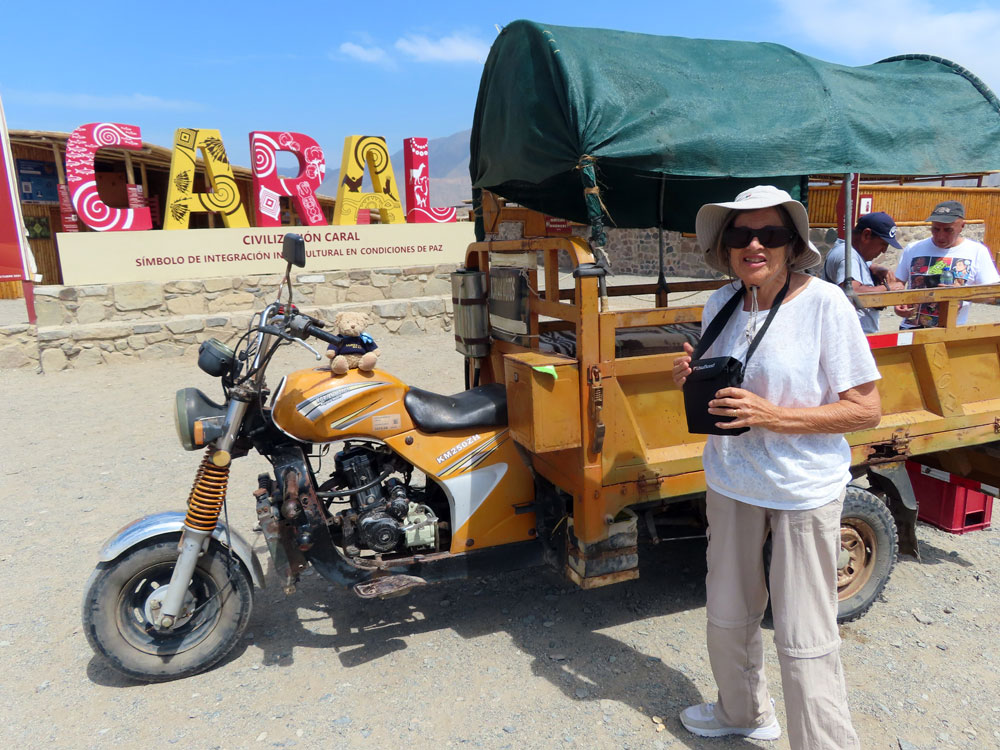
It was a little more complicated to actually get to the Caral site. Overnight rain had swelled the rivers, and the river was to wide, too deep and to fast flowing for our 4x4 to cross. Therefore a detour to get a tuk tuk which could take us over a pedestrian bridge. However no tuk tuks when we got to the pedestrian bridge. A long wait , plus enquiries from our lack lustre guide, failed to get a tuk tuk. We therefore suggested that we walk the 1.5 km to the site - off we set, and 10 minutes later found the tuk tuk, which then conveyed us along a particularly bumpy road to Caral.
It is believed to be 5,000 years old and it is considered the oldest city in the Americas and one of the oldest in the world. No other site has been found with such a diversity of monumental buildings or different ceremonial and administrative functions in the Americas as early as Caral. It has been declared a World Heritage site by UNESCO. Caral claimed to be the civilisation of people 5000 years ago the second oldest in the world after Mesopotamia. Archeological findings suggest it was a society built on commerce and pleasure. No indications of warfare, such as battlements, weapons, or mutilated bodies, have been found at Caral. In one of the Caral temples, researchers found 32 flutes made of condor and pelican bones and 37 cornets of deer and llama bones. One find revealed the remains of a baby, wrapped and buried with a necklace made of stone beads.
The date of 2600 BC for Caral is based on the carbon dating of reed and woven carrying bags that were found on site. These bags were used to carry the stones for the construction of the temples. The material is an excellent candidate for high precision dating. The site may date even earlier, however, as samples from the oldest parts of the excavation have yet to be dated. Caral had a population of approximately 3,000 people. However, 19 other sites in the area (close to Caral), allow for a possible total population of 20,000 people sharing the same culture in the Supe Valley. All of these sites share similarities with Caral, including small platforms or stone circles. The Caral culture developed between 3000BC and 1800 B.C
The ancient Peruvian city of Caral is believed to have gradually declined and been abandoned around 1800 BC, likely due to a combination of factors including environmental changes like potential earthquakes, shifts in river flow caused by sediment buildup, and possibly internal societal pressures, with no single event definitively causing its disappearance; researchers suspect climate change and the emergence of more powerful centres in surrounding areas played a significant role in its decline
We saw several temples and the pictures of bone instruments that had been found there. A Peruvian Indian guide showed us round with Dante and we tried just to follow her Spanish but she did not take prisoners. It was compulsory to have a local guide - bringing income to local people and all that.It was very hot in the baking midday sun here.
Click on thumbnail photo below to get larger photo
 |
 |
 |
 |
 |
 |
 |
 |
 |
 |
 |
 |
 |
 |
 |
 |
 |
 |
 |
 |
 |
 |
 |
 |
 |
 |
 |
 |
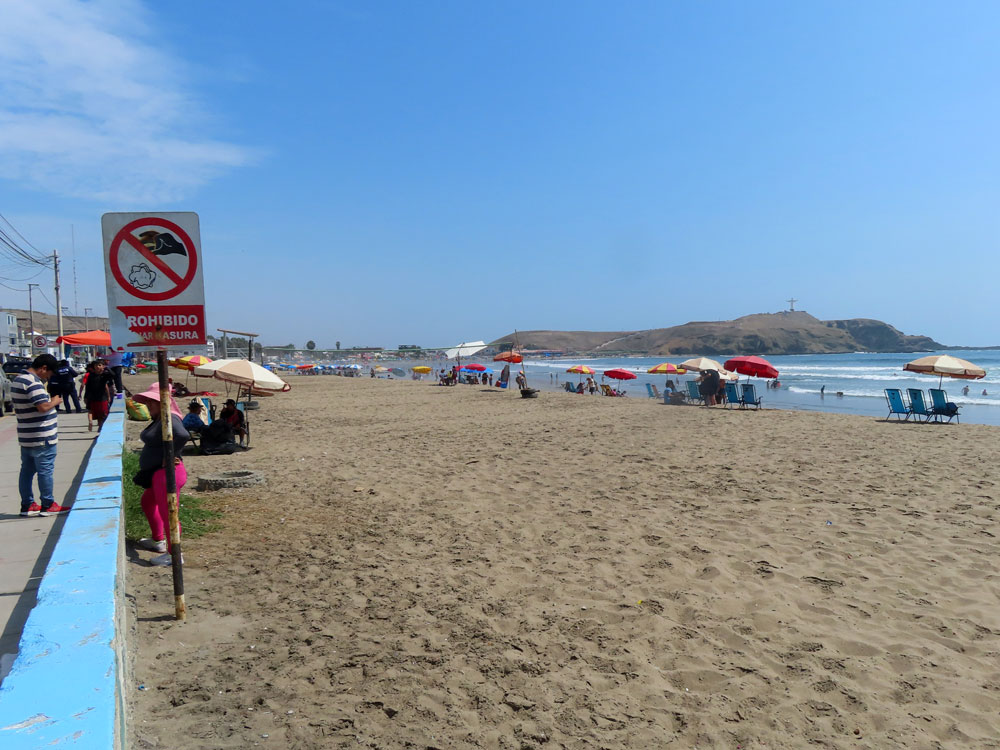
We then carried on to Barranca where we had lunch beside the sea there was plenty of surf and families were enjoying a Saturday on the beach. We had some home-made lemonade which was very enjoyable and then some steamed fish which was fine. Then we headed back inland and reached up to 4000 m before descending slightly to the town of Huaraz, Which was where both Felix and Dante lived .
Click on thumbnail photo below to get larger photo
 |
 |
 |
 |
 |
 |
 |
 |
Our hotel, Patio de Monterrey, was situated 5 km outside Huaraz. By this time it was raining quite consistently. We had to carry the suitcases down several steps to reception which was not brilliant either. We quickly sorted ourselves out in room 14 which was very damp but we thought we could cure it with the fire which David eventually managed to get going. We then had supper of broad bean soup and some spaghetti with chicken, nothing gourmet but very welcome. Returning to the room, it was still cold and I discovered that the sheets and pillows were really damp so I went to reception to ask for some hot water bottles. The night Porter, as he seemed to be to me , said they did not have hot water bottles and claimed that neither the sheets nor the towels were damp at all. But the end he did give us another electric heater for the room. So I then spent an hour or so trying to warm up each pillow each towel and get the sheets as dry as possible. We will see whether we want to stay here for the second night tomorrow morning.
Click on thumbnail photo below to get larger photo
 |
 |
 |
 |
 |
 |
 |
 |
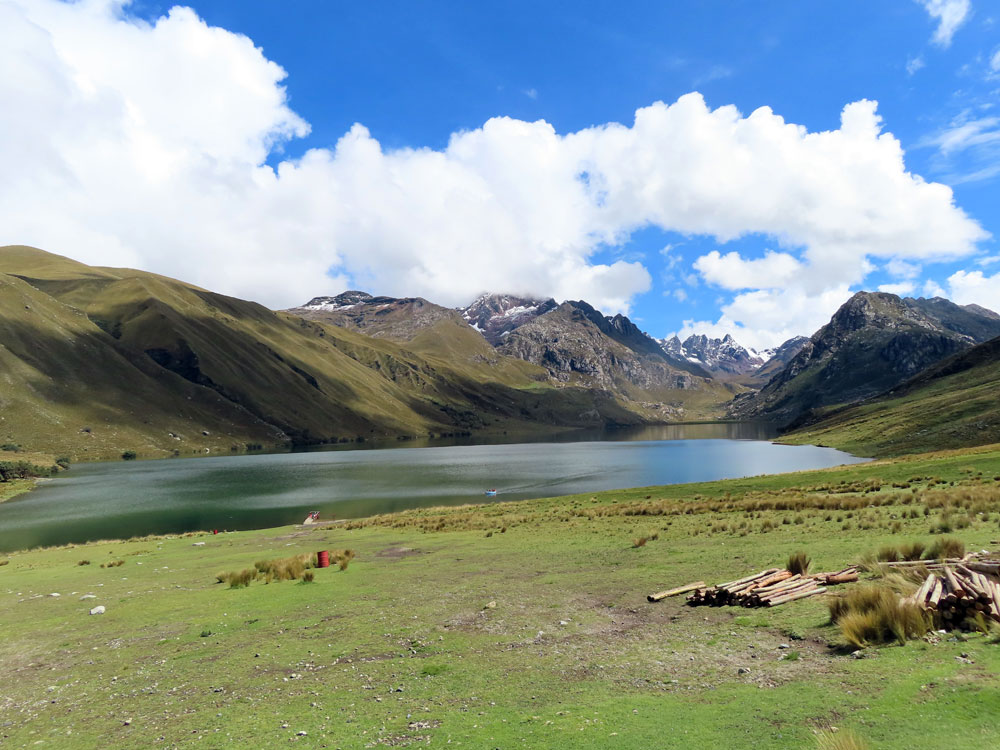
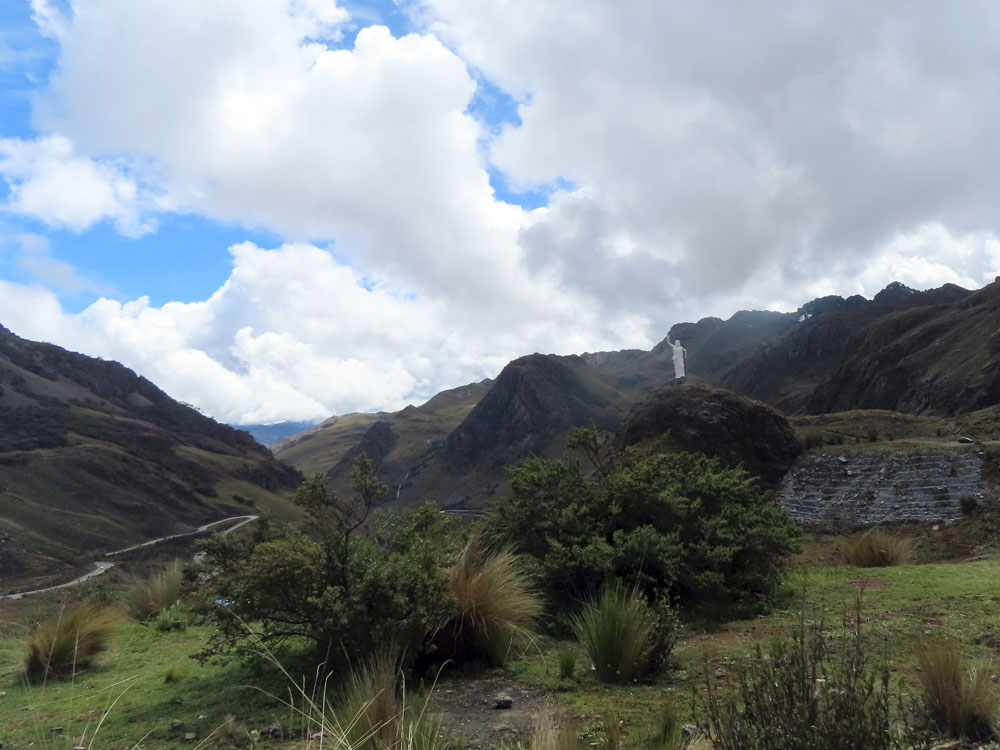
Sunday, January 5 Huaraz 27 and back. We breakfasted in the sunshine on the patio soon after 7 am and we’re off with Dante and a new driver at 8 am. We stopped in the Plaza de Alma of a small town en route where there was a spectacular plant that only flowered once in a lifetime: must ask Maria. The square was also beautifully decorated for Christmas . Then on into the mountains and an alta plana desert called Buenos Aires. We stopped at a lake for restrooms but these were non-existent and we had to wait until we got to the museum in Chavin. The scenery was quite spectacular, but I did not fully appreciate it as I had had a bad night sleep yet again probably due to altitude sickness: although the hotel was only at 3100 m During the journey we were at 4200 m but Chavin itself was back down at 3100 metres
Click on thumbnail photo below to get larger photo
 |
 |
 |
 |
 |
 |
 |
 |
 |
 |
 |
 |
We enjoyed the museum there after we had finally managed to get rid of Dante and let David read what was there a far more profitable way of finding out about the site. Dante’s command of English was proving to be less and less all the time.
Click on thumbnail photo below to get larger photo
 |
 |
 |
 |
 |
 |
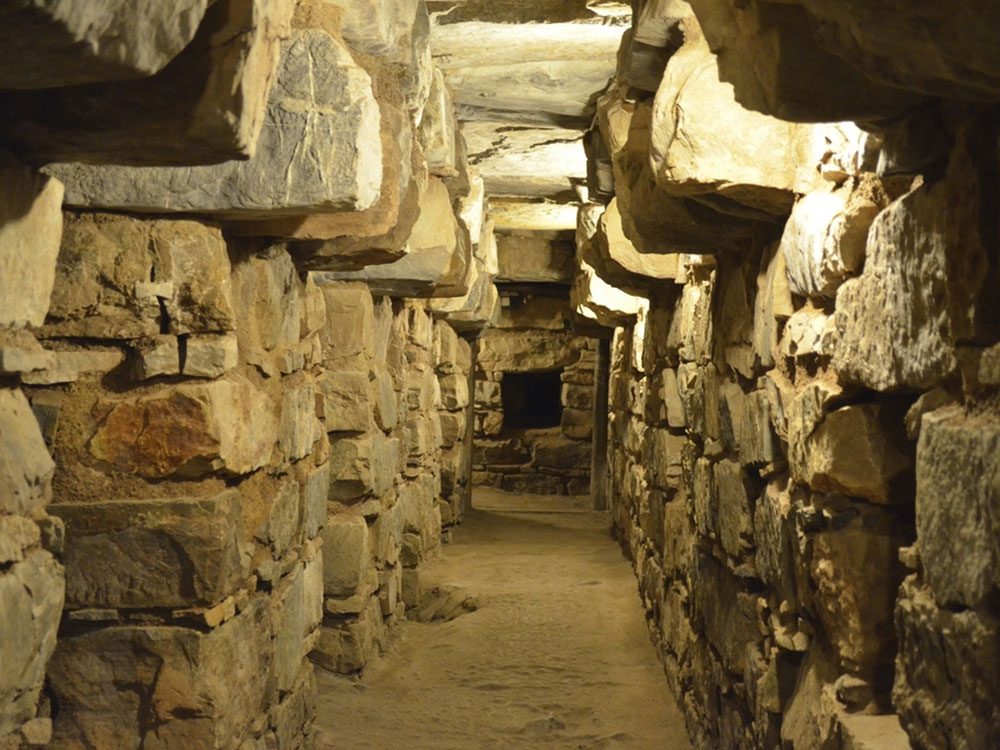
After this we went to the archaeological site walking round and seeing the various temples underwater channels. And I decided not to go down to the underground galleries and this proved to be a wise choice as they were really difficult.
Chavín de Huántar is an UNESCO World Heritage site, containing ruins and artifacts constructed as early as 1200 BC, and occupied until around 400–500 BC by the Chavín, a major pre-Inca culture. While the fairly large population was based on an agricultural economy, the city's location at the headwaters of the Marañón River, between the coast and the jungle, made it an ideal location for the dissemination and collection of both ideas and material goods. This archaeological site is a large ceremonial centre that has revealed a great deal about the Chavín culture. Chavín de Huántar served as a gathering place for people of the region to come together and worship. The transformation of the centre into a valley-dominating monument made it a pan-regional place of importance.
Findings at Chavín de Huántar indicate that social instability and upheaval began to occur between 500 and 300 BC, at the same time that the larger Chavín culture began to decline. Large ceremonial sites were abandoned, some unfinished, and were replaced by villages and agricultural land. At Chavín de Huántar, no later than 500 BC, a small village replaced the Circular Plaza. The plaza was occupied by a succession of cultural groups, and residents salvaged building stones and stone carvings to use in house walls. Multiple occupation floors indicate the village was continuously occupied through the 1940s.
Click on thumbnail photo below to get larger photo
 |
 |
 |
 |
 |
 |
 |
 |
 |
 |
 |
 |
 |
 |
 |
 |
We then went to a restaurant where I fancied just a plate of fresh fruit but this was unavailable so I just had a fizzy water and a little of David’s rice plus a few grated carrots. But after this Dante did stop at the market and buy me some bananas and tangerines. There were seriously large gangs of men painting political slogans along the roads - this sort of graffiti is ubiquitous in Peru
The roads in the area were really bad and we got back to the hotel about 5:30 pm.
Click on thumbnail photo below to get larger photo
 |
 |
 |
 |
We then had a very short wonder round the grounds of the hotel. The room was cozy and we read for a while before going over to the restaurant for a very small supper of cheese, olives and a crepe with a caramel sauce. But the best part of the meal was David’s Pisco sour. Back in the room a very nice girl came over and apologised effusively for the state of the room when we had arrived the previous day and offered us our supper as a goodwill gesture.