John Condon Grave
CWGC says of John Condon - Royal Irish Regiment 2nd Bn. Died 24 May 1915 Age 14 years old Buried or commemorated at POELCAPELLE BRITISH CEMETERY . Son of John and Mary Condon, of Waterford. Youngest known battle casualty of the war.
John is regarded by the Commonwealth War Graves Commission as being the youngest known British and Commonwealth battle casualty of the WW1 conflict.He served with the 2nd Battalion, Royal Irish Regiment - Service No: 6322.
In 1910 his family moved house to no. 2 Wheelbarrow Lane (Thomas's Avenue), Wellington Street. All the males in the family were employed as general labourers, John Jnr. being employed as a bottler in Sullivan's Bottling Stores in the city. In that year his mother, Mary and sister Kate both died from tuberculosis and John went to live with his uncle Michael Condon, a cobbler, at Keefe's Lane, off Barrack Street. He enlisted at the Waterford recruiting office on October 24th, 1913 stating his age as 18 years, although he was then only 17 years old.
He signed up in the Army Reserve for six years service. On June 14th 1914 he travelled to the Victoria Barracks, Clonmel in County Tipperary where he joined the Royal Irish Regiment, (The old 18th Regiment of Foot). He was mobilised on August 7th 1914 and posted to the 2nd Battalion on December 16th 1914. He arrived on the Western Front in March 1915, just in time for the second battle of Ypres whereat Bellevarde Ridge, he succumbed to a German gas attack
His family only discovered he was in Belgium when they were contacted by the British Army after he was reported "Missing in Action". It was not until some ten years after his death that his body was discovered by a farmer and his remains finally laid to rest. His grave has become the most visited grave in that huge cemetery with hundreds of visitors each day, despite the fact that due to recent research, there is serious doubt that it is his remains which rest in his grave. His real age at time of death is more likely to have been 18 years.
The documentary evidence suggests that John Condon was not 14 but 18 when he died. His birth certificate states that he was born on October 16th, 1896. He is listed in the 1901 census as being 4 and in 1911 as 14.
Retired Belgian schoolteacher Aurel Sercu has spent the last 13 years researching the short life of Condon and now maintains that he is not buried in grave LVI F8 in Poelcapelle cemetery.
Condon’s remains were only discovered eight years after he died. He was identified by a piece of boot which was stamped with the inscription 6322 4/RIR.The battlefield clearance team assumed the RIR stood for the Royal Irish Regiment and 6322 was Condon’s service number.
Mr Sercu believes the boot belongs to another Irish-born soldier Rifleman Patrick Fitzsimmons from Raphael Street, Belfast. He was serving with the Royal Irish Rifles and was killed at 35 years of age on June 16th, 1915, three weeks after John Condon. He too had the service number 6322. Fitzsimmons enlisted with the 4th battalion of the Royal Irish Rifles (RIR) so 6322 4/RIR would also match his service record.Condon’s remains were found 3km away from Mouse Trap Farm in Railway Wood. It would be highly unusual for the remains of an unidentified soldier to be found so far away from where he fell.Significantly, the regimental diary for the Royal Irish Rifles reveals that on June 16th, 1915, it was stationed between “Witte Poort Farm and railway”. This is where the body that is in Condon’s grave was located in 1923. In what became known as the Battle of Bellewaarde, the Royal Irish Rifles suffered more than 300 casualties in an assault on the German trenches which was met with a “terrific artillery bombardment”. Fitzsimmons died during this assault. His remains were never identified and his name is on the New Menin Gate to the missing in Ypres.
It has taken Mr Sercu until now to track down relatives of the man he believes is buried in Condon's grave. In the intervening years he wrote to every Fitzsimmons in the Belfast phone book without success until he finally tracked down a retired British soldier Kenneth Hanna based in Cheshire. He is Fitzsimmons's great-nephew.
Willie Redmond Grave
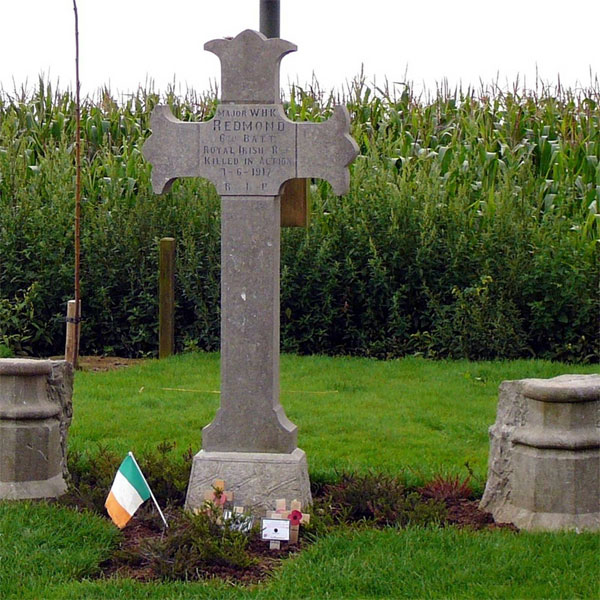
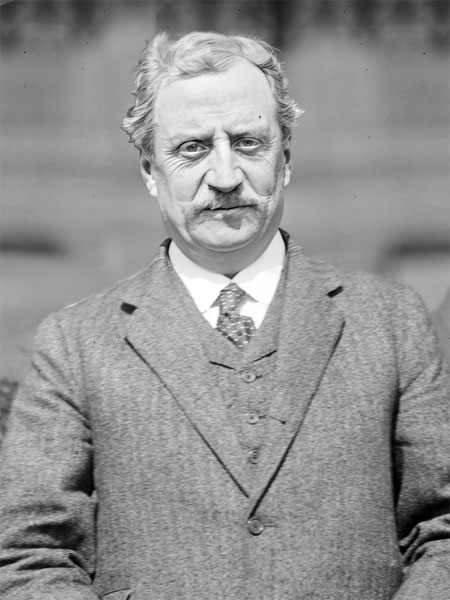
Major W H K Redmond, 6/Royal Irish Regiment. Killed in action 7 June 1916.Buried near Locre (now Loker) Hospice Cemetery. Grave: Stone cross 50m W of the Cemetery.
Although a leading Nationalist MP, he did join the British Army. Willie' Redmond, as he was always known, was commissioned as a captain in the Royal Irish Regiment, with whom he had served 33 years before, at the age of 53. He went to France with the 16th Irish Division in the winter of 1915-16 and was soon in action, winning a mention in despatches from Sir Douglas Haig. He gained his majority but this promoted him away from the action much to his displeasure and he only succeeded in returning to his beloved 'A' Company of the 6th Battalion, Royal Irish Regiment, the night before the Battle of Messines. By then he was 56 years old.
One of the nineteen mines blown on 7 June was at Macdelstede Farm immediately in front of the Royal Irish. 'A' and 'B' companies then advanced reaching the first objectives followed by the remainder of the battalion who passed through them and succeeded in taking Wyteschaete. But Major Willie Redmond, one of the first out of the trenches, had been hit almost immediately in the wrist and then, when hit in the leg, could do no more than urge his men on.
Stretcher bearers of the Ulster Division brought him in and eventually he reached the Casualty Clearing Station at the Catholic Hospice at Locre (now Loker) where he died that afternoon - almost certainly from shock.
Redmond's body was buried in a detached grave in the convent's garden outside the Locre Hospice Cemetery, on the 8 June 1917, near to where the bodies of men from his Brigade who also fell in action that day are buried. At his request, soldiers from both the 16th (Irish) Division and the 36th (Ulster) Division provided his Guard of Honour. The men of the 36th (Ulster) Division made a donation of £100 to a memorial fund for him. Later, the ground was fought over again and after the War the ruined hospice was rebuilt on a new site nearer to the village.
In October 1919 his widow Eleanor visited the grave and was pleased with how it had been kept by the Sisters. When the War Graves Commission started to concentrate burials in the area they wrote to her asking for her permission to move him. Eleanor requested that his body be left where it lay in the care of the nuns of Locre. His detached 'lonely grave' came to be emblematic in the subsequent political passage of events in Ireland in the 20th Century of the dislocation and ambiguity that the Irish nation felt for its sons who had chosen to fight in the conflict.
Wytschaete Cross
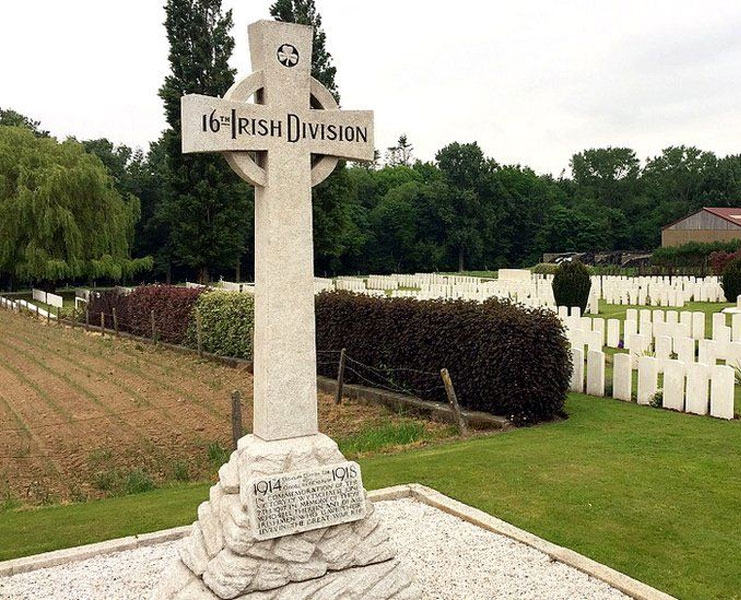
The memorial cross is situated next to the entrance to Wytschaete Military Cemetery. This is located seven kilometres south of Ieper town centre, on a road leading from the Rijselseweg N365, which connects Ieper to Wijtschate (Wytschaete) and on to Armentières. On arriving in the village turn into the main square following the signs for Kemmel. The cemetery and cross are on your right.
From an Irish point of view, the Battle for Messines (now Mesen) in June 1917 is important because for the first time the 16th (Irish) and 36th (Ulster) Divisions would fight alongside each other. The two Divisions had found themselves united within IX Corps. At 0100 hours on 7th June 1917 the British and Anzacs moved up into their jumping off positions. Two hours later everybody was warned to lie flat on the ground.
Then at 0310 hours about 450,000 kilos of explosives were detonated amongst 19 huge mines under the German front line. The effect was a man made earthquake which sent German soldiers in Lille 20 kilometres away into a panic, and was easily heard in the south east of England.
16th (Irish) Division found that their attack against Wijtschate was made relatively simple by the mine at Maedelstede Farm and the twin mines at Petit Bois, which broke any resistance. The village like Mesen had been heavily fortified by the Germans, but a heavy bombardment on 3rd June had battered the defences.
With a tank leading the way the Irishmen overran the northern side and by 0800 hours had attained their objectives. A sad loss to the Division was the death of Major Willie Redmond who was injured near Maedelstede Farm whilst advancing with the 6th Royal Irish. He continued on but was injured again in the leg and could no longer stand.
Island of Ireland Peace Park
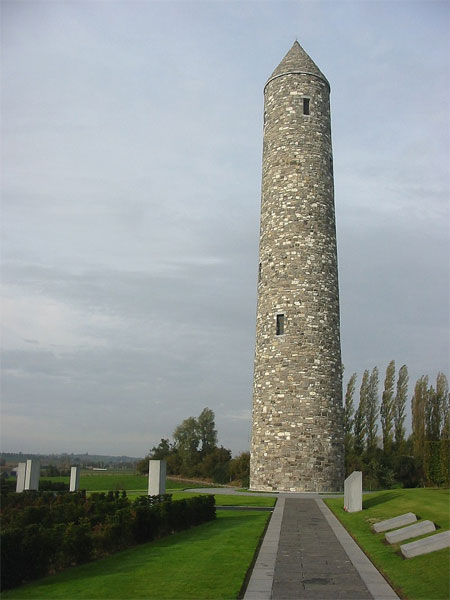
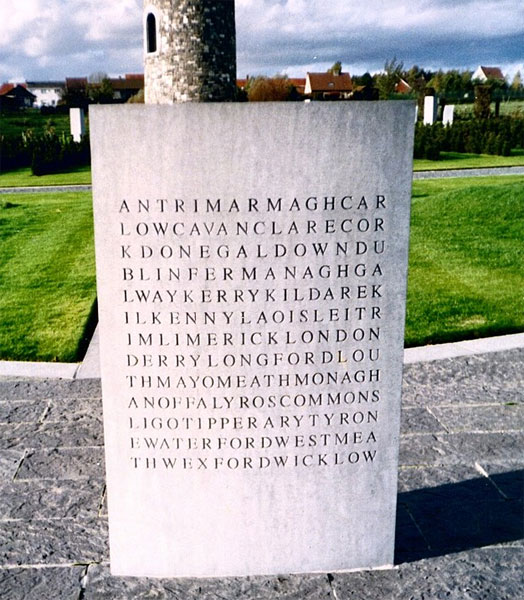
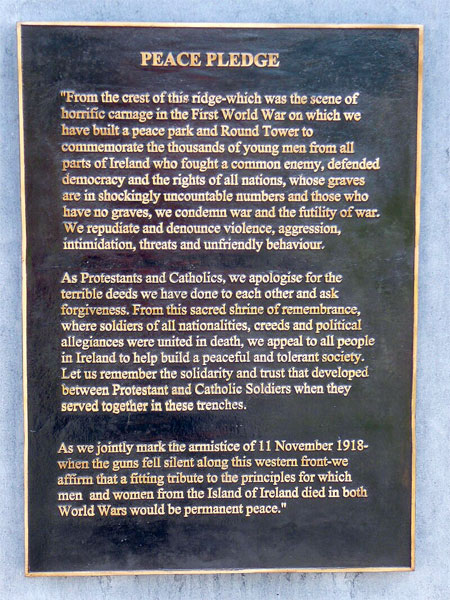
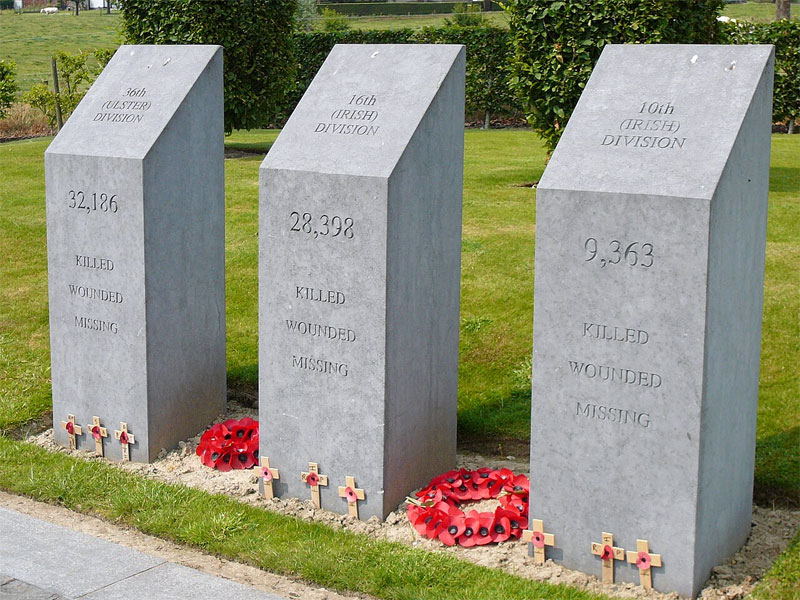
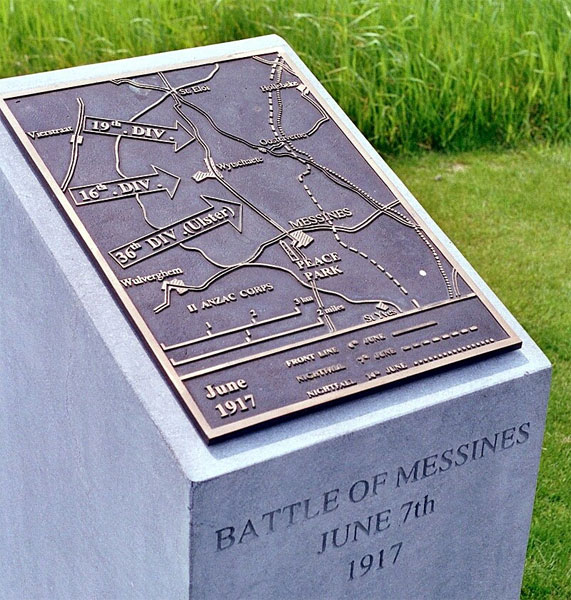
The Irish government became involved in part funding the project together with the Northern Ireland Office. Statutory and private bodies rolled in behind the project and within two years of the initiation of the JRT the Island of Ireland Peace Park and Celtic Round tower was complete. It was formally opened by the Irish President Mary McAleese who, in the presence of Queen Elizabeth of the United Kingdom and King Albert of Belgium, led the wreath-laying ceremony in the afternoon of 11 November 1998. It was the first time an Irish State officially acknowledged the soldiers from Ireland who died in WW1. This was also a seminal moment in Irish history when an Irish Head of State and a British Monarch met publicly in a joint ceremony. The Park is maintained by the Commonwealth War Graves Commission on behalf of the Office of Public Works in Ireland. Prior to the Island of Ireland Peace Park, no Irish government dignitary had ever attended any WW1 Remembrance Service either in Ireland or at the Menin Gate. At an official ceremony on 11 November 1998 the Irish President apologised on behalf of the Republic of Ireland to the families of the fallen for what she called the 'national amnesia' in remembering the soldiers of WW1 from the Island of Ireland.
Sadly, within a year of the Park’s opening, the trees and shrubs that were planted had died off and weeds began to grow. The Park looked dishevelled and forgotten. The image of growing weeds and dead trees gave people who were ideologically opposed to the project, an opportunity to vent their vengeful attack on the Trust. The overgrown image and negative publicity the Park received gave concern at a political level back in Ireland. Under an initiative taken by the then Taoiseach Mr. Bertie Ahern in April 2000, subject to certain conditions, the completion of the Park, along with the future upkeep and maintenance of the Park, would be carried out on a continuous basis by the Office of Public Works from Dublin in conjunction with their counterpart in Northern Ireland. The results of this initiative can be seen today in the splendour and beauty of this magnificent Irish monument to Peace and Reconciliation.
Mousetrap Farm
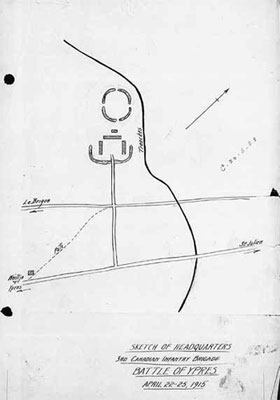
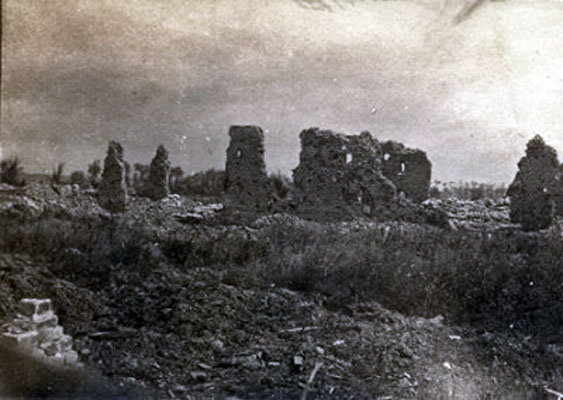
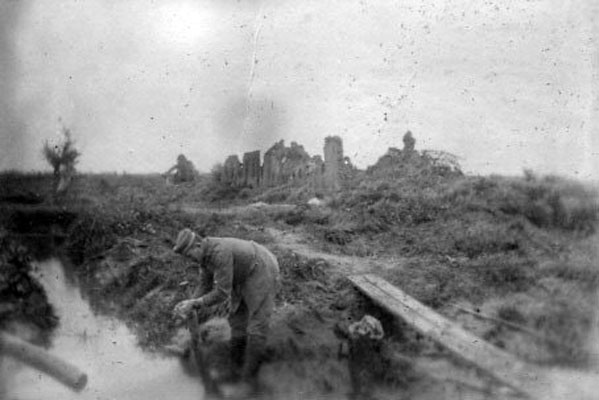
All the major battlefields of the Western Front were the sites of multiple actions during the war, and of battles-within-battles. Nowhere is this more true than in the Ypres Salient.
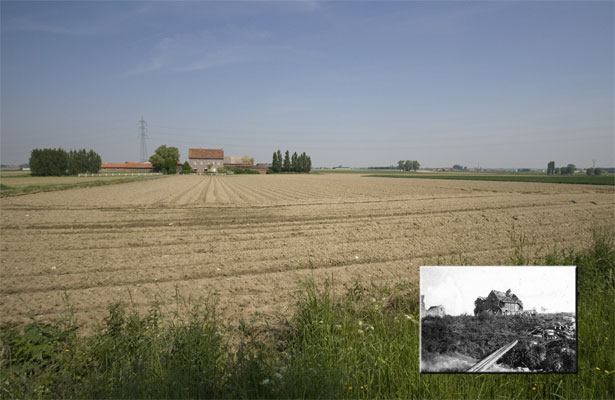
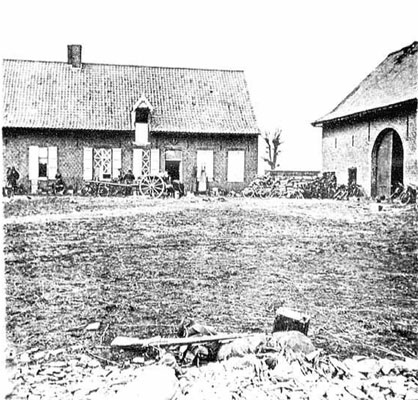
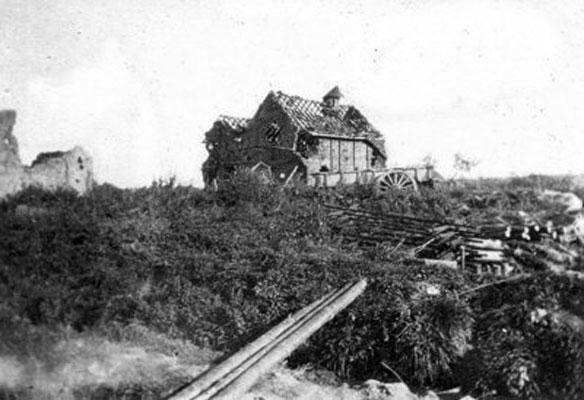
About 2.5 miles northeast of the Menin Gate lies what in 1915 was a moated farm with some outbuildings. It was first given the name "Shell Trap Farm" by the British. The unhappy associations of this designation were held to be detrimental to the garrison's morale, and the position was subsequently renamed by the staff as "Mouse Trap Farm." On the morning of 24 May 1915 what was left of the farm after earlier bombardments ("a mere heap of mud and rubbish") was defended by the 2nd Battalion of the Royal Dublin Fusiliers. (In the previous month's fighting Mouse Trap Farm had provided a location for the 3rd Canadian Brigade's headquarters, which was shelled and burned down on the afternoon of 25 April 1915.)
At 2:45 a.m. on 24 May, the Germans launched an attack on the Allied lines that involved the greatest use of chlorine gas to date, this time delivered with shells. The German gas came "drifting down wind in a solid bank some three miles in length and forty feet in depth, bleaching the grass, blighting the trees and leaving a broad scar of destruction behind it." Being a mere 30 yards from the enemy trenches the rapid occupation of the farm by the quick-moving German infantry was little short of inevitable.
The Dublins quickly lost their commanding officer, Lieut Col Arthur Loveband, from Naas, Co Kildare, who was shot through the heart. The situation for the RDF grew ever more desperate. One officer sent out the message “For God’s sake send some help, we are nearly done”. No help was forthcoming. The only surviving officer, Capt Leahy, recalled that the men “died fighting at their post”. At the end of the day all that was left was one officer and 21 other ranks out of a total complement of 658 officers and men. Rarely in that terrible war had a single battalion suffered such a wipeout.
The battalion did not take part in any more major battles for the rest of the year. Engraved on the Menin Gate Memorial are the names of 461 Royal Dublin Fusiliers killed during the Battles of Ypres. Of those names 143 belong to Dublin Fusiliers belonging to the 2nd Battalion who died on the 24th of May 1915.
Mouse Trap Farm was rebuilt after the war. It is now a pig farm. From its long laneway you can see the twin spires of the Cloth Hall and the cathedral at Ypres. It was so near and yet so far for the Germans. Ypres became the British Verdun. It would not be taken at any cost even if that cost turned out to be nearly 200,000 British and Irish lives.
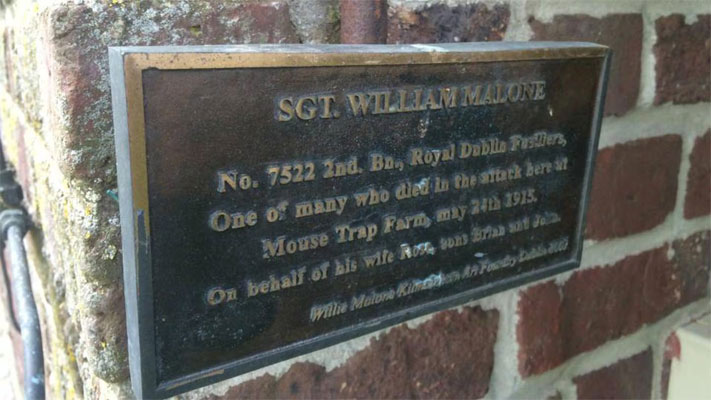
On the gable wall of the farm are two plaques. One, recently put there, remembers Pte William Byrne (19) from Blackrock, Co Dublin, who died on May 24th. The other is a bronze plaque to Sgt William Malone (36) from the South Circular Road. It was put there 10 years ago by his grandson, a bronze sculptor also called William Malone. Sgt Malone was a brother of Lieut Michael Malone, the republican hero of Mount Street Bridge. During Easter Week 1916 he inflicted terrible casualties on the Sherwood Foresters from a house in Northumberland Road before being killed.
In less than a year two brothers from the same family died; one fighting for the British, another fighting against them – the complications and contradictions of Irish history laid bare in a single grieving family.
Ledwidge Memorial
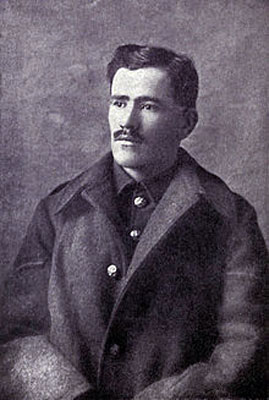
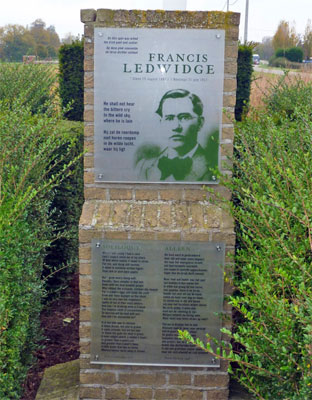
Despite having sided with the faction of the Irish Volunteers which opposed participation in the war, and the opposition of Lord Dunsany, he enlisted in the Royal Inniskilling Fusiliers in October 1914, and continued to write poetry on campaign, sending work to Dunsany and to family and other friends. Having been posted to several theatres of the war, he was killed in action in July 1917 during the early phase of the Battle of Passchendaele. At the time of his death, he and Dunsany were in advanced preparation for a second volume of his work, and Dunsany later arranged for a third volume, and a collected edition of 122 poems in 1919.
Ledwidge seems to have fitted into Army life well, and rapidly achieved promotion to lance corporal. In 1915, he saw action in the Landing at Suvla Bay during the Gallipoli Campaign, where he suffered severe rheumatism. Having survived huge losses sustained by his company, Ledwidge became ill after a back injury gained during the Battle of Kosturino in Serbia (December 1915), a locale which inspired a number of poems.
Ledwidge was dismayed by the news of the Easter Rising, and was court-martialled and demoted for overstaying his furlough and being drunk in uniform (May 1916). He gained and lost stripes over a period in Derry (he was a corporal when the introduction to his first book was written), and then, returned to the front, received back his lance corporal's stripe one last time in January 1917 when posted to the Western Front, joining 1st Battalion, Royal Inniskilling Fusiliers, part of 29th Division. Bust of Ledwidge in Richmond Barracks. Ledwidge continued to write when feasible throughout the war years, though he lost many works, for example, in atrocious weather in Serbia. He sent much of his output to Lord Dunsany, himself moving on war assignments, as well as to readers among family, friends and literary contacts. The poems Ledwidge wrote on active service reveal his pride at being a soldier, as he believed, in the service of Ireland. He often wondered whether he would find a soldier's death.
On 31 July 1917, a group from Ledwidge's battalion of the Royal Inniskilling Fusiliers were road-laying in preparation for an assault during the earliest stages of the Third Battle of Ypres (July to November 1917), near the village of Boezinge, northwest of Ypres. According to Alice Curtayne, "Ledwidge and his comrades had been toiling since the early morning at road-making. The army's first need was men; their second, guns; their third roads. These latter consisted mainly of heavy beech planks bolted together, which could be rapidly laid down. Survivors concur in placing the road work done by B Company that day one mile north-east of Hell Fire Corner, so called because it was very exposed to German shelling. There was a violent rainstorm in the afternoon, shrouding the region in a gray monochrome. Sullenly, the enemy's long-range guns continued to fling their shells far behind the lines. Road-work could not be suspended, however, as the tracks were in use as fast as they were laid down. Tea was issued to the men and, drenched to the skin, they stopped to swallow it. A shell exploded beside Ledwidge and he was instantly killed."
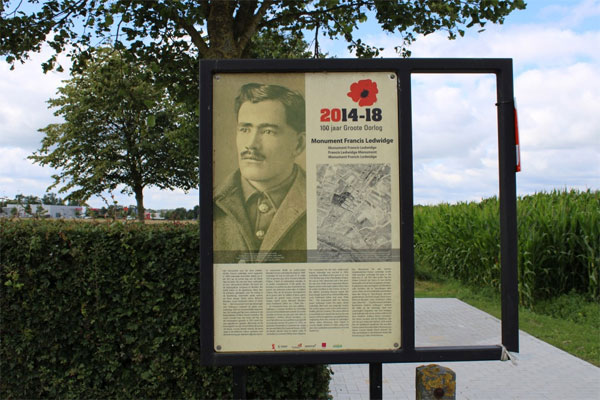
On the 81st anniversary of his death in 1998 a simple non-militaristic monument was unveiled by the poet's nephew, Joe Ledwidge, and the writer Dermot Bolger, on the exact spot where he was killed - the location having been unearthed by Piet Chielens, the director of the In Flanders Fields Museum. The monument consists of a portrait of Ledwidge on glass over yellow Ieper brick, with the text of his poem "Soliloquy" printed in English and in Dutch
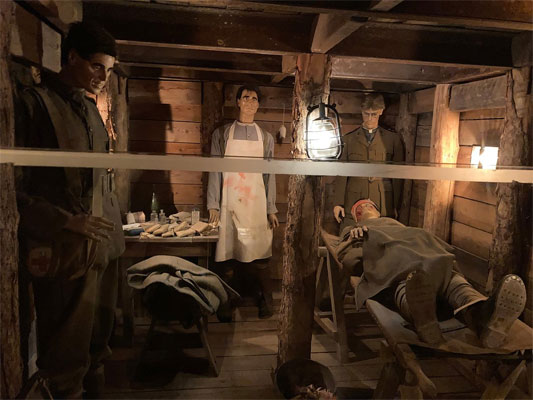
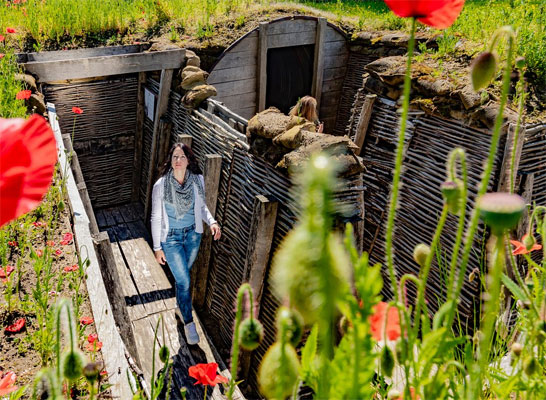
Discover and experience the story of the First World War and the Battle of Passchendaele in the interactive design of the Passchendaele Museum. Descend into the dugout (underground shelter) and explore the reconstructed British and German trenches.