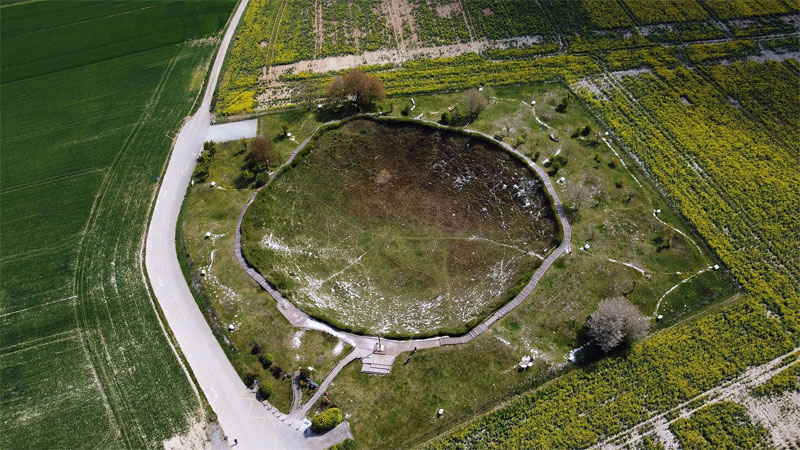
The Lochnagar Crater was created by a large mine detonated beneath the German front line by the British Army’s 179th Tunnelling Company Royal Engineers, at 7:28am on July 1st, 1916. The explosion marked the beginning of the Battle of the Somme and was the largest of 19 mines, placed beneath the German front line to assist the British infantry advance. It is the largest man-made mine crater from the First World War on the Western Front.
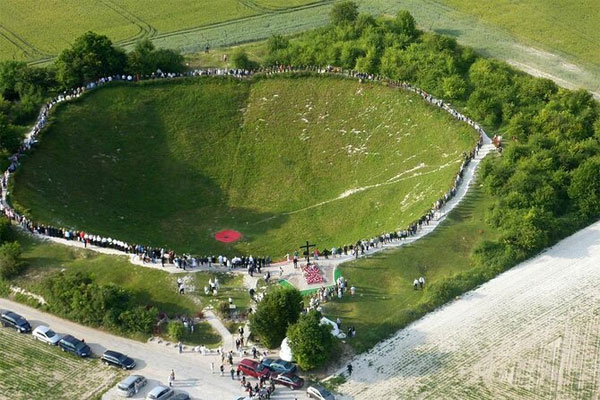
Lochnagar is now privately owned and you can visit this enormous crater quite easily from the village of La Boisselle. Simply follow the signs for: La Grande Mine. There are a number of small memorials around the edge of the crater and the large cross at its entrance is made from church timber that originated on the Tyne.When it exploded the mine created a hole almost 30 metres deep and a 100 metres across with debris being thrown a kilometre into the sky. Each year at 0730 hours on the 1st July the Friends of Lochnagar hold a service of remembrance up at the cross.
The tunnel
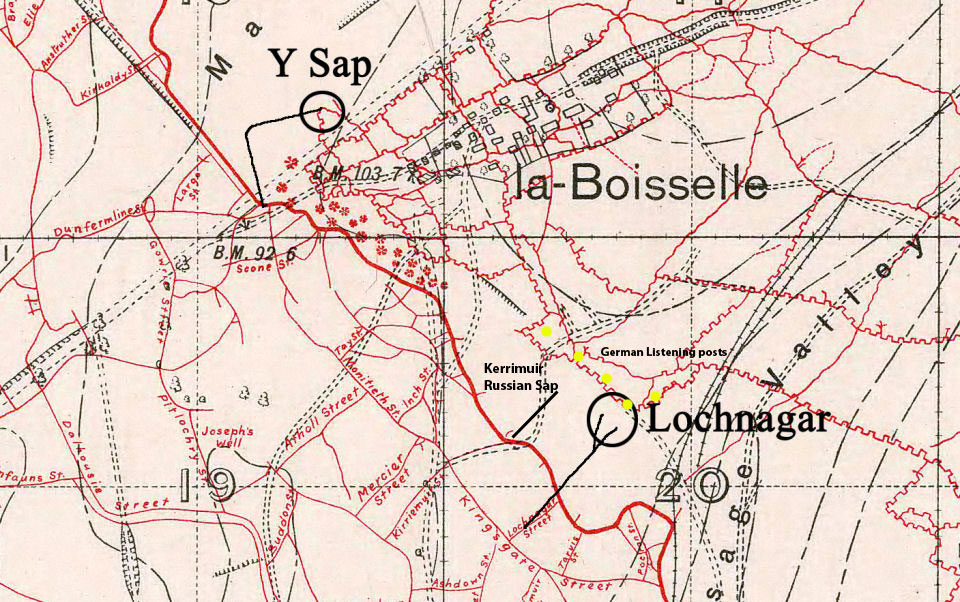
The tunnel for the Lochnagar mine was started on 11th November 1915 by 185 Tunnelling Company, but was completed by 179 Tunnelling Company who took over in March 1916. The shaft for the Lochnagar mine was sunk in the communication trench called Lochnagar Street. It was probably the first deep incline shaft, meaning that it was not sunk vertically but sloped down with an incline of between 1:2 and 1:3, to a depth of some 95 feet . It was begun some 300 feet behind the British front line and 900 feet from the German front line.
The British took over the Somme area from the French during July and August 1915. On 24 July, 174 Tunnelling Company moved to the Somme front and established headquarters at Bray, taking over some 66 shafts at Carnoy, Fricourt, Maricourt and La Boisselle. Prior to the takeover, La Boisselle had been the scene of much mining activity and underground fighting. No-mans-land just south west of La Boisselle was very narrow, at one point no more than about 50 yards , and had become pockmarked by many chalk craters. The French and German forces were constantly mining and countermining, and the area became known as the Glory Hole.
Nothing changed when the British took over, the underground war continued with offensive mining designed to destroy enemy strong points, and defensive mining to destroy enemy tunnels. Depths of tunnels ranged from 30 feet down to the deepest at 120 feet . Around La Boisselle the Germans had dug defensive transversal tunnels at a depth of about 80 feet , parallel to the front line.
Tunnelling was a dangerous business, each side doing its best to detect and destroy enemy tunnels. On 4 February 1916, two officers and 16 men were killed, either being burnt or gassed when the Germans detonated a camouflet (a small explosive charge big enough to destroy enemy workings but not big enough to break the surface). Captain Richardson wanted to test the then very new listening device, the Geophone to see how accurate it was in pinpointing the direction from which sounds of enemy mining were coming. He had a three level mine system starting from Inch Street, La Boisselle, the deepest being just above the water level at around 100 feet. Lieutenant Edward Lyall went to the deepest level and made deliberate noises, whilst Captain Richardson and Second Lieutenant Arthur Latham went into the middle level to see if they could use the Geophone to ascertain the direction from which Lieutenant Lyall’s noise was coming from. It was during this experiment that the Germans blew the large and unexpected camouflet that killed the 18 men.




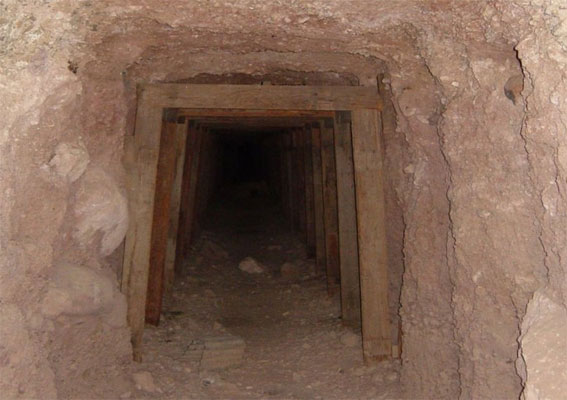

The Y Sap mine reached its target beneath the German position, at the cost of sacrificing quiet working, but progress at Lochnagar was so slow that time was running out. When the 4th Army Operation Order was issued on 14th June, neither of the two Lochnagar branches tunnels had reached beneath the German line, both were well over a hundred feet short. Hance stopped driving the two tunnels forward and began cutting out chambers to contain explosives. To compensate, he would have to ‘overcharge’ the mines with far more explosive than was needed simply to form a crater, in order to throw the maximum amount of debris over the German trenches: rather than blow the defenders skywards, they would bury them alive. The overcharging would also to throw up high lips of debris which might form a barrier to prevent the Germans firing from the flanks, especially from the village of La Boisselle across no man’s land, and also create high ground from which the attackers could gain observation and fire over the Germans. But this depended on the attackers reaching the high lips before the Germans and previous experience showed that the Germans were faster than the British at capturing crater lips, even when taken by surprise.
The timing of the mines blown on 1st July 1916 became controversial when that at Beaumont Hamel was detonated ten minutes before Zero. This fatal error gave the Germans the perfect warning that the attack had finally come. At La Boisselle where initially the Lochnagar mine was ordered to be fired at one minute before Zero and the Y Sap Mine at Zero. Within a few days orders were amended so that Lochnagar was to be blown two minutes before Zero, then both mines were to be blown at this time In reality the Germans knew of the attack and its timing. he German Moritz eavesdroppers warned of the imminent attack, enabled the Germans to vacate the underground shelters near Y Sap in time and shoot down the infantry of the fourth brigade column.
This was probably prompted by caution over the attackers being injured by falling debris and the danger of a slight delay in the mines firing. Two minutes were in fact more than adequate for the debris to fall but it required precise coordination of the firing of the mine and the advance by the infantry. The infantry were eager to get across no man’s land as soon as their barrage moved on to the next line of defences, before the Germans could open fire, but the mining officer in the trenches had to fire the mine exactly to synchronise with the artillery barrage and the infantry attack.
For the 1 July 1916 attack two large mines were planned, one to the north of La Boisselle (Y Sap) and one to the south (Lochnagar). Both were ‘overcharged’ which means that more explosive was used than was necessary to just break the surface, so large rims were formed from the disturbed ground. The tunnel for the Y sap mine started in the British front line near where it crossed the Albert to Bapume road, but because of German underground defences it could not be dug in a straight line. About 500 yards (457 metres) were dug into no-mans-land before it turned right for about another 500 yards (457 metres). Some 40,000 lbs (18,144 kilograms) of ammonal (high explosive) was placed in the chamber beneath Y sap. In addition to the two large mines, the Glory hole was also attacked with two smaller charges of 8,000 lbs (3,628 kilograms) each, designed to wreck German tunnels. Communication tunnels were also dug for use immediately after the first attack, but were little used. To try to ensure that the enemy did not find out about them, a high level of secrecy was maintained about their existence. So secret that Incredibly the attacking infantry did not know about them. An exception to this was the Russian sap from Kerriemuir Street which was eventually connected to Lochnagar Crater and the German front line. For some time this was the only means of crossing Sausage Valley. A battalion of the 19th Division and the 9th Chrshires passed through it, and it was used to evacuate the wounded.
The Lochnagar mine hurled up 84,000 tonnes of earth and chalk and left a crater 220 feet across and 55 feet deep.[40] The debris buried 600 feet of the German front line and the Baden infantry in the dugouts had no chance: some were instantly fragmented, some hurled into the air, crushed, or would die slowly trapped 30 feet underground. At Y Sap the mine completely destroyed the German advanced position, leaving a high-lipped crater 130 feet wide but, having detected the British digging beneath them, the Germans had withdrawn back to their front line and suffered no casualties.
Apart from around the Lochnagar mine and in places south of the Schwabenhöhe, the deep German dugouts had withstood the British bombardment. The mine explosions and the lifting of the British barrage alerted the Baden infantrymen that the long-expected attack had arrived. The survivors emerged from dugouts with machine guns and rifles to open fire on the rows of soldiers advancing in orderly lines through the long grass and sweeping down the slopes behind in columns. Within two minutes of setting out, the leading attackers were struck by the German machine gun and rifle fire. Many of the Grimsby Chums and 11th Suffolks were hit before they had even passed their own front line, having been pulled back to avoid the Lochnagar mine debris. The pace of the advance was carefully regulated to keep behind the protective British barrage but as the men at the front faltered, those following caught up and the bunched men formed perfect targets. Within ten minutes eighty percent of the leading battalions were hit. The losses suffered by the 34th Division attacking at La Boisselle were the worst of any on the 1st July 1916. However, the Lochnagar mine successfully destroyed a section of the German front line. The destruction enabled the attackers to penetrate the German front line and advance beyond it until, counterattacked, they were forced back to the area of the crater.
The Kerriemuir Russian Sap was intended to allow the re-supply of the captured front line in just such an eventuality. By the night before Zero, the 179th was supposed to have prepared the tunnel with just two feet of cover left before it broke the surface, three-quarters of the way across no man’s land. The final work of opening it immediately the mines were blown was the task of a platoon of the 18th Northumberland Fusiliers Pioneers under Lieutenant John Nixon. On the evening of 30th June, however, Nixon was shocked to learn that his men would have to dig through twelve feet of chalk to open the tunnel, a full day’s work. They therefore began the task at midnight and managed to open the Kerriemuir tunnel an hour after Zero, and it was used later in the afternoon to feed men through to reinforce the captured German line in the Schwabenhöhe (it was not, as was claimed later, connected to the Lochnagar mine crater). Y Sap crater was filled in during the 1970s,
The number of visitors to this site has increased dramatically in recent times, reaching approximately 200,000 people now visiting each year.