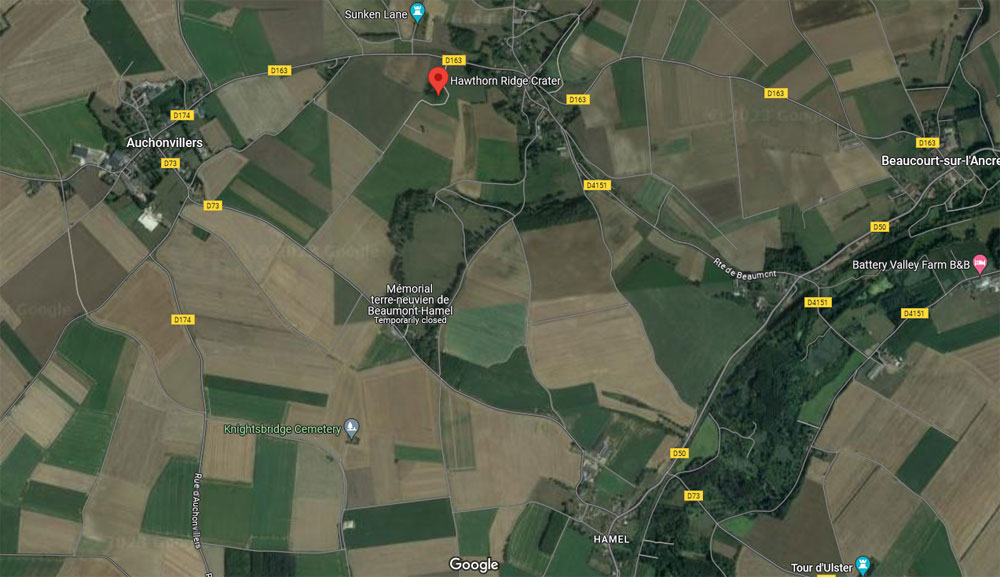
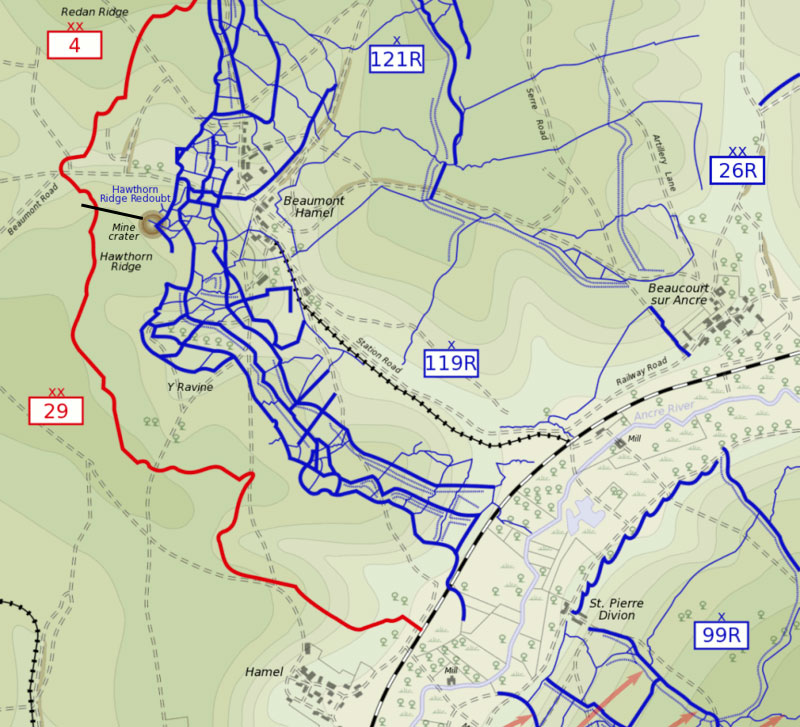


There are two craters on Hawthorn Ridge. The larger one, closer to the road is that of 1st July 1916 while the small one to the South West is that of 13th November 1916
The Great War came to the area of Beaumont Hamel with the arrival of the German XIV Reserve Corps in October 1914. Units of the French 10th Army managed to halt the advancing German troops by 4th October, but by that point Beaumont and its related village, Hamel had been lost. Both sides dug in and the line stabilised in this area and was to be the same when the Battle of the Somme began on 1st July 1916.
At 07.20, Lt Geoffrey Malins, one of the two official film makers, managed to record the only explosion of a British mine, and his footage has been used in countless documentaries. The main attack on the crater was made by 2/Royal Fusiliers, 86 Brigade, 29 Division. It would prove a complete failure. Within days the old H3 gallery was re-opened and a new tunnel driven from the point where it was too crushed to use. By the end of October the new chamber, 61 metres south of the original mine was charged. The attack staged by the 51st Highland Division took place on the 13th November. This time the mine was blown at 5.45. It was before dawn and in thick fog so no filming was possible. This explosion was a success and collapsed the southen side of the existing crater
As the second mine was smaller but slightly deeper the crater has steeper sides than the original one and its force swept a large segment of the eastern side of the position away creating a roughly triangular shaped feature that we see today. Within days the Battle of the Somme was over and the ridge remained in British hands until it was recaptured by the Germans in April 1918.