
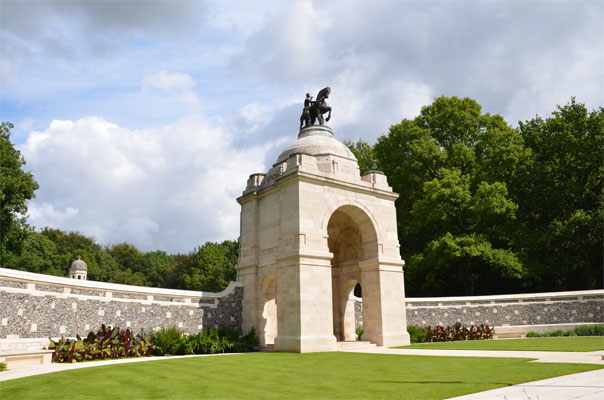


A World War I memorial, located in Delville Wood, near Longueval. It is opposite the Delville Wood Commonwealth War Graves Commission Cemetery, on the other side of the Longueval–Ginchy road. Visitors are required to park and walk to the memorial and museum in Delville Wood. There is a large, free designated car park within a few minutes' walk of the memorial and museum.
The memorial was designed by Sir Herbert Baker, with a sculpture by Alfred Turner. It consists of a flint and stone screen either side of an archway, with a shelter at each end of the screen. On top of the arch is Turner's bronze statue of two men and a war horse. The two male figures, symbolising Castor and Pollux, represent the two white races of South Africa (British and Afrikaans). The main inscriptions are in both English and Afrikaans. Other inscriptions include the location of the South African campaigns (France, Flanders, West Africa, Central Africa, East Africa, Egypt, Palestine, the Sea).
The memorial at Delville Wood is a national memorial dedicated to all South Africans who served in all theatres of war. It is the only memorial dedicated to the participation of the South African Forces on the 1914-1918 Western Front. 229,000 officers and men served with the South African Forces in the Great War. Their casualties who died in action or who died of wounds numbered approximately 10,000. All those who died in the service of the Union of South Africa are named in a book held at the Delville Wood Museum next to the memorial. This memorial does not bear the inscribed names of South Africans missing in action on the Western Front. The names of the missing South Africans are included on memorials to the missing of the United Kingdom.
On 15 July 1916, the S.A. Infantry Brigade under Major-General H.T. Lukin was ordered to clear the wood at d'Elville, north-east of the village of Longueal, France, of enemy soldiers, thereby covering the flanks of the British Brigade. The South Africans occupied the wood on that day, but the problem was not so much to take the wood, than to hold it. Despite fierce counterattacks and artillery bombardments from German divisions, the SA brigade refused to surrender. The brigade was relieved on 20 July after six days and five nights of ferocious fighting. Only 750 soldiers remained of the Brigade's 3 433 soldiers, the rest had either been killed or wounded. Black people were also involved in this battle as unarmed combatants and non-military personnel. The Battle of Delville Wood went down in the history of WWI as an example of supreme sacrifice and heroism and remained the most costly action the South African Brigade fought on the Western Front. A memorial site was erected in remembrance of those who died in the Battle and was unveiled by the widow of General Louis Botha on 10 October 1926. 146 000 Whites volunteered for service in WW1, while altogether 83 000 Blacks and 2 000 Coloureds did service in non-combatant capacity.
The battle for Delville Wood was costly for both sides and the 9th (Scottish) Division had 7,517 casualties from 1 to 20 July, of which the 1st (South African) Infantry Brigade lost 2,536 men. From 11 to 27 July the 3rd Division had 6,102 casualties. The 5th Division lost c. 5,620 casualties from 19 July to 2 August and the 17th Division had 1,573 casualties from 1 to 13 August.[56] The 8th Division lost 2,726 casualties from 14 to 21 July. The 14th Division lost 3,615 casualties and the 33rd Division lost 3,846 men in August and from the end of August to 5 September, the 24th Division had c. 2,000 casualties. Details of German losses are incomplete, particularly for Prussian divisions, due to the loss of records to Allied bombing in the Second World War. From 15 to 27 July the 7th and 8th divisions of IV Corps held the line from Delville Wood to Bazentin le Petit and suffered 9,494 casualties. The 5th Division was not relieved from Delville Wood until 3 August and lost c. 5,000 casualties, a greater loss than at Verdun in May. Infantry Regiment 26, which had been at full strength on 13 July was reduced 260 men on 20 July.[90] The British official historian, Wilfrid Miles, wrote that many German divisions returned from a period on the Somme having suffered more than c. 4,500 casualties. Bavarian Infantry Regiment 5 of the 4th Bavarian Division recorded "the loss of many good, irreplaceable men"