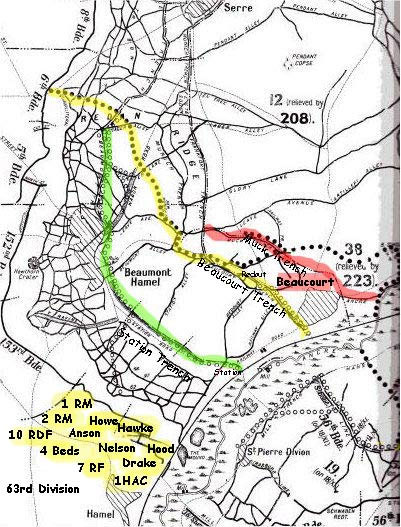

On 19 November troops of the 19th Division defeated a German counter-attack at the west end of Grandcourt. Another defensive position was dug from the Ancre to Battery Alley 500 yd (460 m) away from the Grandcourt line, from which the British retired, as they were overlooked from the south end of the Grandcourt line, where it was still held by the Germans. Puisieux trench was abandoned, when the 19th Division was withdrawn from Grandcourt that night. The Battle of the Somme lasted from 1 July to 18 November on the British reckoning. In the southern sector, the Fourth Army ended operations on 16 November and on the French sector, the final action took place on 14–15 November in St Pierre Vaast Wood. On 22 November, part of the 96th Brigade tried to rescue infantry of the 16th Battalion, Highland Light Infantry, who were trapped in Frankfort Trench south of the Soden Redoubt; the effort failed and the survivors surrendered.
Battle of Ancre- 10th Royal Dublin Fusiliers

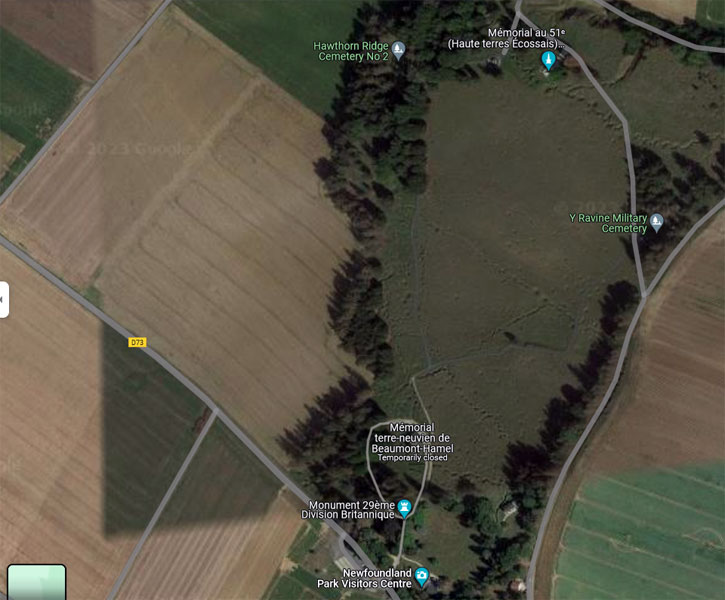
The Newfoundland Memorial Park, which encompasses an area of the opposing front lines of 1 July 1916. Trench systems, part of which can be walked; memorials to 29th Division, 51st(Highland) Division and Newfoundland memorial to the missing; several cemeteries within the enclosed grounds; visitor centre with toilets. Today, there aren’t many places where the ground has been undisturbed since the end of the First World War. However, the Newfoundland Memorial Park is one of those, and one of the largest areas on the Western Front where shell-holes and the trenches of both sides can still be clearly seen and even entered and walked along
When you arrive at this memorial, go straight to the visitor center and ask for the tour. Highly recommended! It is free 45 minute tour where you are guided by one of the many guides who are all students from Newfoundland, Canada. The tour takes you through the original preserved trenches of the allies, explanations of the memorials and the story of how the Newfoundland Regiment fought in the war. Our guide pointed out the exact trenches of where both allied and enemy trenches were in the landscape, allowing you to truly understand the distance of no mans land in the middle.


And the 10th RDF at the Ancre
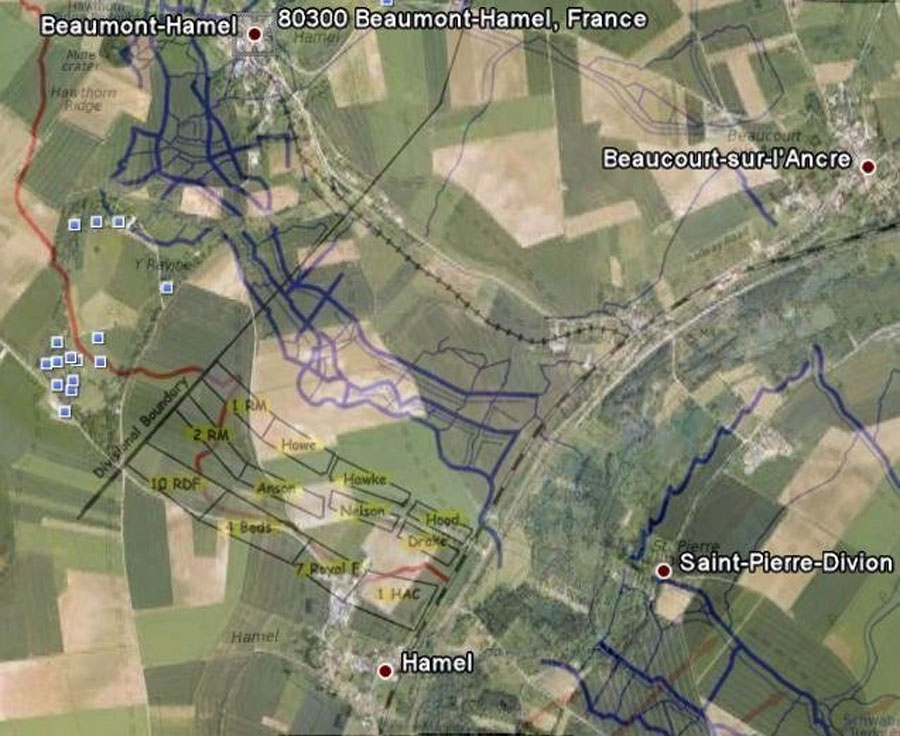
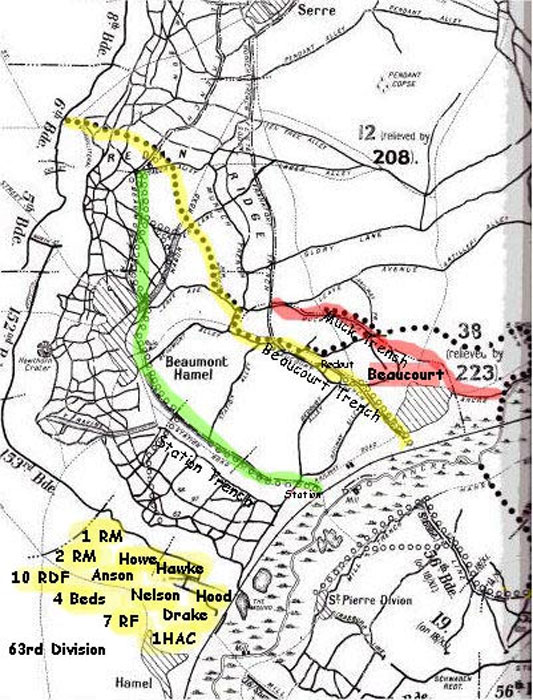

My grandfathers account
In the Battle of the Somme my battalion went over with the Division in the big attack at Beaumont Hamel, which was supported by other divisions. For days the battle front was subject to heavy artillery fire from both sides . The Division as a whole moved into the frontline the night before the attack, which was due between 4 and 5 a.m. The order was given to advance. I was in command of the bombing section on the right of the battalion. The enemy apparently anticipated the attack, as immediately we crossed into no man’s land we came under heavy fire, which lost us time to get to the wire entanglements on the Bosch line. Our army brought heavy fire to bear on the German line and its rear. After some hours of severe fighting the German trenches were taken and the enemy forced back for some fifteen miles.
We took over the former German line, and around 6 p.m. I received orders to go to Headquarters and report the position. I found the General and his staff. He offered me a whisky, which I took. I also asked him for a drink for my runner, which he gave him. We had had neither food nor drink since early morning, so the whisky had some effect. I then left to rejoin the battalion. We were in such a good mood that we sat for a short time amid the shambles of the wounded, and watched the Jerries giving a shell dump some miles away a terrible artillery pounding. They got their target and the explosion together with the blowing up of a tunnel created such a scene as to remind me of the old fashioned pictures depicting the “last day on earth”. On reporting back to my regiment, I received further orders to take a party of 30 men from several regiments in the Division (units in the big attack had got mixed up with other regiments) to go to the village of Hamel where I would find a staff party, and receive further instructions. I (here a page is missing, his writing stops like this in mid flow - there is no mention of his movements in the War Diary for that day)
His official record says that he was wounded on 13th November 1916, and was suffering from "neurasthenia". It states that "he was buried in a shell hole, but was contributed to by being under shell fire in the course of his duties as bombing officer and also by septis resulting from injuries received from barbed wire in September or Oct 1916 at Mailly-Maillet" (probably 8th Oct 1916). 5 officers and 76 men from 10th Royal Dublin Fusiliers were killed in action on that date.
He had leave in Ireland and married during it, returned to France
After our wedding on 15th January 1917, which was on the 2nd day of my leave from France, I only had 5 days leave unexpired before I had to return to France. We spent a couple of days in the Royal Hotel, Kingston, then crossed to London for 2 days before I crossed back to France. On eventually getting back to my battalion in France, my Commanding Officer sent for me. When I entered the Orderly Room, he inquired in an irate way what I meant by overstaying my leave, and proceeded to give me a ticking off. On producing my authority for extended leave, he cooled down and dismissed me. I had proceeded a short way from the Orderly Room when I heard the CO calling my name. He came up and asked me how I had managed to get the extended leave. When he heard, he laughed and told me that he had tried to get extended leave when last in London, and had been turned down. So all was well.
My regiment was by then on a march back to the lines, and I was ordered to take over command of B Company. We rejoined the 63rd Division on the Somme and went into the attack, during which I received a bullet wound and further injury from the explosion of a shell. I was wounded in early 1917 3 weeks after my return to France in the attack on part of Bapaume.(this is the only reference I can find in his writings to when he was wounded. He must have returned to the line about 21st January. The Battalion reentered the line in the support trenches at Beaucourt on 27th January 1917. His official record shows he was hospitalised on 28th January 1917. A letter he later wrote to the War Office states the "I continued in the discharge of my duties until 28th January, when my health completely broke down owing to the hardship and the heavy shelling we were subjected to while in the line. I was sent to hospital on that date.")
The 10th War Diary does not mention him. He was later on 7 Mar 1917 struck off the strength of the battalion as "sick"
27 Jan Argueves the battalion marched out of billets and proceeded via Lealvillers,Varenne, Hedauville, Bouzincourt, and Aveloy Wood to the support line of the Beaucourt Sector, arriving at 6pm and taking over from the Nelson Battalion. The relief was accomplished with out any incident of importance.
28 Jan Beaucourt Support Line 9.30am to 3pm intermittent shelling. HE and shrapnel (hostile) at new work at Redoubt Trench. Q12D70.. 17 whizbangs fell in the valley and bank Q10 B7.8. Situation very quiet all day. Map ref Trench Map 57D.
29 Jan Beaucourt Support Line Situation very quiet. Isolated shells fell at intervals throughout the day near our positions at Q12 D7.8. Casualty wounded in acton 1OR Casualty amendment - 1 OR previously reported wounded, now reported wounded and missing