
Fascinating museum about Mons at war - and there's been a lot of battles centred on Mons over the centuries! The town as been attacked and rebuilt again and again. The museum does not just focus on World War I - it's a much wider story. Lots of interesting exhibits. Well worth a visit.
In front of the museum and next to the museum there is parking.


Casteau First Shot Memorial

The first shot memorial was designed by a Mons architect and was unveiled on 20 August 1939, just ahead of the 25th anniversary of the action. This was just two weeks before Britain and France declared war on Germany, at the start of the Second World War. The memorial lay neglected for many years, discoloured by the exhaust fumes of passing traffic, but has since been restored. A commemoration ceremony at the memorial was held on the 100th anniversary of the action.
It marks the first British engagement on the Western Front of the First World War. The monument stands near to the start of a charge made by elements of C Squadron of the 4th (Royal Irish) Dragoon Guards, commanded by Captain Charles Beck Hornby, against cavalry scouts from the German 9th Cavalry Division on 22 August 1914. A number of Germans were sabred and captured before the unit came under fire from a larger German force. The British dismounted and returned fire, with Drummer Edward Thomas firing the first shot by British troops on this front of the war, before withdrawing.
Thomas saw the man fall to the ground but did not know if he had hit him. Being outnumbered the British withdrew, having suffered one man lightly wounded, two horses killed and one wounded. Several German soldiers were taken prisoner, some of whom were wounded and received treatment from the Dragoon Guards' medical officer. The records of the 4th Cuirassiers note losing three men captured, one missing (who rejoined the regiment later that day), no wounded or killed and one horse grazed. The action was a prelude to the following day's Battle of Mons which led to the Great Retreat of the British forces to new defensive positions along the Marne.
Although it was the first shot fired on the Western Front, British forces elsewhere in the world had already opened fire on German forces. By the time the first British shot was fired Belgium had been almost totally overrun and the French and Belgian armies engaged for some days and had suffered in excess of 300,000 casualties.
The action is commemorated by a stone-built monument with a bronze plaque in Casteau. The monument names Thomas and Hornby and commemorates both the first shot and the preceding charge. The memorial stands some 2 kilometres from the location of Thomas's shot but is close to the starting point for Hornby's charge. The commune of Mons, in which the memorial stands, stated that it was sited here for ease of maintenance, though the real reason may have been to provide a juxtaposition with a plaque marking the furthest advance by British Commonwealth forces in this sector in 1918. The plaque, which is mounted to the wall of a restaurant opposite the first shot memorial, marks the furthest advance by picquets of the Canadian 116th Infantry Battalion at the time of the 11 am, 11 November 1918 armistice.
Nimy Bridge Plaque
 |
 |
 |
Commemorative plaque along the towpath to the railway bridge at Nimy, with the following inscription:
«To the glorious memory of the Officers, NCO and men of the 4th BN Royal Fusiliers who held this sector of the British Front in the defence of the town of Mons. August 23/8/14. This memorial marks the M.G. position where the first V.C.’s awarded during the war 14-18 were gained by Lt M.J. DEASE and Pte S.F. GODLEY».
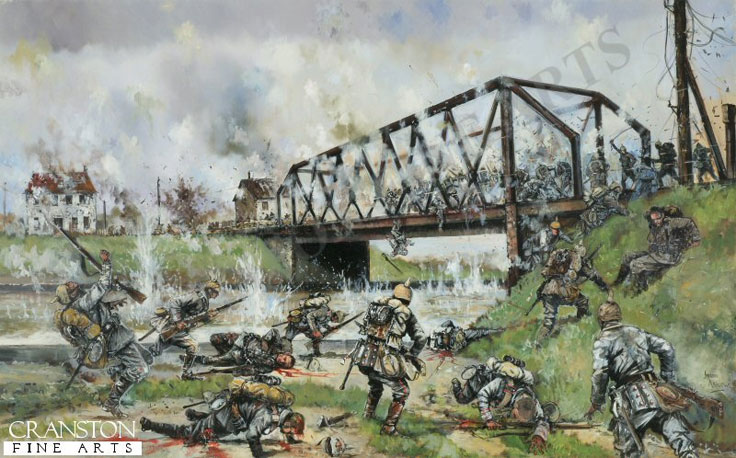
On 23 August 1914, the Mons salient, formed by the canal around the city, was a week point in the British defences during the Battle of Mons. It was here that the first two British heroes of the Great War would emerge.
At the Nimy rail bridge, Lieutenant Maurice James Dease and Private Sidney Frank Godley of the 4th Battalion The Royal Fusiliers fought with exemplary courage. They were both members of a machine-gun company that was ordered to cover the retreat of their battalion during the afternoon of 23 August 1914. Although wounded, Lieutenant Dease maintained fire as his comrades were killed around him. He was finally evacuated from the battlefield and died of his wounds. Private Godley, the last remaining soldiers, took over the machine gun and maintained fire until he was seriously wounded, whereupon he summoned his last reserves of strength and dismantled the weapon, throwing its parts into the canal so that they would not fall into the hands of the enemy, before being taken prisoner.
Both were awarded the Victoria Cross, Dease posthumously, whereas Godley survived the War. They ware the first soldiers to be awarded the VC in the First World War. Their bravery is commemorated by a plaque unveiled on 9 April 1939. Maurice Dease is buried at Saint-Symphorien military cemetery.
DEASE, Maurice James. Lieutenant 4th Battalion. Royal Fusiliers. . London Gazetted on 16th November, 1914.
Born on 28th September, 1889 at Coole, County West Meath, Ireland. Died on 23rd August, 1914 at Mons, Belgium. (killed in action)
Memorial at St Synmphorien Military Cemetery, Belgium. Mentioned on a plaque on Nimy Bridge, Belgium and also in Westminster Cathedral.
Citation reads:
On 23rd August 1914 at Mons, Belgium, Nimy Bridge was being defended by a single company of Royal Fusiliers and a machine gun section with Lieutenant Dease in command. The gunfire was intense, and the casualties were heavy, but the lieutenant went on firing in spite of his wounds, until he was hit for the 5th time and was carried away to a place of safety where he Died on. A private* of the same Battalion who had been assisting the Lieutenant while he was still able to operate the guns, took over, and alone he used the gun to such a good effect that he covered the retreat of his comrades.
Irish Lancers Plaque


Mons main square. In the porch of the town hall, you will find two bronze plaques. One is dedicated to the 5th Royal Irish Lancers who took part in the two battles for Mons in 1914 and in 1918 (during the fighting for liberation). The other plaque is dedicated to the 3rd Canadian Division that took part in the fighting of November. Grand Place 23-25 (Porche de l'Hôtel de Ville)
5th Lancers became part of the British Expeditionary Force, sailing from Dublin to France as part of the 3rd Cavalry Brigade in the 2nd Cavalry Division in August 1914 for service on the Western Front. It saw action during the Battle of Mons in August 1914.During the Battle of Cambrai in November 1917 George William Burdett Clare received the Victoria Cross posthumously. The 5th (Royal Irish) Lancers also has the grim honour of being the regiment of the last British soldier to die in the Great War. This was Private George Edwin Ellison from Leeds, who was killed by a sniper as the regiment advanced into Mons a short time before the armistice came into effect
The Royal Irish Lancers were in Mons at the time of retreat in 1914 but escaped and returned on Armistice Day. The panel records the return welcomed by the Maire and the Curé. The scene is taken from a painting, “5th Lancers, Re-entry into Mons”, last heard of in the private collection of a Belgian citizen. This in turn is almost a mirror image of a painting “5th Lancers, Retreat from Mons” (whereabouts unknown). In the former, the troopers are heading in the opposite direction to the “Retreat”, and a middle-aged priest and a pregnant woman watching the departure of the regiment among a worried-looking crowd of Belgian citizens have subtly changed: the priest is now white-haired and the mother holds up her four-year-old child, having lived through the occupation of the German forces in Mons for four years
Celtic Cross at La Bascule, Mons


The following inscription is to be found at the base of the Celtic Cross that is a memorial to the Royal Irish Regiment in Mons, Belgium, and commemorates the fighting that took place there on 23rd August 1914: "To the Glory of God and to the memory of the officers and men of the Royal Irish Regiment (18th Foot) who fell during the Great War 1914-1918. Near this spot the 2nd Battalion commenced operations on 23rd August 1914 and finished on 11th November 1918 after being decimated on four occasions."
The British soldiers got into position at the crossroads as far as the Barthelemy suburb. The ground provided good shelter from rifle fire, but was swept by howitzers and machine-guns. A section of artillery, placed to the left of the batallion, tried valiantly to counter the fire of the German artillery, but drew such a deluge of shells that it was forced to withdraw. Here too, then, the position was becoming untenable. The batallion regrouped and started to retreat. The 2nd Royal Irish went down the rue Leon Save, apart from B Company which withdrew through a wood behind the hospital. The 4th Middlesex then retired in turn. The losses of the 4th Middlesex reaached 15 officers and 467 other ranks.
Following the British retreat to the cemetery, the Germans reconstituted their front, with a redeployment from the approach to Mons as far as the Bascule. They wanted to seize the crossroads and so cut the retreat of the British forces. They poured across fields and followed the chemin des Mourdreux. Sergeant FITZPATRICK, who was Regimental Quarter-Master Sergeant, had been ordered by Lieutenant R.E.G. PHILIPPS, around 1230 hours to stay put and await orders. At that time, the regiment was at the Segard public-house (now a banking complex) where he had just been served with a beer. FITZPATRICK began to prepare to eat with his men. When he saw that his batallion was in trouble and that some men were starting to retreat, he got together 40 men, a mixture of cooks, batmen, storemen, drivers, etc. and manned the trenches on the other side of the crossroads. He impressed upon his men not to open fire until the enemy were less than 200 yards away.
When the German infantry appeared, they were received with sustained fire. After two conventional mass attacks, the Germans changed their tactics. They attacked in penny-packets in loose order. About 3 pm, Major SIMPSON (of the 2nd Gordon Highlanders) whose defences were to the right, arrived at the Bascule. He was astonished to find so few men at such an important point. He came back shortly with a dozen men. Sadly, Major SIMPSON was wounded, but was able to leave the scene on his horse. During a lull, FITZPATRICK, accompanied by volunteers, fetched an abandoned and damaged machine-gun together with some boxes of ammunition. Sergeant REDMONT managed to repair the weapon, something that considerable assisted their defence. There were already 11 dead among the Irish and three among the Gordons. The Germans bombarded the sector and the shells reached the houses. Some civilians who had taken shelter in the cellars were killed. The Germans tried one more charge, but REDMONT’s machine- gun made ominous gaps in their ranks. The fighting moved towards the positions of the Gordon Highlanders and the Royal Scots. FITZPATRICK and the others who survived were able to get some rest.
Night fell at last. The losses were 15 dead and four gravely wounded. A memorial in the form of a Celtic cross was put up at this crossroads in 1923, being inaugurated on 11 November by Lord FRENCH, the Earl of Ypres, to commemorate the participation of the Irish unit and its glorious defence of this place. Opposite this memorial, on the other side of the highway, was unveiled on 23 August 1986 a monument dedicated to the two battles of Mons. Initially in the castle park, not far from the belfry, this monument was put up in 1952, being inaugurated by Field-Marshal Lord Alexander of Tunis.