Butrint has been city and a bishopric. Following a period of prosperity under Byzantine administration, then a brief occupation by the Venetians, the city was abandoned in the late Middle Ages after marshes formed in the area. The present archaeological site is a repository of ruins representing each period in the city’s development.
Butrint is in the south of Albania approximately 20km from the modern city of Saranda, has a special atmosphere created by a combination of archaeology, monuments and nature in the Mediterranean. With its hinterland it constitutes an exceptional cultural landscape, which has developed organically over many centuries. Butrint has escaped aggressive development of the type that has reduced the heritage value of most historic landscapes in the Mediterranean region. It constitutes a very rare combination of archaeology and nature. The property is a microcosm of Mediterranean history, with occupation dating from 50 000 BC, at its earliest evidence, up to the 19th century AD. Prehistoric sites have been identified within the nucleus of Butrint, the small hill surrounded by the waters of Lake Butrint and Vivari Channel, as well as in its wider territory.
From 800 BC until the arrival of the Romans, Butrint was influenced by Greek culture, bearing elements of a “polis” and being settled by Chaonian tribes. In 44 BC Butrint became a Roman colony and expanded considerably on reclaimed marshland, primarily to the south across the Vivari Channel, where an aqueduct was built. In the 5th century AD Butrint became an Episcopal centre; it was fortified and substantial early Christian structures were built. After a period of abandonment, Butrint was reconstructed under Byzantine control in the 9th century. Butrint and its territory came under Angevin and then Venetian control in the 14th century. Several attacks by despots of Epirus and then later by Ottomans led to the strengthening and extension of the defensive works of Butrint. At the beginning of the 19th century, a new fortress was added to the defensive system of Butrint at the mouth of the Vivari Channel. It was built by Ali Pasha, an Albanian Ottoman ruler who controlled Butrint and the area until its final abandonment.
The fortifications bear testimony to the different stages of their construction from the time of the Greek colony until the Middle Ages. The most interesting ancient Greek monument is the theatre which is fairly well preserved. The major ruin from the paleo-Christian era is the baptistery, an ancient Roman monument adapted to the cultural needs of Christianity. Its floor has a beautiful mosaic decoration. The paleo-Christian basilica was rebuilt in the 9th century and the ruins are sufficiently well preserved to permit analysis of the structure (three naves with a transept and an exterior polygonal apse).
Albania since WW2
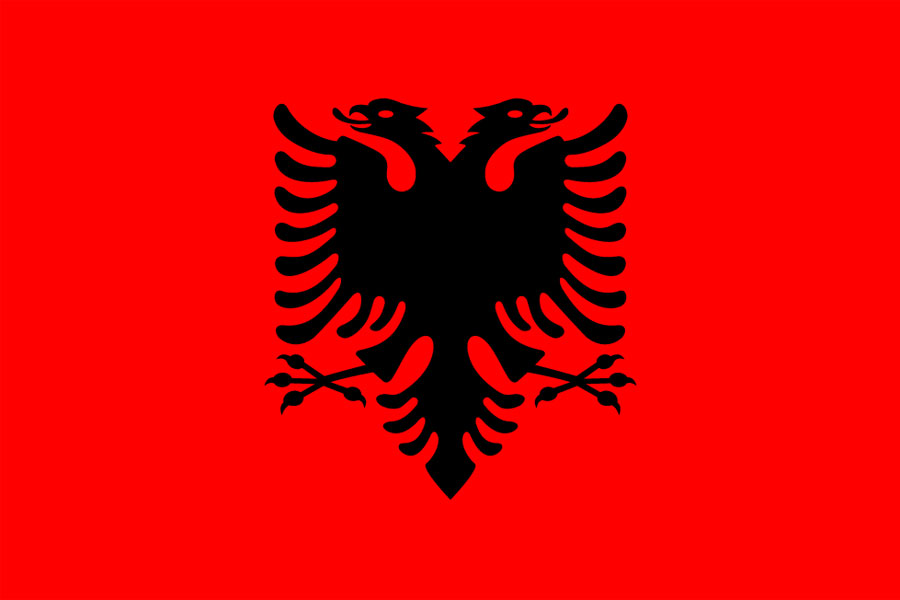
In the aftermath of World War II and the defeat of the Axis Powers, the country became initially a satellite state of the Soviet Union, and Enver Hoxha emerged as the leader of the newly established People's Republic of Albania. Soviet-Albanian relations began to deteriorate after Stalin's death in 1953. At this point, the country started to develop foreign relations with other communist countries, among others with the People's Republic of China. During this period, the country experienced an increasing industrialisation and urbanisation, a rapid collectivisation and economic growth which led to a higher standard of living. The new land reform laws were passed granting ownership of the land to the workers and peasants who tilled it. Agriculture became cooperative, and production increased significantly, leading to the country becoming agriculturally self-sufficient.

In 1946 there was the Corfu Channel incident, The incident consists of three separate events involving Royal Navy ships in the Channel of Corfu which took place in 1946, and it is considered an early episode of the Cold War. During the first incident, Royal Navy ships came under fire from Albanian fortifications.The second incident involved Royal Navy ships striking mines; and the third occurred when the Royal Navy conducted mine-clearing operations in the Corfu Channel, but in Albanian territorial waters, and Albania complained about them to the United Nations. The final incident occurred in October 1946 when Britain decided to raise the stakes. A flotilla was ordered to sail through the channel to assert the right to free passage through, and to test the Albanian reaction. The Albanians regarded it as a provocation. On the 22nd October the flotilla, consisting of two cruisers, HMS Mauritius and HMS Leander, and two destroyers, the Saumarez and HMS Volage, began their journey through. Unknown to them a few days earlier the Yugoslavian navy, following a request from Albania, had laid mines in Albanian waters. At 3 p.m., close to the Bay of Saranda, the Saumarez struck a mine, blowing her bow off, and killing over thirty men.
.This series of incidents led to the Corfu Channel case, where the United Kingdom brought a case against the People's Republic of Albania to the International Court of Justice.The Court rendered a decision under which Albania was to pay £844,000 to the United Kingdom. This is equivalent to £31.7 million in 2015 terms.. Because of the incidents, Britain, in 1946, broke off talks with Albania aimed at establishing diplomatic relations between the two countries. Diplomatic relations were only restored in 1991.
Albania incurred large debts initially with Yugoslavia until 1948, then the Soviet Union until 1961 and China from the middle of the 1950s The constitution of the communist regime did not allow taxes on individuals, instead, taxes were imposed on cooperatives and other organisations, with much the same effect. After hundreds of mosques and dozens of Islamic libraries containing priceless manuscripts were destroyed, Hoxha proclaimed Albania the world's first atheist state in 1967. The churches had not been spared either and many were converted into cultural centres for young people. A 1967 law banned all fascist, religious, and antisocialist activity and propaganda. Preaching religion carried a three to ten-year prison sentence.

Hoxha ran the country from 1944 until his death in 1985. During his 41-year rule, his government rebuilt the country, which was left in ruins after World War II, building Albania's first railway line, raising the adult literacy rate from 5–15% to more than 90%, wiping out epidemics, electrifying the country and leading Albania towards agricultural independence. At the same time, Hoxha's Albania was a police state. His government outlawed travelling abroad and private proprietorship. It declared itself an atheist state, and closed or converted to secular uses all of Albania's religious facilities. His government imprisoned, executed, or exiled thousands of landowners, rural clan leaders, Muslim and Christian clerics, peasants who resisted collectivization, and disloyal party officials. Hoxha's government was characterised by his proclaimed firm adherence to anti-revisionist Marxism–Leninism, i.e. Stalinism, from the mid/late-1960s onwards. After his break with Maoism in the 1976–1978 period, numerous Maoist parties around the world declared themselves Hoxhaist. The International Conference of Marxist–Leninist Parties and Organisations (Unity & Struggle) is the best-known association of these parties.
After enduring four decades of communism paired with the revolutions of 1989, Albania witnessed a notable rise in political activism, particularly among the students, which ultimately lead to a transformation in the prevailing order. Subsequent to the attainment of widespread in the first multi-party elections of 1991, the communist party maintained a stronghold in the parliament until their defeat in the parliamentary elections of 1992 directed by the Democratic Party.
Considerable economic and financial resources were devoted to pyramid schemes that were widely supported by the government. The schemes swept up somewhere between one sixth and one third of the population of the country.[106][107] Despite the warnings of the International Monetary Fund, Sali Berisha defended the schemes as large investment firms, leading more people to redirect their remittances and sell their homes and cattle for cash to deposit in the schemes. The schemes began to collapse in late 1996, leading many of the investors to join initially peaceful protests against the government, requesting their money back. The protests turned violent in February 1997 as government forces responded by firing on the demonstrators. In March, the Police and Republican Guard deserted, leaving their armouries open. These were promptly emptied by militias and criminal gangs. The resulting civil war caused a wave of evacuations of foreign nationals and refugees.
The crisis led both Aleksandër Meksi and Sali Berisha to resign from office in the wake of the general election. In April 1997, Operation Alba, a UN peacekeeping force led by Italy, entered the country with two goals exclusively to assist with the evacuation of expatriates and to secure the ground for international organisations. The main international organisation that was involved was the Western European Union's multinational Albanian Police element, which worked with the government to restructure the judicial system and simultaneously the Albanian police.
Albania is currently a member of NATO, and is an official candidate for EU membership
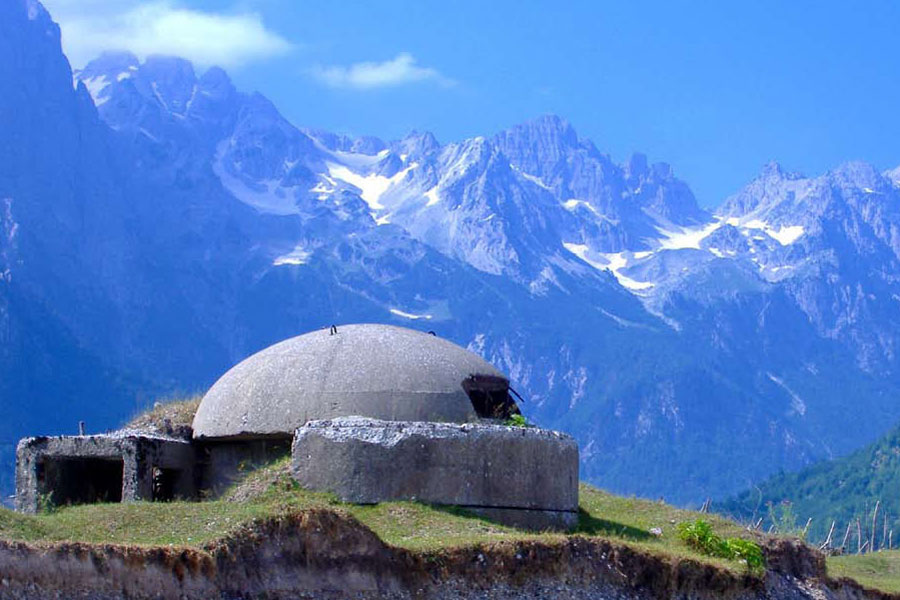
Bunkers. An odd legacy of the communist era are Bunkers - By 1983, approximately 173,371 concrete bunkers were scattered across the country.
May 18th.
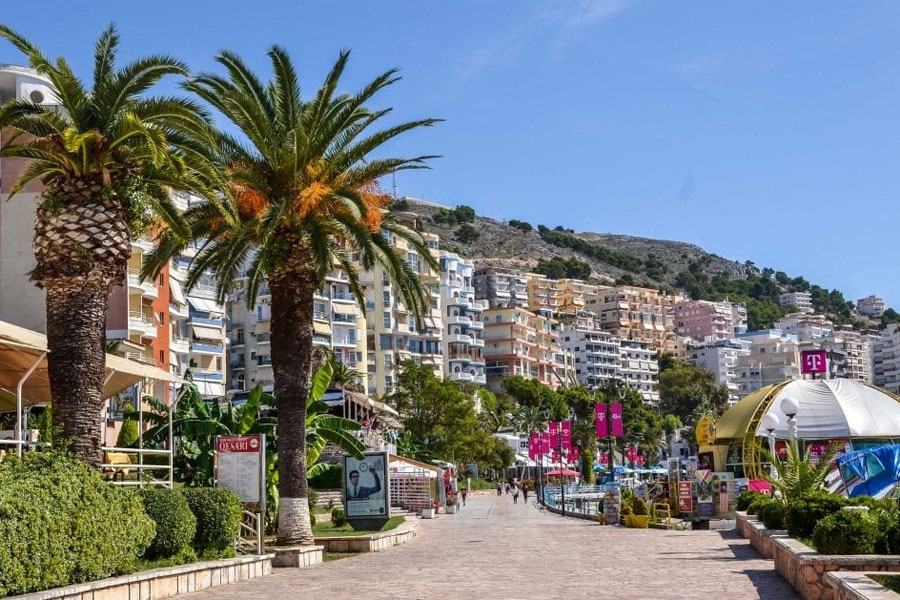
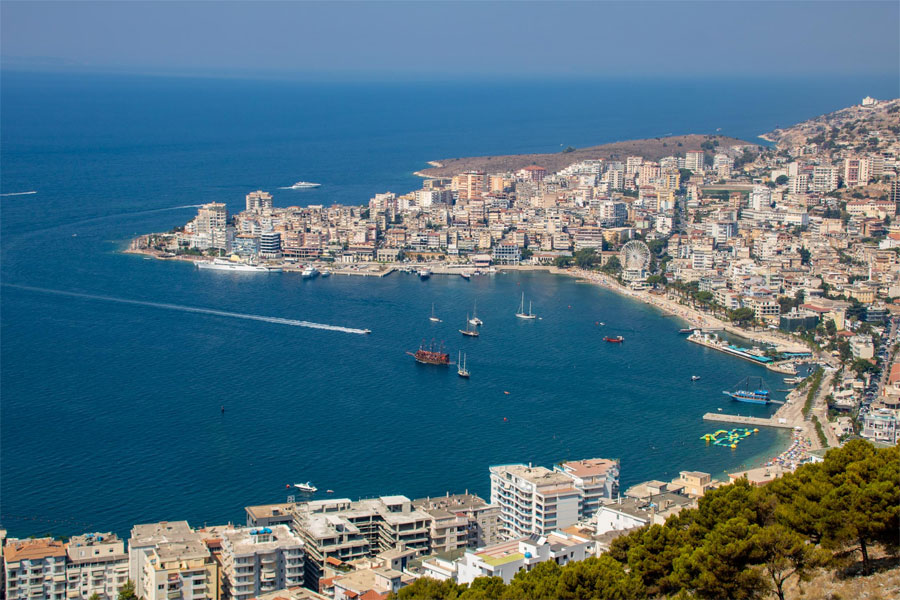
We started the day badly by getting up an hour too early due to a clock change; then they had the breakfast hours wrong so we had coffee and fruit, a slow arrival, on the back deck. Then Chris went to a stretching class that did not exist. Finally the Albanian harbour master would not let us anchor off Butrint!!, We eventually disembarked at Saranda at 10.30 , wandering for 20 minutes along the shore before boarding buses to Butrint. Saranda was a middle of the market tourist town today, and has clearly evolved quickly from Albania Communist days - though I would not want to spend a holiday there.
click on a thumbnail to get a bigger photo
 |
 |
 |
 |
 |
 |
 |
 |
Butrint was an UNESCO World Heritage site. It is a 4th C AD, Greek and Roman town, set in a magnificent forest. We toured it by ourselves with the aid of a good map.
At 2pm we went into a nearby restaurant.- all 200 hundred of us!! - where, after initial chaos, we enjoyed a beer, a buffet with tasty mussels, some wine and an Albanian dance show.
click on a thumbnail to get a bigger photo
 |
 |
 |
 |
 |
 |
 |
 |
 |
 |
 |
 |
 |
 |
 |
 |
 |
 |
 |
 |
 |
 |
 |
 |
 |
 |
 |
 |
A swim and Siesta back aboard and then dinner with Mike and Cathy in the Terrazza
