 |
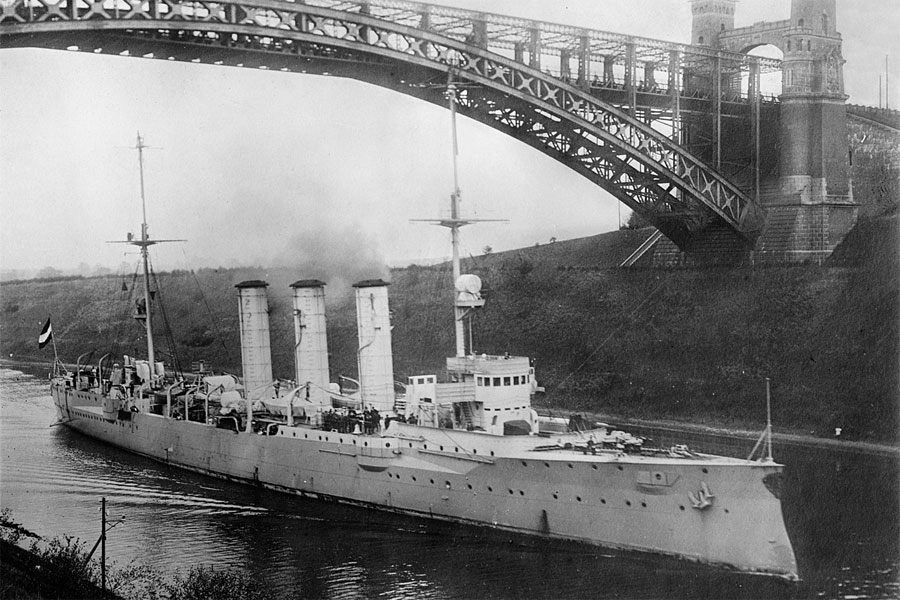 |
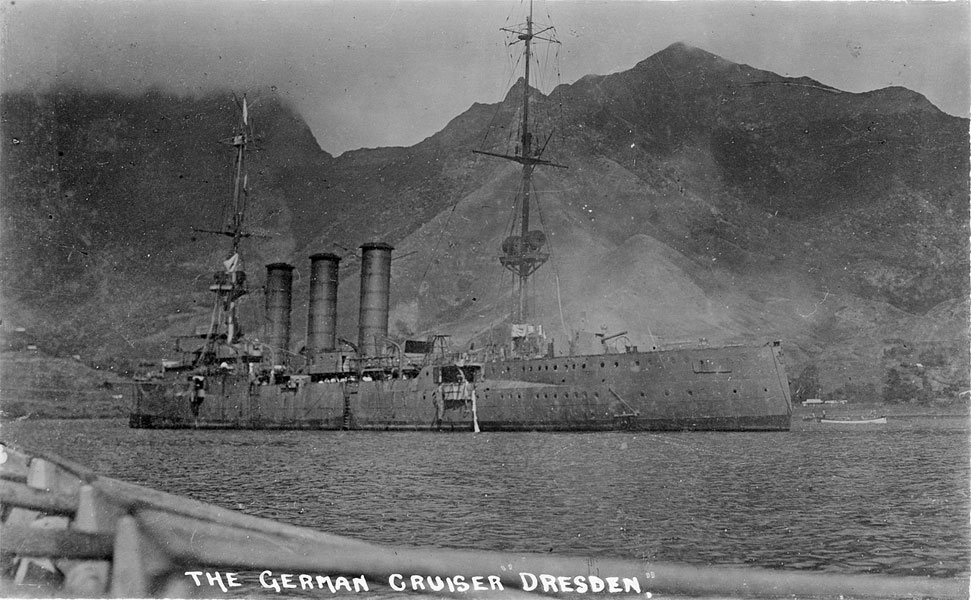
German Battle Cruiser Dresden.was scuttled at Cumberland Bay, Juan Fernandez Islands
|
|
During World War I, Vice Admiral Maximilian von Spee's German East Asia Squadron stopped and re-coaled at the island 26–28 October 1914, four days before the Battle of Coronel. While at the island, the admiral was unexpectedly rejoined by the armed merchant cruiser Prinz Eitel Friedrich, which he had earlier detached to attack Allied shipping in Australian waters. The British were defeated by the German squadron at Coronel off the Chilean coast on 1 Nov 1914
After the Battle of Coronel, the German squadron went to the Atlantic, clashing again with the British fleet near the Falkland Islands on 8 December 1914. This time, the British won a resounding victory, the destruction of the German fleet was almost total and numerous casualties, was killed that day Admiral Von Spee himself. The Dresden was saved, because it had been ordered to stay away from the scene of combat. Pursued by British ships, he spent three months hiding in the maze of channels of southern Chile. In need of supplies, went to Punta Arenas, where he received some, thanks to the efforts of the German colony residents. He managed to continue his flight by sailing from the place just a couple of hours before the arrival of British ships. The ultimate fate of Dresden would be at Cumberland Bay on Isla Robinson Crusoe. The British were informed of the location of Dresden and left with three ships in pursuit
The Dresden, German battle cruiser, was built in 1908. Displacing 3,650 tonnes and was equipped with 12 high-powered guns. It was under the command of Lüdecke. His first mission was in early 1914 when he was sent to the coast of Mexico to protect the interests of the German colony, in the event that it was threatened by the Mexican Revolution. During the voyage back to Europe Commander Lüdecke, received the news of the outbreak of World War I, and was ordered to join the German squadron in the South Pacific under the command of Admiral Von Spee .
The Dresden had arrived at Juan Fernandez short of coal and with broken engines. On the morning of 14 March, Kent and Glasgow approached Cumberland Bay; their appearance was relayed back to Dresden by one of her pinnaces, which had been sent to patrol the entrance to the bay. Dresden was unable to maneuver, owing to her fuel shortage, and Lüdecke signaled that his ship was no longer a combatant. The British disregarded this message, as well as a Chilean vessel that approached them as they entered the bay. Glasgow opened fire, in violation of Chile's neutrality; Britain had already informed Chile that British warships would disregard international law if they located Dresden in Chilean territorial waters.Shortly thereafter, Kent joined in the bombardment as well. The German gunners fired off three shots in response, but the guns were quickly knocked out by British gunfire.
The Log of HMS Glasgow records
Log of HMS Kent showed she fired 29 rounds in the engagement
The British logs say the Gresden fired only 3 rounds during the engagement, all at the Kent, and that they missed
The Intelligence Officer at British Embassy in Montevideo sent to Admiralty Following received from Captain of Glasgow. Begins: Glasgow, Orama and Kent found Dresden at anchor in Cumberland Bay, Juan Fernandez Island, at 9 a.m., on 14th March. After engagement lasting five minutes Dresden hoisted white flag and hauled down her colours. She was much damaged and her crew were leaving her. An officer was sent from Dresden to negotiate, but was told that unconditional surrender only could be accepted. Dresden’s crew set her on fire and after an explosion she sank at 11.37 a.m., local time. Crew are all on shore, with exception of 15 engineer officers,¹ badly wounded, who have been temporarily sheltered in Orama for treatment. Dresden’s captain claimed had already interned, but there was nothing to show this when we approached. Have sent all available medical assistance. No British casualties or damage. Orama proceeding to-night to Valparaiso to land German wounded. Glasgow proceeding to-morrow to Vallenar to coal and afterwards to east coast, calling at Punta Arenas. Kent remains in vicinity of Juan Fernandez Twenty German killed and wounded
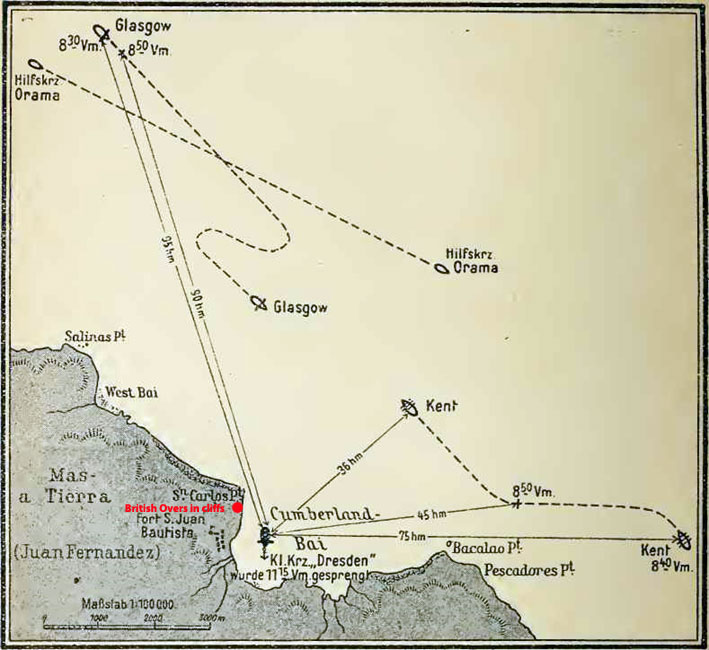
Official German map of engagement
Lüdecke sent the signal "Am sending negotiator" to the British warships, and dispatched Canaris in a pinnace; Glasgow continued to bombard the defenseless cruiser. In another attempt to stop the attack, Lüdecke raised the white flag, which prompted Glasgow to cease fire. Canaris came aboard to speak with Captain John Luce; the former strongly protested the latter's violation of Chile's neutrality. Luce simply replied that he had his orders, and demanded an unconditional surrender. Canaris explained that Dresden had already been interned by Chile, and thereafter returned to his ship, which had in the meantime been prepared for scuttling.
At 10:45, the scuttling charge detonated in the bow and exploded the forward ammunition magazines. The bow was badly mangled; in about half an hour, the ship had taken on enough water to sink. As it struck the sea floor, the bow was torn from the rest of the ship, which rolled over to starboard. As the rest of the hull settled below the waves, a second scuttling charge exploded in the ship's engine rooms.
A letter home from the 2nd officer of the Glasow gives more information. However, we saw a little white steamboat just as we were opening up the bay, and then a long grey stem come out, and then three funnels. She saw us first, and hoisted a German ensign at her foremast head which meant she was going to fight. We were then about 14,000 yards off. Next thing she saw the Kent, We waited 30 minutes to see if she would haul down her flag but she made no move that way, so at 9.10 we fired two salvoes. Kent also opened fire. Our first went mostly just over her. Second salvo all hit and she caught fire, range 8,400. She hoisted some sort of signal so we ceased fire at 9.11, but then she fired at us, quite harmlessly, so at 9.12 we opened fire again and continued till 9.14, when she hoisted a white flag and hauled down her ensign. Quick work. We closed her, and she sent an officer on board to make what she was pleased to call her terms. Was told that the only terms were complete unconditional surrende
On 15 March 1915 the crew of Dresden and its commander arrived on the Robinson Crusoe Island . Soon after, the entire group was interned by Chilean authorities on Quiriquina Island (Concepcion), where they remained captive until 1919. Except for Canaris who escaped back to Germany.
Diplomatic repercussions of the breaching of Chilean neutrality rattled on. Grey, the UK Foreign Secretary responded to a Chilean protest on 30 March 1915 begins “His Majesty's Government, after receiving the communication from the Chilean Government of 26th March, deeply regret that any misunderstanding should have arisen which should be a cause of complaint to the Chilean Government; and, on the facts as stated in the communication made to them, they are prepared to offer a full and ample apology to the Chilean Government.” Grey then goes on to offer an alternative (British) reading of the possible situation. He concludes however, “His Majesty's Government do not wish to qualify the apology that they now present to the Chilean Government.”
The wreck remains in the harbor; several artifacts, including her bell and compass, have been returned to Germany.
The two guns on the shore that I saw in 2023 are NOT from the Dresden, but are 2nd World War defences.