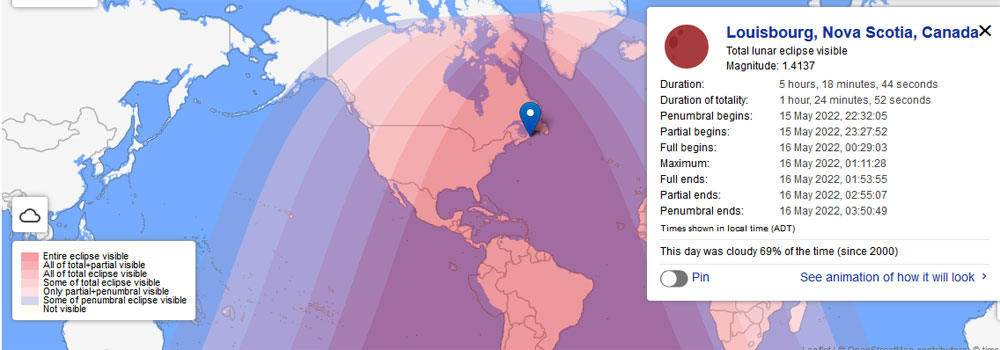
The ship will be in a prime position for the total lunar eclipse, taking place between 00.15 and 02.15.
The total lunar eclipse will see the sky gradually darken to totality, as the Earth, sun and moon align. The scientific term for this is called syzygy (from the Greek word syzgia, which means "yoked together,") and it is pronounced "sizigee". Due to the Earth’s cone-shaped shadow, we cannot tell exactly how long the total lunar eclipse will last, but our educated guess is around two hours. During that time, the moon will go through series of partial eclipses, allowing guests to fully experience the phenomenon. In the past, total lunar eclipses have terrified people who have no understanding of them.
In fact, Christopher Columbus himself very cleverly used a one to his favour in 1504. In an effort to induce the natives of Jamaica to continue provisioning him and his hungry men, he successfully intimidated the natives by correctly predicting a total lunar eclipse for 1 March 1504. Of course, this was trickery as he had an almanac that predicted the date with him. However, his trick worked - when the natives saw the eclipse — on schedule, just as Columbus predicted — they ran from all directions to Columbus' ships with fresh provisions, begging him to pray to his God for protection. Sneaky!
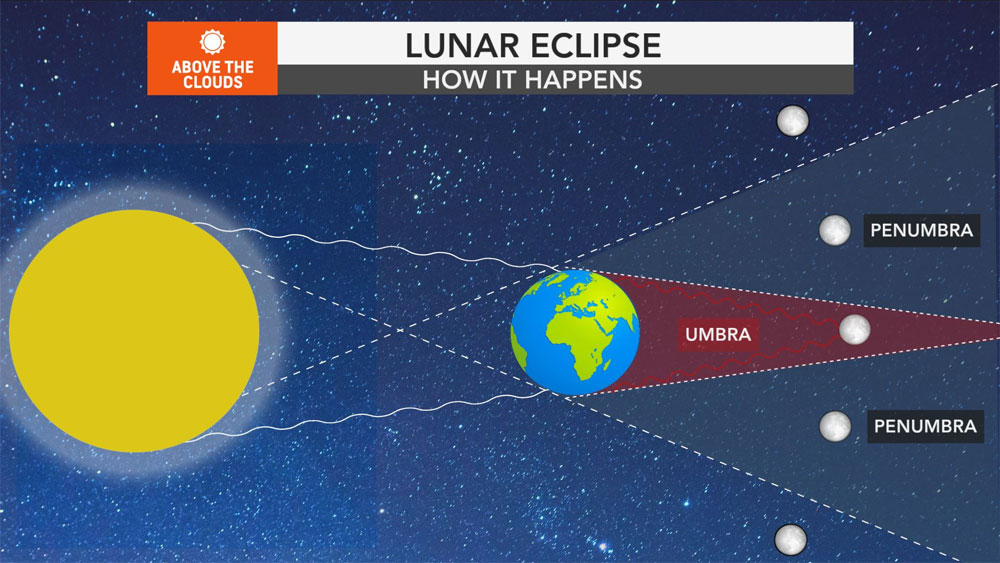
Lunar eclipses have been a favorite event for skywatchers for countless years. They occur when Earth's shadow blocks the sun's light, which otherwise reflects off the moon. There are three types of lunar eclipses — total, partial and penumbral — with the most dramatic being a total lunar eclipse, in which Earth's shadow completely covers the moon. During a total lunar eclipse, the moon will appear bright red in the night sky. Throughout history, eclipses have inspired awe and even fear, especially when total lunar eclipses turned the moon blood-red, an effect that terrified people who had no understanding of what causes an eclipse and therefore blamed the events on this god or that.
Why Red?The reason why the Moon takes on a reddish color during totality is a phenomenon called Rayleigh scattering. It is the same mechanism responsible for causing colorful sunrises and sunsets, and for the sky to look blue.
Colorful SunlightEven though sunlight may look white to human eyes, it is actually composed of different colors. These colors are visible through a prism or in a rainbow. Colors towards the red part of the spectrum have longer wavelengths and lower frequencies compared to colors towards the violet part of the spectrum which have shorter wavelengths and higher frequencies.
Earth's Atmosphere
The next piece of the puzzle of why a totally eclipsed Moon turns red is the Earth's atmosphere. The layer of air surrounding our planet is made up of different gases, water droplets, and dust particles. When sunlight entering the Earth's atmosphere strikes the particles that are smaller than the light's wavelengths, it gets scattered into different directions. Not all colors in the light spectrum, however, are equally scattered. Colors with shorter wavelengths, especially the violet and blue colors, are scattered more strongly, so they are removed from the sunlight before it hits the surface of the Moon during a lunar eclipse. Those with longer wavelengths, like red and orange, pass through the atmosphere. This red-orange light is then bent or refracted around Earth, hitting the surface of the Moon and giving it the reddish-orange glow that total lunar eclipses are famous for.
Look for a Blue Band
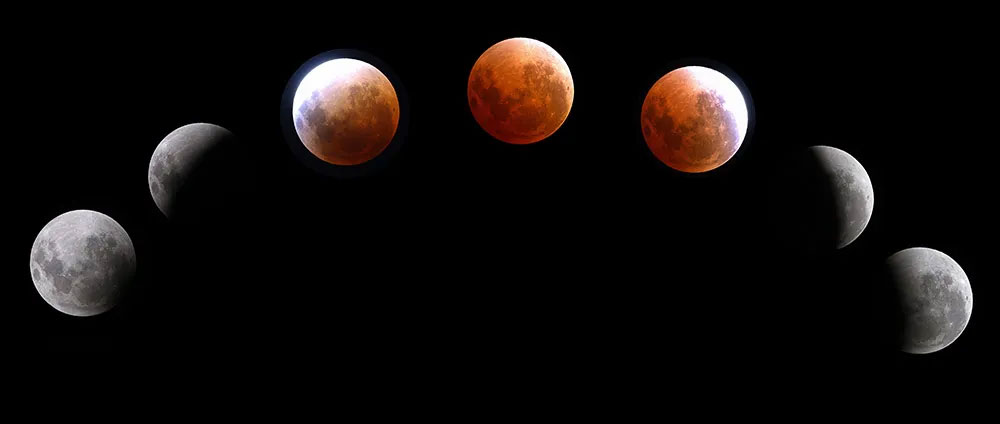
Veteran eclipse watchers will tell you that if you look really hard right at the beginning and just before the end of totality, you may detect a light blue or turquoise band on the Moon's face (see image). This happens because the Earth's Ozone layer scatters red light and lets through some of the blue light that is otherwise filtered out by other layers of the atmosphere.