
The Panama Canal is an artificial 82 km waterway that connects the Atlantic Ocean with the Pacific Ocean. Canal locks at each end lift ships up to Gatun Lake, an artificial lake created to reduce the amount of excavation work required for the canal, 26 m above sea level, and then lower the ships at the other end. A wider lane of locks was constructed over a number of recent years and opened in 2016. The new locks allow transit of larger, neo-Panamax ships, capable of handling more cargo.
France began work on the canal in 1881, but stopped due to engineering problems and a high worker mortality rate.
The project was inspired by the diplomat Ferdinand de Lesseps, who was able to raise considerable funds in France as a result of the huge profits generated by his successful construction of the Suez Canal. Although the Panama Canal needed to be only 40 percent as long as the Suez Canal, it was much more of an engineering challenge due to the combination of tropical rain forests, debilitating climate, the need for canal locks, and the lack of any ancient route to follow. De Lesseps wanted a sea-level canal (like the Suez). The dense jungle was alive with venomous snakes, but the worst challenges were yellow fever, malaria, and other tropical diseases, which killed thousands of workers; by 1884, the death rate was over 200 per month. Public health measures were ineffective because the role of the mosquito as a disease vector was then unknown. Conditions were downplayed in France to avoid recruitment problems, but the high mortality rate made it difficult to maintain an experienced workforce.
 |
 |
 |
Steam shovels were used in the construction of the canal. Other mechanical and electrical equipment was limited in capabilities, and steel equipment rusted rapidly in the rainy climate. In France, de Lesseps kept the investment and supply of workers flowing long after it was obvious that the targets were not being met, but eventually the money ran out. The French effort went bankrupt in 1889 after reportedly spending US$287 million; an estimated 22,000 men died from disease and accidents, and the savings of 800,000 investors were lost. De Lesseps and his son Charles were found guilty of misappropriation of funds and sentenced to five years' imprisonment. This sentence was later overturned, and the father, at age 88, was never imprisoned.
In 1894, a second French company, the Compagnie Nouvelle du Canal de Panama, was created to take over the project. A minimal workforce of a few thousand people was employed primarily to comply with the terms of the Colombian Panama Canal concession, to run the Panama Railroad, and to maintain the existing excavation and equipment in saleable condition. The company sought a buyer for these assets, with an asking price of US$109 million. In the meantime, they continued with enough activity to maintain their franchise. Phillipe Bunau-Varilla, the French manager of the New Panama Canal Company, eventually managed to persuade de Lesseps that a lock-and-lake canal was more realistic than a sea-level canal.
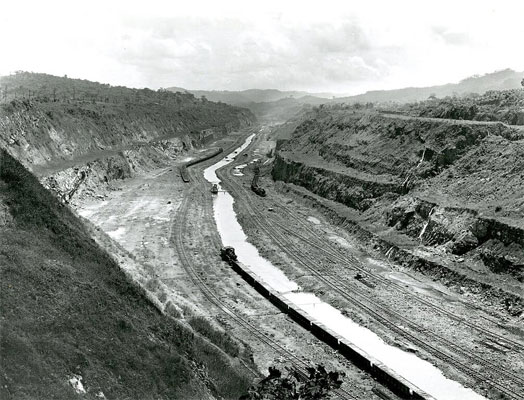
Up till this point in time the canal was on land that was part of Colombia. But in 1903 the US supported a Panamanian rebel breakaway from Colombia, and the creation of a new state, Panama. After the revolution in 1903, the Republic of Panama became a US protectorate until 1939. And in 1904, the United States purchased the French equipment and excavations, including the Panama Railroad, for US$40 million, of which $30 million related to excavations completed, primarily in the Gaillard Cut (then called the Culebra Cut). The United States also paid the new country of Panama $10 million and a $250,000 payment each following year.
The United States took over the project in 1904. One of the largest and most difficult engineering projects ever undertaken, the Panama Canal enabled ships to avoid the long, hazardous route around the southernmost tip of South America
The US chief sanitation officer of the canal construction project implemented a range of measures to minimize the spread of deadly diseases, particularly yellow fever and malaria, which had recently been shown to be mosquito-borne. Investment was made in extensive sanitation projects, including city water systems, fumigation of buildings, spraying of insect-breeding areas with oil and larvicide, installation of mosquito netting and window screens, and elimination of stagnant water. After two years of extensive work, the mosquito-spread diseases were nearly eliminated. Even after all that effort, about 5,600 workers died of disease and accidents during the US construction phase of the canal.
In 1905, a US engineering panel was commissioned to review the canal design, which had not been finalized. The panel recommended to President Roosevelt a sea-level canal, as had been attempted by the French. But by 1906 a sea-level approach was deemed to be "an entirely untenable proposition". It was decided to use a lock system to raise and lower ships from a large reservoir 85 ft (26 m) above sea level. This would create both the largest dam (Gatun Dam) and the largest man-made lake (Gatun Lake) in the world at that time. The water to refill the locks would be taken from Gatun Lake by opening and closing enormous gates and valves and letting gravity propel the water from the lake. Gatun Lake would connect to the Pacific through the mountains at the Gaillard (Culebra) Cut. The construction of a canal with locks required the excavation of more than 130,000,000 m3 of material over and above the 23,000,000 m3 already excavated by the French. As quickly as possible, the Americans replaced or upgraded the old, unusable French equipment with new construction equipment that was designed for a much larger and faster scale of work.
The canal finally opened on August 15, 1914. And the US had spent around $500 million to achieve this. After construction the US controlled the canal and surrounding Panama Canal Zone until 1999, when the canal was taken over by the Panamanian government. It is now managed and operated by the government-owned Panama Canal Authority. Annual traffic has risen from about 1,000 ships in 1914, when the canal opened, to 14,702 vessels in 2008. By 2012, more than 815,000 vessels had passed through the canal.
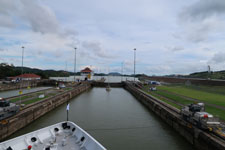
The Silver Explorer paid about $30,000 to transit the canal. Which equates to $300 per passenger. The ship was moving or transiting locks for about 7 hours, and we were moored, awaiting our turn to descend to the Pacific, for 3 hours on top of that. We entered at dawn, and exited into the Pacific in late afternoon, and anchored off Panama City


The Panama Canal is one of the largest engineering feats ever accomplished. but, transiting the canal, one is actually quite oblivious of the difficulties involved in construction.
Click on any of the thumbnails to get a bigger version of the picture
 |
 |
 |
 |
 |
 |
 |
 |
 |
 |
 |
 |
 |
 |
 |
 |
 |
 |
 |
 |
 |
 |
 |
 |
 |
 |
 |
 |
 |
 |
 |
 |
 |
 |
 |
 |
 |
 |
 |
 |