
1884 - Spain colonises Western Sahara, an area formerly populated by Berber tribes.
1934 - Becomes a Spanish province known as Spanish Sahara.
1957 - Newly-independent Morocco lays centuries-old claim to Western Sahara.
1965 - The UN calls for the decolonisation of Western Sahara.
1973 - Polisario Front, the indigenous Saharawi independence movement, is founded.
1975 - Morocco's King Hassan defies a Hague ruling in favour of Saharawi rights to self-determination and stages the "Green March" of 350,000 Moroccans into Western Sahara. Spain withdraws.
1975-91 - Polisario Front fights a 16-year-long guerrilla war against Moroccan forces, which ends with a UN-brokered cease-fire.
1975-76 - Morocco annexes two-thirds of Western Sahara after colonial power Spain withdraws. Polisario guerrillas declare the Saharan Arab Democratic Republic (SADR), with a government-in-exile in Algeria. Thousands of Sahrawi refugees flee to western Algeria to set up camps near the town of Tindouf.
1979 - Mauritania withdraws, leaving Morocco to annex its share of the territory.
1991-2000s - UN brokered cease-fire ends war but Morocco has yet to hold an agreed referendum on independence. Numerous UN-sponsored talks have failed to yield a breakthrough.
2016 - Long-term leader Mohamed Abdelaziz Ezzedine dies.
Western Sahara is a sparsely-populated area of mostly desert situated on the northwest coast of Africa. A former Spanish colony, it was annexed by Morocco in 1975. Since then it has been the subject of a long-running territorial dispute between Morocco and its indigenous Saharawi people, led by the Polisario Front. A 16-year-long insurgency ended with a UN-brokered truce in 1991 and the promise of a referendum on independence which has yet to take place. A buffer strip, or "berm" with landmines and fortifications, stretches the length of the disputed territory and separates the Moroccan-administered western portion from the eastern area controlled by the Polisario Front. The Saharan Arab Democratic Republic (SADR), declared by the Polisario Front in 1976, is now recognised by many governments and is a full member of the African Union. Home to phosphate reserves and rich fishing grounds off its coast, Western Sahara is also believed to have as yet untapped offshore oil deposits.
The Polisario Front proclaimed the Saharan Arab Democratic Republic (SADR) in 1976, with a government in exile in Algeria. Brahim Ghali was elected leader of the Polisario Front and president of the Saharan Arab Democratic Republic (SADR) in July 2016 following the death of long-term president Mohamed Abdelaziz Ezzedine. A seasoned military leader, described both as a "hard-line supporter" and "historic figure", he was one of Polisario's founding members in 1973 and led the first raids against the occupying Spanish forces that sparked the armed struggle for Western Saharan independence.
We were aggressively followed and photographed (as a group) by the DST (Moroccan Secret Police). It was difficult to see why they were so concerned about photographing us, but a group of 7 to 9 of them were with us at every stop. As we were shown the outside of a mosque, as we toured an animal market and. most oddly, when we were out in the desert with nothing to see other than sand dunes
Morocco maintains specially trained military commando and intelligence units that focus on protection of national interests within Morocco, especially in the Western Sahara region. The main government intelligence agency is the Direction de la Surveillance du Territoire (DST), or Directorate of Territorial Surveillance. The DST conducts most all of Morocco's intelligence operations, both foreign and domestic. The largest organizational department of the DST is the counter-intelligence unit. Though the DST is known as both an intelligence agency and a secret police force that sometimes carries out political espionage, the agency does conduct joint operations with allied foreign intelligence services. I did not see any Secret Police in our first stop at Dakhla, but they were painfully obvious at Laayoune
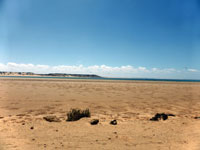
Dakhla was just a trip out into the desert. This was in fact a major feat of organisation as we were taken by 4*4, hence about 50 jeeps were required for the Cloud's passengers.. Things being what they are, we had to have a police escort, and in turn that meant that we could not start until all the jeeps had been filled. We were taken to a "Bedouin camp"
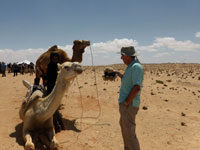
Here we saw some bad demonstration of making mint tea, and a few biscuits (apparently traditional Bedouin hospitality), and some rather bad dancing. There were 2 quite well groomed camels specially for us to photograph. And that was it, apart from an opportunity to buy the normal knick knacks from merchants who miraculously appeared with them in the middle of nowhere. If you were enthused you could walk to a distant "white sand dune", which I declined to do. We had a poke round in the sand for signs of prehistoric peoples making flint tools - results inconclusive

Click on any of the thumbnails to get a bigger version of the picture
 |
 |
 |
 |
 |
 |
 |
 |
 |
 |
 |
 |
 |
 |
 |
Then is was an overnight cruise along the coast to Laayoune. Where we had the same guides and entertainers who must have driven up.
The animal market was small and scruffy. 2 (very) mangy camels and a few goats and sheep, and secret service men. A visit I could have done without, but Laayoune does not have many attractions and they have to pad the day out somehow
The stop at the mosque was only to take photos; we were not allowed inside the mosque
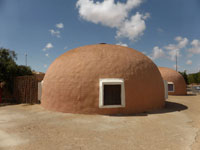
I had been expecting more from the billed "old Spanish town" which turned out to be a small group of about 10 domed houses. The domed houses were built in 1975 shortly before the Moroccan invasion of Western Sahara: these houses are among the few testaments to its former Spanish colonial past.
 .
.
Click on any of the thumbnails to get a bigger version of the picture
 |
 |
 |
 |
 |
 |
 |
 |
 |
 |
 |
 |
 |
 |
 |
 |
Once we got to Laayoune, the DST (the Moroccan Secret Police) followed our group everywhere. There were 7 to 9 of them following our bus alone. Apart from these grunts there were 2 "suits" who were probably controlling the various grunts assigned to our 7 buses from the ship. That makes for about 50 of them watching over the tourists from the Silver Cloud - a major operation. They had standard Secret Service earpieces, and must have taken hundreds of photos of us all.
 |
| The Secret Police at their best. They watch (note earpieces) as Pablo, the ship's official photographer, snaps some very scenic dunes. Apart from sand there is not a single building or person in the landscape |
Click on any of the thumbnails to get a bigger version of the picture
 |
|
 |
 |
 |
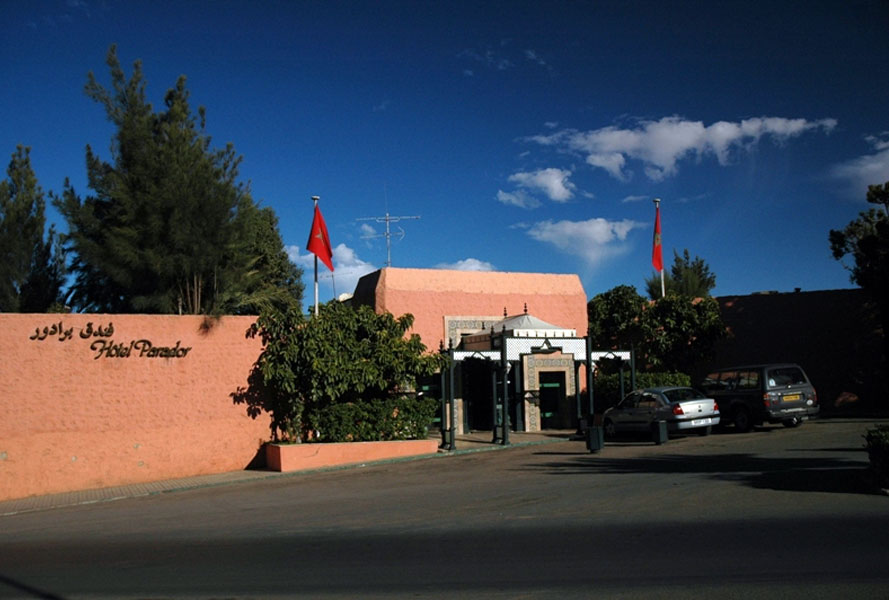
The best of this tour was the refreshment venue, the Parador Hotel. There we had real fresh Orange Juice, some quite nice nibbles, and Chris was interviewed for Moroccan TV (though this might just have been the Secret Police wanting to get a closer view of her for their records)
Click on any of the thumbnails to get a bigger version of the picture
 |
 |
 |
 |
 |
 |
 |
 |
We headed back from Laayoune to the ship and had a stop en-route. And another of the peculiar "meet the real Bedouins" stops in the desert. We pulled off the tarmac and clattered for a kilometre up a dirt road to a military camp, where the tents we had seen the day before in Dakhla were now standing, complete with the same musicians and dancers. The view was quite impressive, with sand dunes stretching off to infinity. As there was not a lot else to do, we opted for the early bus back to the ship. At this point a farce that last a couple of hours ensued. The bus did not move, we were then informed that there were "problems" with the authorities that stopped us going to the port; we were then taken in the bus back to the town and driven without stops for a period to see further (non existent) sights. Eventually we got back to the ship without any real explication and with out any apology (par for the course with Nikki as expedition leader)

Click on any of the thumbnails to get a bigger version of the picture
 |
 |
 |
 |
 |
From here we set sail for Morocco proper