The British invasion of Iceland took place on 10 May 1940 during World War II. The British military operation, codenamed Operation Fork, was conducted by the Royal Navy and Royal Marines. The invasion was carried out because the British Government feared that the island would be used by Germany. The Government of Iceland issued a protest, charging that its neutrality had been "flagrantly violated" and "its independence infringed".
At the start of the war, the UK imposed strict export controls on Icelandic goods, preventing profitable shipments to Germany, as part of its naval blockade. The UK offered assistance to Iceland, seeking cooperation "as a belligerent and an ally", but Reykjavík declined and reaffirmed its neutrality. The German diplomatic presence in Iceland, along with the island's strategic importance, alarmed the UK. After failing to persuade the Icelandic government to join the Allies, the UK invaded on the morning of 10 May 1940.
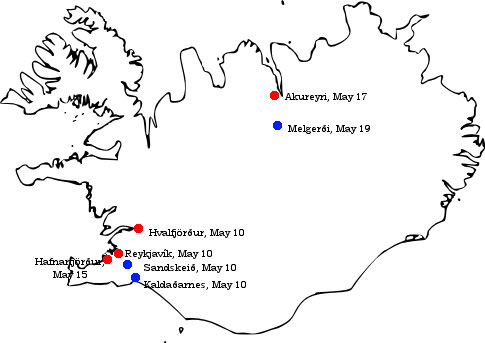
The initial force of 746 British Royal Marines, commanded by Colonel Robert Sturges, disembarked at the capital, Reykjavík. Meeting no resistance, the troops moved quickly to disable communication networks, secure strategic locations, and arrest German citizens. Requisitioning local transport, the troops moved to Hvalfjörður, Kaldaðarnes, Sandskeið, and Akranes to secure landing areas against the possibility of a German counterattack.
However, the initial invasion force was ill-equipped, only partially trained and insufficient to the task of occupation and defence of the island. On 17 May 4,000 additional troops of the Canadian Army arrived to relieve the marines. In July elements of the 2nd Canadian Division and 3rd Canadian Division were landed. Commonwealth occupation forces eventually totalled 25,000 infantry with support elements from the Royal Air Force, Royal Navy and Royal Canadian Navy. One year after the invasion, forces from the still officially neutral United States were stationed on the island by agreement with the Icelandic government, relieving the bulk of British ground forces. US forces grew considerably after the US entered the war on 7 December 1941, reaching up to 30,000 army, navy and air force personnel at any one time. The RAF and RCAF continued to operate from two Royal Air Force stations through to the end of the war.
The UK invaded to forestall a German occupation, to provide a base for naval and air patrols, and to protect merchant shipping lanes from North America to Europe. In this the invasion was successful. However, the presence of British, Canadian, and US troops had a lasting impact on the country. Foreign troop numbers in some years equalled 25 percent of the population or almost 50 percent of the native male population. Icelanders were, and remain, sharply divided about the war and occupation – what is sometimes referred to as "blessað stríðið" or "the Lovely War". Some point to the subsequent economic revival, others to loss of sovereignty and social upheaval. The occupation required the building of a network of roads, hospitals, harbours, airfields and bridges across the country, and this did have enormous positive economic impact. However, the Icelanders severely censured the sexual relationships between troops and local women (and men), which were causing considerable controversy and political turmoil. Women were often accused of prostitution and of being traitors.
During the occupation, on 17 June 1944, Iceland declared itself a republic, and while continuing to cooperate with the British, Canadian, and American military, they remained officially neutral throughout the war. The Keflavík Agreement signed in 1948 between the US and the Republic of Iceland stipulated that the American army would leave the country within six months, and Iceland would take possession of the Keflavík Airport. This did not happen for many decades, and a substantial US military presence remained in Iceland until 30 September 2006. At the end of hostilities most British facilities were turned over to the Icelandic government.