
Pécs is the fifth largest city of Hungary, located on the slopes of the Mecsek mountains in the south-west of the country, close to its border with Croatia. Pécs is also the seat of the Roman Catholic Diocese of Pécs.
After being captured and freed from the Ottomans a number of times, finally with the city under siege, in June 1543 the Bishop himself went to the Ottomans with the keys of the city. After occupying the city, the Ottomans fortified it and turned it into a real Ottoman city. The Christian churches were turned into mosques; Turkish baths and minarets were built; Qur'an schools were founded; there was a bazaar in place of the market. For a hundred years the city was an island of peace in a land of war. However in 1686 the Ottomans were forced to surrender the city
After the end of World War I, with the conferences on frontier delineation, it was not until August 1921 that Pécs could be sure that it remained part of Hungary. During World War II, Pécs suffered only minor damages, even though a large tank-battle took place 20–25 kilometres south of the city, close to the Villány area late in the war, when the advancing Red Army fought its way towards Austria.
The Cathedral of Pécs dates back to the 11th century and the times of Peter Orseolo, second king of Hungary. It bears the traces of the Romanesque, Gothic and Renaissance periods as well as the Turkish conquest when it was partially used for storage. It was renovated in Rococo and Classicist styles, but gained its modern form in the 1880s, when it was mostly restored to its imagined Romanesque origins, destroying much of the subsequent decorations. On John Paul II’s papal visit in 1990, the Cathedral gained the rank of Basilica Minor.
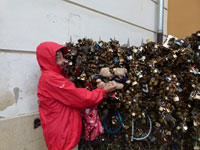
The custom of "Love Padlocks" in Europe is said to have been started in Pecs in the 1980s. At that time mainly young student couples clamped their padlocks to a wrought-iron fence. The fence can be found in a corner of the street Janus Pannonius utca, which links the north western end of the square Szechenyi with the square in front of the St. Peter and Paul Basilica. A second grid was added about 40 meters from the first one when the first one was hopelessly full. At present, there is a third place, new stainless steel bars in the park Sétatér. Photo of the padlocks below.
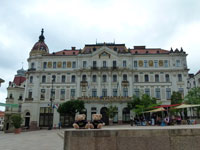
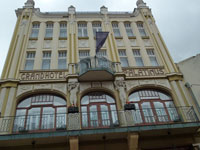
Signs of economic problems were simmerimg just below the surface. The very elegant Grand Hotel (photo below) has been empty for years. And the Zsolnay Ceramic Works are in doubt.
Click on any thumbnail photo to get a larger version
 |
 |
 |
 |
 |
 |
 |
 |
 |
 |
 |
 |
Bishops Palace
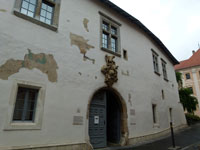
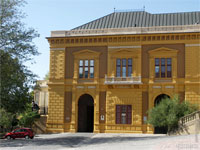
King Saint Stephen established the Bishopric of Pécs in 1009. The Bishop's Palace was formed by the buildings built around the cathedral in the coming centuries. The origins of the Bishop's Palace goes back to the 12th century. Later on, in the 15th - 16th century, it was reconstructed in Renaissance style, while Bishop György Klimó had it rebuilt entirely between 1751 and 1770. The second story was added to the north and east wings, while the south wing was extended. The façade was remodeled to a uniform Baroques style. Between 1838 and 1852 the eastern façade was also rebuilt and this is when it gained its neo-Renaissance style. The six Renaissance windows of the south wall were discovered in 1965. The façade of the two-story section towards Dóm square is ornamented by forceful ledges and wooden columns. There is a balcony with a balustrade between the two gates. To the left of the entrance stands the statue of Imre Varga commemorating the Pécs concert of Franz Liszt.
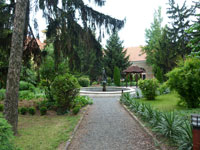
We had to put on plastic overshoes to avoid scuffing the newly restored inlaid wood floors. It has fine gardens and the main facade overlooks the cathedral
Click on any thumbnail photo to get a larger version
 |
 |
 |
 |
 |
Necropolis of Sopianae
The area has been inhabited since ancient times, with the oldest archaeological findings being 6,000 years old. Before the Roman era the place was inhabited by Celts. When Western Hungary was a province of the Roman Empire (named Pannonia), the Romans founded several wine-producing colonies under the collective name of Sopianae where Pécs now stands, in the early 2nd century. By the 4th century, it became the capital of Valeria province and a significant early Christian centre. The early Christian necropolis is from this era which became an UNESCO World Heritage Site in 2000.
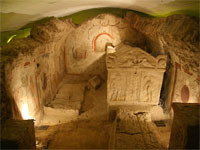
In the 4th century, a remarkable series of decorated tombs were constructed in the cemetery of the Roman provincial town of Sopianae (modern Pécs). These are important both structurally and architecturally, since they were built as underground burial chambers with memorial chapels above the ground. The tombs are important also in artistic terms, since they are richly decorated with murals of outstanding quality depicting Christian themes.
Burial chambers, memorial chapels and other sepulchral remains and fragments excavated since the 18th century have been preserved at their original location following scientific research and restoration, using techniques available at the given time as well as technical solutions available today.
We had a underground tour of the Cella Septichora, or Church of the Seven Apses, dating from Roman times. You can see the stone foundations and outlines of various rooms in the old church in this essentially archaeological area. Access is easy via a system of metal walkways that thread around the ancient church. There are remnants of a medieval castle wall. The Peter and Paul Burial chamber has a barrel vaulted ceiling with frescoes from the 4th Century.
The tombs are decorated with murals which can still be seen today. The site has been carefully preserved and made accessible to us visitors with lots of glass, good natural light, and easy to navigate paths. They claim this is the largest early Christian burial chamber that has been found so far, outside of Italy.
Click on any thumbnail photo to get a larger version
 |
 |
 |
 |
 |
Church of the Blessed Virgin Mary - the former Mosque
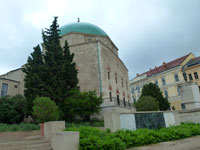
Pécs has a rich heritage from the age of a 150-year-long Ottoman occupation, like the mosque of Pasha Qasim the Victorious on Széchenyi square.
Formerly known as the Mosque of Pasha Qasim today it is a Roman Catholic church. It is one of the symbols of the city, located in the downtown, on the main square (Széchenyi square). The current building, was built by Pasha Qasim the Victorious between 1543 and 1546. The mosque was converted into a church in 1702, after the Habsburg-Hungarian troops conquered the city. The minaret was destroyed by the Jesuits in 1766. It is still one of the largest Turkish buildings that remain in Hungary.
The bell tower has been added as a separate edifice. The three bells on three columns are practically a moving statue capable of rising up as a tower. The tower rises up about 13 meters by hydraulics hidden 13 meters deep. A bronze statue represents the eponym of the former church, the Apostle St. Bartholomew, patron saint of tanners and vineyards. Hence the snake represents Bartholomew’s main activity, exorcism while the crucifix represents suffering and his naked body in bronze is symbolic of his having been flayed. The peal and the composition ring to movement every day at 7.00, 12.00 und 19.00 o’clock. We waited, along with a throng of a couple of hundred other tourists, for this happening, but it happened not, and the whole tower remained silent and unmoving. Our guide said this often happened
Click on any thumbnail photo to get a larger version
 |
 |
 |
 |
 |
 |
Zsolnay Porcelain Museum
This museum traces the history of the porcelain factory established in Pécs in 1853. At the forefront of European art and design for more than half a century, many of its majolica tiles were used to decorate buildings throughout the country and contributed to establishing a new pan-Hungarian style of architecture. Zsolnay’s darkest period came when the postwar communist government turned it into a plant for making ceramic electrical insulators. It’s producing art (well, knick-knacks, really) again, but contemporary Zsolnay can’t match the chinoiserie pieces from the late 19th century and the later Art Nouveau and Art Deco designs done in the lustrous eosin glaze. The museum was once the home of the Zsolnay family and contains many original furnishings and personal effects
Many Zsolnay ceramics are noted for the use of the eosin process that was introduced in 1893. The process results in a light red iridescence of the first prepared hue, hence the term eosin (Greek eos, flush of dawn). Different eosin colours and processes were developed over time.
Pyrogranite is a type of ornamental ceramics that were developed by Zsolnay and placed in production by 1886. Fired at high temperature, this durable material remains acid and frost-resistant making it suitable for use as roof tiles, indoor and outdoor decorative ceramics, and fireplaces. Architects that used the material in their buildings include those of buildings such as Matthias Church in Budapest, the Hungarian Parliament Building,
We gathered that there were a lot of politics going on over attempts by the city to regain control of the company from the current owners
Click on any thumbnail photo to get a larger version
 |
 |
 |
 |
 |
Polgar's Bortrezor Wine Tasting
Although the quality of the wine was not outstanding, the experience was interesting. We were served food and 7 different local wines, with an explanation about each from the owner. All done in a very atmospheric cellar somewhere in rural Hungary. You can tell that very few tourists come to this part of Hungary as there are virtually no Google hits on English language sites, but lots in Hungarian
Click on any thumbnail photo to get a larger version
 |
 |
 |
 |
MS Treasures
Cleared out by Hungarian emigration, we sailed for Croatia - and it looks like another formal dinner
Click on any thumbnail photo to get a larger version
 |
 |
 |
 |
 |