
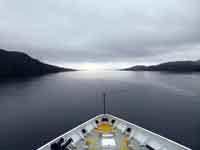
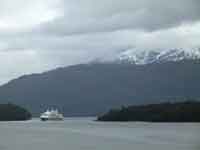
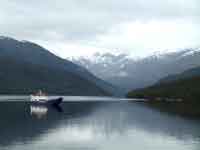
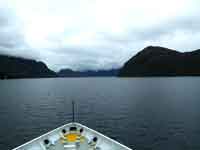
Once we upped anchor at Castro, Chiloe, and headed into the fjords, we fairly quickly moved from a normal mild climate to one of ice, snow and bitingly cold winds. It was time to get out the parkas and thermals.
The Chilean Fjords run north south for hundreds of kilometres and offer a sheltered and (comparatively) safe passage for coastal shipping. Between Castro and Puerto Natales we only had a few hours of rolling in seas as we crossed exposed bays, but most was calm sailing.
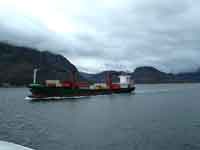
There is virtually no human habitation at all here, not a house. Just the occasional salmon farm, and fisherman. As well as just enjoying the spectacular scenery, we saw whales, the wreck of the Capt Leonidas and the Pio XI Glacier. Plus the frissons of excitement in passing the English Narrows (180 metres wide) and later the even narrower White Narrows (100 metres wide)
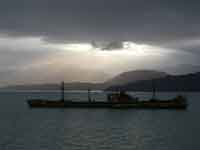
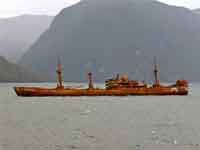
Capitain Leonidas is the rusting remains of the motor tramp Capitán Leonidas which ran aground on 7 Apr 1968 in the Messier Channel on a voyage with sugar in bulk from Santos, Brazil to Valparaiso, Chile.. The ship now serves, according to the ferry company guide, “as a lighthouse and as a point of reference for sailors”. She looks remarkably whole considering she has been abandoned for over 50 years and had a hard life before that since built at Bremen in 1937 as the Molda for the Bergen firm Mowinckels. When WW2 broke out Molda was in New York and when absorbed into the Allied cause she was an invaluable asset, a big 8,425 dwt modern freighter which would go on to make a remarkable number of transatlantic convoy voyages usually out of New York to Liverpool but also to Swansea, London and Newcastle. Post war she worked for Norwegian firms being renamed Fana but became the Panama registered Captain Leonidas in 1966 and within two years on a voyage from Santos to Valparaiso with sugar she had grounded where she still lies.(it was dark at the time & the photos below are from the web) .
There is a cut and paste story on a number of web sites, without any references being given, that it was deliberately run aground as part of an insurance scam and that the Captain was jailed for it. This is very unlikely in as much as that rock is in the middle of a fjord and not a good place to try to sink a ship. Whatever the cause of her stranding she is a full scale model of what a mid 20th century motor freighter looked like. If she hadn’t grounded here she would have been scrapped and largely forgotten. After the ship was abandoned, the Chilean navy used her as target for practice shooting, and that is why the hull and superstructure look so messed up.
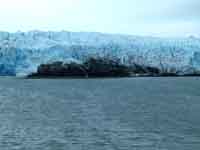
Pio XI Glacier, also known as Brüggen Glacier, is the largest western outflow from the Southern Patagonian Ice Field. Now about 66 km in length, it is the longest glacier in the southern hemisphere outside of Antarctica. Unlike most glaciers worldwide, it advanced significantly from 1945 to 1976. National Geographic say . "What is happening … is not well understood," Rivera said. Theories centre on the geography and topography of the glaciers; the depth and temperature of the waters where the glaciers end; and how quickly, or slowly, they react to changes in the climate. Yet overall, "if you account for the gains and losses of all of Patagonia's glaciers, they are [still] losing huge amounts of ice," Rivera pointed out.
We had a zodiac cruise along the front face of the glacier. It appears to have stopped advancing (Oct 2015) as we could see a terminal moraine about 100 metres in front of the face of the glacier. Evidence of recent advances was clearly visible in the mess of broken trees down the northern side of the glacier - had it been retreating, then there would have been a barren parch.
Click on any thumbnail photo to get a larger picture
 |
 |
 |
 |
 |
 |
 |
 |
 |
 |
 |
 |
 |
 |
 |
 |
 |
 |
 |
 |
 |
 |
 |
 |
 |
 |
 |
Whale Ahoy
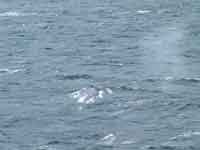
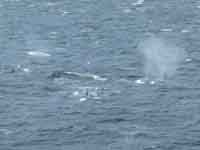
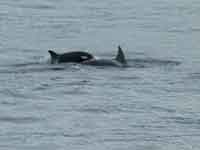
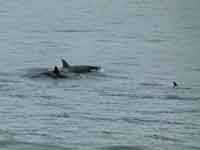
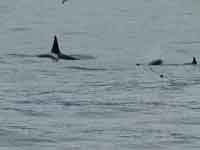
The announcement over the PA of of whales being spotted was guaranteed to get the passengers scampering for their parkas and cameras, and the upper decks being full of debutante whale watchers. Now to get a photograph of a whale is very difficult. These animals surface and dive again very quickly, just long enough to expel the stale air from their lungs (the spray you see when one surfaces) then they take a gulp of fresh air and descend again into the deeps.
In the normal course of events you do not see the flapping of the tail into the air, nor do you see "breaching" when they leap out of the water. So you sit with your camera ready, hoping that they will surface in the same place, but invariably they surface somewhere else, and by the time you have located the whale and fired off a photograph, it has dived, and your shot is just of empty water. Anyway, one edits out the photos of empty ocean, and hopefully there remain enough shots to see some whales
The first series is, I think, Fin Whales. And the second are Orca, known also as Killer Whales.
Click on any thumbnail photo to get a larger picture
 |
 |
 |
 |
 |
 |
Click on any thumbnail photo to get a larger picture
 |
 |
 |
 |
The White (or Kirke) Narrows
Click on any thumbnail photo to get a larger picture
 |
 |
 |
 |
 |
 |
 |
 |
 |
 |
 |
 |
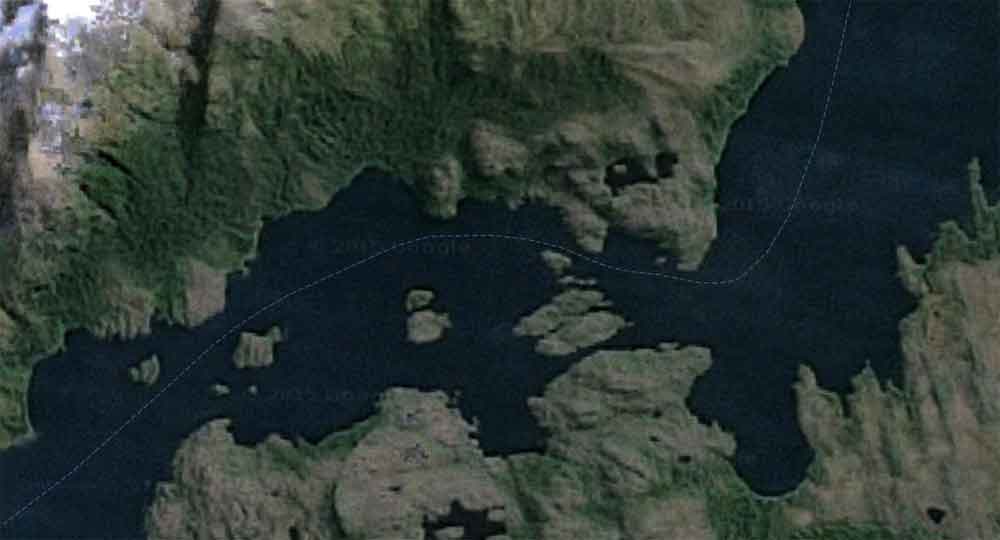
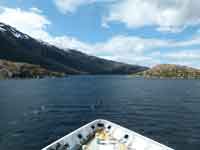
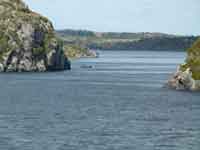
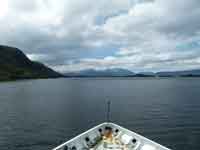
These narrows are quite spectacular, being only 100 metres wide, and the ship is 20 metres wide, so there is not much room for error. Throw in strong tides (ships can only pass an half an hour either side of slack water, and frightening cross winds and you can see that it is not for the faint hearted captain. The Explorer sent off a zodiac to scout ahead and report back on tide and wind, just to be sure.
What they did not tell us was that in Aug 2014, a Navimag ferry grounded and had to be abandoned here. It was only hauled off a year later in Sep 2015. When you consider that the Navimag ferries sail through the Narrows twice a week, every week, even an expert can make mistakes
The voyage on Silversea Explorer in South America