Red Centre. Alice Springs to Ayers Rock 450km - about 1100 kmthe round trip to Alice
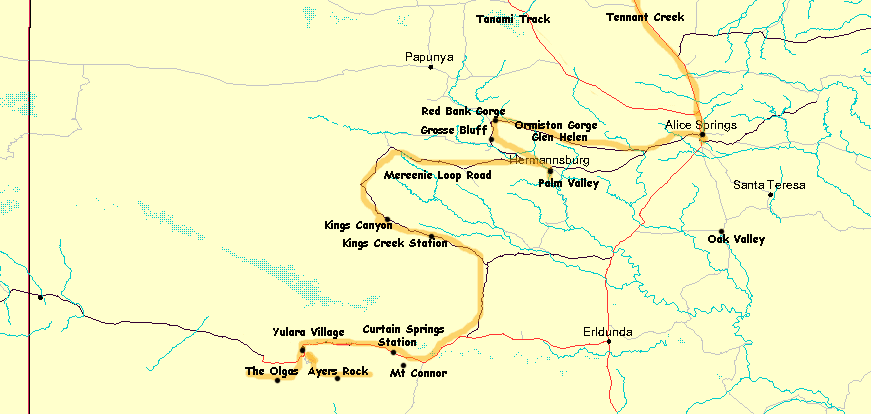
Red Centre. Alice Springs to Ayers Rock 450km - about 1100 kmthe round trip to Alice
Alice Springs to Wattarka (Kings Canyon)
Daily Telegraph writeup of this area by 4WD
It´s a fairly quick and easy 5 hour run from Alice Springs to Ayers Rock, due south along the Stuart and west along the Lasseter highways on an all-sealed, speed limit free highway. However, there is a better way for those that like to take their time exploring, and who don´t mind a little dust ? the Mereenie Loop Road, a 330km unsealed road that spears through the spectacularly beautiful West MacDonnell Ranges to Kings Canyon and then (via sealed road) to Uluru.
The Mereenie Loop Road, Alice Springs to Kings Canyon, is 330km. Much of the land is Aboriginal, so you need a permit to travel. These are available from Kings Canyon Resort, CATIA office in Alice Springs and the Central Land Office in Alice Springsand must be carried with you at all times whilst travelling through Aboriginal land.
From Alice Springs, head across the dry sandy bed of the Todd River and west onto Larapinta Drive and then on to Namatjira Drive, travelling across the desert plains beside the ancient West Macdonnell Ranges, known as the West Macs. The landscape here is all about colour: rich, vibrant and primary ? red rocks and sand, blue sky, yellow spinifex and purple hills.
Travelling this road, it feels as if you have stepped inside the frame of one of Australia's famous landscape paintings. Indeed, the former Lutheran mission, Hermannsburg, birthplace and home of aboriginal artist Albert Namatjira, is just on the other side of he ranges. His paintings of red rock and dunes, hazy purple mountains and tall desert oaks are some of the most familiar images of outback Australia and you can see some of his work at the small gallery there. (You can get there by staying on Larapinta Drive and meeting up with the Meerenie Loop Road again just west of the community.)
The road is sealed until Glen Helen, (133km from Alice Springs) and has gorges galore. Just minutes from Alice Springs is Simpson's Gap, a spectacular cleft in the red rocky range and a few kilometres further on is Standley Chasm, less than nine metres wide and towering to a height of 80 metres. The best time to see it is at midday, when the sun is directly overhead and lights up the walls and floor of the rocky chasm. Glen Helen Homestead offers motel accommodation and camp site (Glen Helen Homestead lies next Glen Helen gorge on the Finke river. And indeed there was some water in the river when we were there. I have no idea what accomodation costs there, but everything I had to pay (a beer and a helicopter flight) was moderately priced. As there are not too many people there, that evening the helicopter pilot was the cook, too. The only thing that worried me a bit, was the aircondition I couldn't switch off. But maybe I was the first person ever asking for that...)
Even in mid winter the temperatures out here can soar during the daytime, so half an hour down the road we pull off and get changed into our swimmers for an icy dip at Ellery Creek Big Hole. Only in Australia could you find a spot so pristine, so intoxicatingly beautiful, and manage the have the entire place to yourself.
Back in the car we zoom past Serpentine Gorge and the Ochre Pits and then drop into Glen Helen Gorge for a cold drink at the caravan park-cum-resort with views of the rust red gorge walls. Just opposite the resort is the turn-off to Ormiston Gorge, where we take a short walk to a beautiful sandy swimming hole and watch a bunch of kids splashing around in the clear water. The road is unsealed from here on in until Kings Canyon and not generally suitable for caravans and four-wheel-drive is recommended, although there are plans to seal the Mereenie Loop Road by 2007.
We pass by Tnorala (Grosse Bluff) Conservation Reserve, a huge crater formed by a comet over 130 million years ago, and link up with the southern section of the Mereenie Loop Road (Larapinta Drive) that heads to Hermannsburg and back to Alice Springs. Just west of the mission is Finke Gorge National Park. You´ll need a four-wheel-drive to travel the last 16km along the sandy bed of the Finke River. The highlight of this park is Palm Valley, an oasis of ancient palms that is the remnant of the tropical rainforest that once covered the interior of Australia.
We continue west towards Watarrka National Park, home to Kings Canyon, where breathtaking 300-metre sheer cliffs cut deep into the ground. Arriving just on sunset yet again, we take a quick 15-minute helicopter flight over the canyon, before joining a Sounds of Firelight dinner at Kings Canyon Resort. Unlike the Sounds of Silence dinner at Yulara, where dinner and fine wine is served, with great flair and panache, atop a sand dune in the desert with a view of Uluru and Kata Tjuta, the Kings Canyon version is served in full view of the restaurant´s buffet table, which rather makes you wonder why you are outside shivering when you could be inside nice and cosy. The six-course meal is tasty though. Kings Canyon Resort Voyages Kings Canyon Resort is located in a loop off the main highway running between Ayers Rock and Alice Springs. The sensitively designed resort is just seven kilometres from Watarrka National Park, the home of the magical sandstone formation of Kings Canyon.
Due to Voyages commitment to best environmental practice, the resort has been built to blend harmoniously with the surrounds. That is not to say the accommodation is basic! Kings Canyon Resort offers a wide range from the campground that enjoys the outdoor stillness of the Red Centre to deluxe spa rooms - offering understated opulence rather unexpected in such a remote location. It is the perfect oasis from which to explore the wonders of Kings Canyon including the amazing rock formation called the Lost City and the Garden of Eden an oasis of an entirely different kind at the foot of the Canyon. The flora of Kings Canyon offers a clear indication that the climate of this whole area was once vastly different.
Kings Creek Station also offers camping and accommodation. The station lies 36 kilometres from the magnificent Kings Canyon (Watarrka) and is set amongst majestic desert oaks.Kings Creek Station is a working cattle/camel station with facilities for camping, accommodation and an opportunity to experience the outback either by quad (4 wheel motorbike), helicopter or camel. Basic supplies, meals and drinks can be bought at the station shop. You could even try one of our famous Kings Creek camel burgers!!!! The station is the largest exporter of wild camels in Australia and sells camels for live export, live domestic sales and meat. Clive recommends the helicopter ride here.
Day three and we´re up nice and early again to tackle the 6km Rim Walk before the heat and flies begin to fray our tempers. One of the best short walks in the country, the first half-hour or so is a lung-busting, thigh-crippling climb up the side of the canyon, but if you can make it that far, the remainder of the two to three-hour walk is an easy stroll around the rim of the canyon where breathtaking 300-metre sheer cliffs cut deep into the rock. From King´s Canyon it´s bitumen all the way to Uluru, 305km. past Curtin Springs Cattle Station.
Wattarka (Kings Canyon) to Uluru (Ayers Rock)
An early morning start gives you the opportunity to do the complete Kings Canyon walk (Clive recommends with a guide) during the coolest part of the day. Spend part of the day driving from Wattarka to Uluru along Luritja Rd and Lasseter highway. A mid morning departure allows you to arrive and settle into Ayers Rock Resort in a relaxed state. In the afternoon we have organised a 40min scenic flight to take photos of this extraordinary landscape. The aerial view puts the size of Uluru and The Olgas into perspective against the flat desert.
Outback holidays at Uluru have come a long way in the last few years. In the beginning, if you wanted to see the rock you camped, in your own tent, amongst the sandunes and spinifex. Then Yulara was built, and you had a choice of accommodation, from five-star luxury through to family-style motels and backpackers to yes, a campground amongst the sand and spinifex.
Longitude 131, Ayers Rock Resort's new luxury take on the traditional camping holiday, changing the concept of outback camping forever. Longitude 131 is a trail of tents stretching along the side of a sand dune a stone's throw away from Uluru - well at least close enough to have unimpeded views from every room.
But these are no ordinary tents.They are suites, elevated high above the sand and spinifex, luxuriously appointed with all mod cons marble bathrooms, TV, stereo, king-size bed, objet d'art on the walls.That's right these tents have walls, the front one made entirely of glass so as not to miss the view.(There's even a neat remote control so you can open the blind in the morning to watch sunrise over Uluru from your bed!) The only thing that is vaguely tent-like is the fabric cascading down from the peaked ceiling.
Each of the 15 'tents' is named and themed after an outback pioneer or legend and is full of their personal mementoes and historical documents - from the wedding ring of Daisy Bates to the early travel brochures of Bill King. Pioneers honoured include John Flynn, Len Tuit, Olive Pink, Peter Severin, Edward John Eyre, William Christie Gosse and Ernest Giles. Also, while all 'tents' do have stunning views of Uluru, some are better than others. Two are built behind others, so make sure you ask for one that is at the front when you book.
Dune House
In the middle of the row of 'tents' is the main resort complex, Dune House.
It is the main gathering area, and has an outdoor pool great for the summer
months but icy during the winter even though the days can be very warm - library,
bar, gallery, lounge and restaurant. The view from here, and on the huge deck
wrapped around it, is just as good as those from the tents. It's one of those
views that you simply can't drag your eyes away from always changing and always
spectacular, even if you've seen it a hundred times before.
Despite the lavish furnishings, Dune House does manage to feel a little more like a tent. Here, the front wall is not glass, but open screens - which can mean it gets a little chilly if you've got a breezy window seat at dinner in the middle of winter.Outdoor gas heaters are used to warm up the space. If the cold gets too much, opt for a cosy dinner for two in the library.
Sunrise tour
Tours usually include at least one sunrise tour. On this you'll get out of bed
an hour or so before dawn and travel to a remote sand dune where you can watch
the sun rise over Uluru before doing a guided walk around the base of the rock.
Be warned though - it's always cold in the desert at night, so dress in as many
layers as you can.
Kantju Gorge Tour
At sunset there's the Kantju Gorge Tour, where you travel to the base of Uluru
and walk through a gorge to watch the sunset, champagne and canapés in
hand, from within the rock - or so it seems.
Other touring highlights include a dune top sunset (with more champagne and nibblies) watching both Uluru and Kata Tjuta change colours, night startalks with astronomers who explain the legends and meanings of the millions of desert stars, botanical walks through the desert landscape and tours within the Uluru-Kata Tjuta National Park.
Hyperbole aside, it really is that special: nobody is ever disappointed with their first glimpse of Uluru. Join the throng of awestruck tourists who gather like religious pilgrims to watch the rock turn red, then purple, then blue and finally black in the setting sun on any given evening, and it's highly unlikely you'll hear a disappointed complaint among them.
For many Uluru is a place of pilgrimage, an elemental landscape symbolising the heart and spirit of the country. Others come here to madly scramble 350 metres up the sheer red face of the rock like small ants and then leave, just as quickly as they came. For the traditional owners, the Anangu people, Uluru, and nearby Kata Tjuta (The Olgas), are fundamental to their spiritual beliefs and relationship with the land.They do not climb Uluru, and would prefer it if you didn't.
Your first trip to Uluru should begin at the cultural centre. The centre, made from mud brick, massive timber trunks and an undulating shingle roof representing a scaly snake back, is shaped as two curving snakes.The snake is an important part of the Tjukurpa, the creation law that is the foundation of Aboriginal life.Inside, the award-winning centre is packed with multilingual displays, videos, and exhibitions. The Tjukurpa display, with its art, sounds and videos, is a good introduction to the Anangu complex system of beliefs and laws. The Maruku Arts and Craft shop inside the cultural centre offers Aboriginal art and crafts by Aboriginal people and is wholly Aboriginal-owned. There are also dancers and musicians who give performances to visitors. This is not a centre that you can look over in a few minutes. There is a lot to see and learn here, so put aside a couple of hours.
Sunset and sunrise are the most spectacular times to visit Uluru when the red rock takes on different colours with the changing light. One of the most spectacular tours available is the Sounds of Silence dinner. The evening begins with a bus ride out to a sand dune on the edge of the park for champagne and canapés as you watch the sun set behind the domes of Kata Tjuta, lighting up Uluru, followed by a three-course dinner served on crisp white tablecloths with fine silver. It's not your average bush barbecue - after tucking into fine wines, fresh barramundi, lamb, kangaroo and emu steaks, bush vegetables and luscious desserts, the lanterns are dimmed, the port poured and the legends of the southern sky are explained by a local astronomer.
Or try the Sunrise breakfast, where you gather in the pre-dawn chill on a sand dune to watch the rock come alive in the morning light. Show over, there's an open-air silver-service three-course hot breakfast and Predators of the Red Centre show where you will get up close and personal with bearded dragons, pythons and dingos, all in front of a million dollar view of the rock.
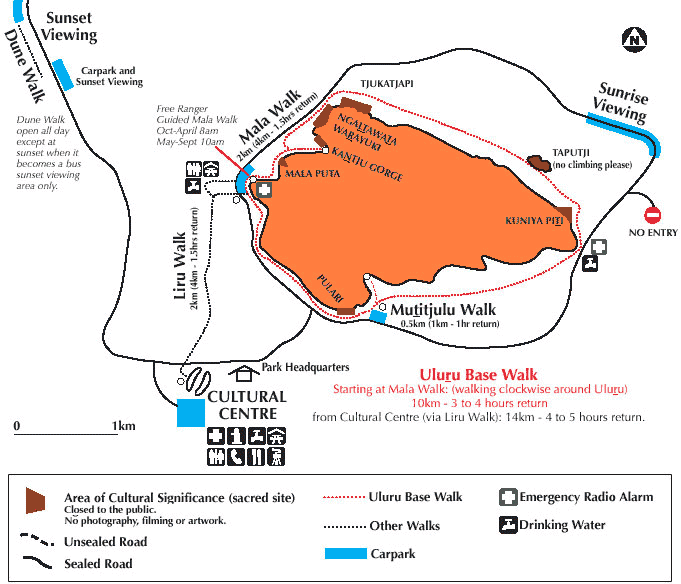
For a more down-to-earth dawn service, there's the Uluru Breakfast Tour, run by Anangu Tours where you join one of the local Aboriginal guides and an interpreter on the Liru Walk to the base of Uluru. The Liru Walk takes around two and a half hours but is only two kilometres of easy walking. It begins with participants sitting in a wiltja (traditional shade structure) as an Aboriginal elder shows how to make kiti, a glue-like resin made from spinifex that was used to make spears and other tools, and how to ground 'flour' from grass seeds to make a traditional bread. On the rest of the walk, you will learn how to make spears, spear throwers, bowls and other tools along with traditional bush skills and medicines.You will also learn about the ancient creation law and legends of Uluru.
The Kuniya tour, at sunset, visits Mutitjula waterhole at the base of Uluru and caves with ochre and charcoal paintings. Here you will also learn about local bush foods and the Law of Kuniya, the sand python.
Further afield, Kata Tjuta (The Olgas), 53km from the resort, with its huge, weathered domes, is every bit as impressive as Uluru. The eight kilometre Valley of the Winds walk winds along a rocky trail past sheer rock faces and unusual rock formations to a magnificent lookout.
The third of the great red centre rock formations, Mt Connor (which countless first-time visitors to Uluru have mistaken for the Rock on the drive in from Alice Springs) is 100km east of the resort village of Yulara, a huge flat-topped mesa rising from the desert plains. There is a good lookout just off the highway, or you can take a day tour from Yulara.
Another full day tour is the 4WD safari to Cave Hill, an Aboriginal community across the state border in South Australia. The rock art found here dates back 20,000 years, and portrays the Yankunytjatjara version of the story of the Pleiades, or Seven Sisters.
Where to stay
Ayers Rock Resort consists of seven accommodation options for varying budgets:
* Longitude 131, a luxury wilderness camp with million dollar views from your
bed of Uluru
* Sails in the Desert
* Desert Gardens Hotel
* Emu Walk serviced apartments
* Lost Camel Hotel
* Outback Pioneer Hotel
* Ayers Rock campground.Tel: 1300 134 044.
Exploring Uluru - Kata Tjuta National Park:
A magnificent day exploring the Kata-Tjuta National Park. Spend the time driving or walking around the base of the rock exploring the many aspects of this amazing monolith . You also have the opportunity to climb the Rock (people with heart and respiratory problems or fear of heights should not attempt it). In the afternoon visit Kata Tjuta (The Olgas) a collection of weathered red domes, located 50 km from Ayers Rock along a sealed road. There are two formal walks at Kata Tjuta and both are recommended. Many people believe Kata Tjuta is even more spectacular than the Rock. Return to your accommodation before being picked up and taken to the Sounds of Silence Dinner. Watch the sunset over the Rock and fine dinning under the stars.