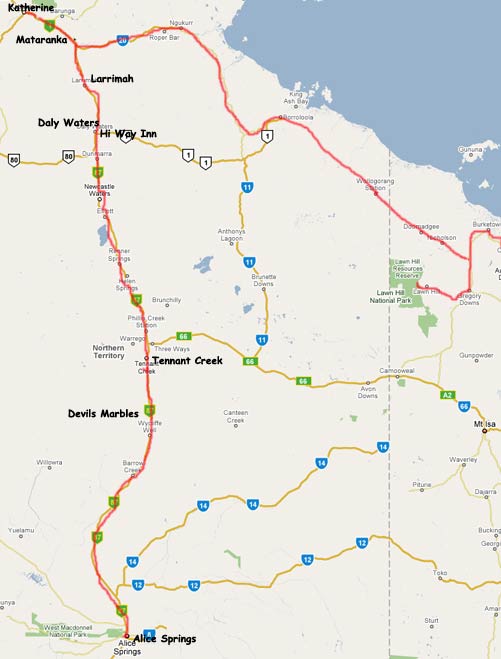
Katherine to Tennant Creek (about 667km)
Mataranka (approx 112 kms). Allow time to explore the tiny township of Mataranka, the setting of the famous Australian historical novel, "We of the Never Never". The Mataranka Thermal Pools are a welcome stop for all travellers. The warm, crystalline waters of this natural pool have the power to rejuvenate bodies tired from a long day on the road. The water in Mataranka Thermal Pool is spring-fed and bubbles up from deep within the earth at an amazing 30.5 million litres per day and at a fairly constant temperature of 34 degrees Celsius. Almost as beautiful as the thermal pool is the surrounding paperbark and palm forest. Allow an hour or two to fully enjoy this attraction. The area around the pool is a natural breeding ground for the Flying Fox. Mataranka offers motels, roadhouses, a backpacker hostel and caravan park, in beautiful surroundings
Larrimah is half way between Darwin and Tennant Creek, and is 180 km south of Katherine. It is one of the NT's most historic towns, originating as a WWII staging camp, with more than 3000 servicemen stationed there. If you didn’t fuel up at Katherine then the gentleman with the “wrong” kind of tattoos up to his chin, keeping a watchful eye on the chickens clucking among the petrol bowsers, will tell you with a kind of righteous pride – “No fuel in Larrimah”. Despite the fact that there appears to be two petrol stations and that one still has the price per litre displayed out the front, he has indeed seen to it that there is no fuel. I didn’t trouble him for a name, but this modern day highwayman claims to own both stations and has stopped selling fuel at both, possibly because it caused too much distress to the chickens. I am told a little way up the track that “they’ve run into financial problem
Daly Waters and Hi-Way Inn, at the intersection of the Stuart and Carpentaria (the Gulf Road) Highways is a roadhouse and campground offering many facilities. It's a true oasis. Refuel at Hi-Way Inn (proper roadhouse) and lunch at Daly Waters.
The Pub about 5km beore HiWay Inn has limited fuel options, but is worth a stop for lunch and to check out it’s history. Travellers will meet some true Territory characters at the unique Daly Waters pub, just off the Stuart Highway. It is one of the oldest licensed establishments in Australia and played an integral role in the London to Sydney air race of 1926. In a past life it was also a World War II airforce base and a refuelling stop for Qantas. In the 1930s Daly Waters was the north's most significant aviation centre situated at the junction of major air routes. The oldest hangar in the Territory, transported there in 1930, remains at the aerodrome and is managed by the National Trust. John McDouall Stuart named Daly Waters on 23 May 1862 after the new Governor of South Australia, Sir Dominick Daly. He inscribed a tree with an 'S' on the west bank of the creek near what later became the depot of the Overland Telegraph Line. The trunk of the tree with the inscription can still be seen.
Tennant Creek, the modern outback gold mining town, .has a very strong Aboriginal heritage, and you can learn about the culture from murals around the town, by visiting the Aboriginal art gallery or watch the locals as they create their paintings and objects. More information on the local area is available at the Information Centre. Local attractions include the Nyinkka Nyunyu Art and Culture Centre and Battery Hill Mining Centre.
Tennant Creek is quite something - its outskirts plying pinnacles of pointillist Spinifex grass motifs upon cone-shaped hills that imply a grand sky, rather than simply stating that it’s “there” in all its deep blue glory. It’s a town of about 3,000 people which now primarily services the Barkly Region (about the size of New Zealand but with less sheep) and is borne from a strong gold-mining heritage that’s easy to read from the signs to Battery Hill.
The Nyinkka Nyunyu Cultural Centre is definitely a “must see” in TC. And should your nerves be the kind that rattle without coffee, they have a proper machine and know how to work it, too. Although they are a little short-staffed at present, just ask the general manager to pop over and make your cupachino. (Well, that’s what the sign says at the roadhouse in the centre of town. Culture, you gotta love it.)
Further out is the aqueous wonder, MaryAnne Dam, a palatial reservoir of the precious commodity, here on open display for all to bask in its wet glory and is also ideal for a swim (which the seasoned traveller knows isn’t the same as a shower. Fortunately there is a cold one on offer if you can brave the occasional school group.) TC also marks your last chance to purchase supplies and perhaps some fuel before the final 500 kilometres to Alice Springs. (Some of the fuel prices on the next stretch would be easier to believe if the cashier had a parrot on his shoulder. But if that is your thing…)
Tennant Creek to Alice Springs about 500km
Travelling south from Tennant Creek you come to the Devils Marbles. Head off
early. The Devils Marbles have been formed over millions of years, a great spot
for photos. Devils Marbles are a collection of huge, round, red-colored boulders.
The Devils Marbles Conservation Reserve lies on each side of the Stuart Highway
near the town of Wauchope about 114 kilometres south of Tennant Creek, 1092
kilometres south of Darwin and 390 kilometres north of Alice Springs.
Devil’s Marbles Conservation Reserve, or Karlu Karlyu as the Warumungu people call it, is a valley 100km south of TC, bearing witness to a series of four-plus-metres high spheroid rocks, lying, stacked and scattered in formations across the area. Eerie by twilight, this wonder of prehistoric geology is an intriguing place to stop and show some respect to the landscape. Standing abruptly amid the widening arid vista, the rocks resist the passage of time as they did the erosion of former inland seas, shifting to a deep red in the sunset and sunrise hues.After departing the Devils Marbles continue for several hours of driving (approx 400 kms to Alice)
Wycliffe Well.“Way Out In Front” the signs of the buxom lass unashamedly proclaim – way out in front for what? Flies? Beer? Statues of Elvis and the incredible Hulk? The answer is the UFO centre of the arid centre: Aliens and UFOs at Wycliffe Well, Australia “It” by the bucket-load. This place truly has to be seen to be disbelieved: from the sizable UFO parked out the front and the small green round-headed man standing before it, to the realistic and astonishing sculptures residing within the campground, in competition only with the green ants for local supremacy. If ever there was an “It” then Wycliffe Well has “It” by the bucket-load. And that’s without the beer selection that is a true extension on the usual range of substandard poisons that do the rounds of front bars Territory wide.
Alice Springs
Alice Springs has plenty of interesting Outback history. Include a visit to
the historic Old Telegraph Station, the Royal Flying Doctor Service Visitor
Centre (daily tours), the Aboriginal Art and Culture Centre, and other historic
buildings; or for the more adventurous, take a ride on a camel. Just west of
Alice Springs detour to explore the stunning landscapes and magnificent gorges
of the surrounding McDonnell Ranges, including Simpsons Gap and Angkerle (Standley
Chasm).
You don´t have to drive far from Alice Springs to see spectacular gorge scenery, at Emily Gap, Simpson´s Gap and Standley Chasm, but you need a whole day to visit Palm Valley. On the way, we stopped for morning tea at Hermannsburg, the first aboriginal mission in the Northern Territory. After apple strudl and big flat scones on the verandah of Pastor Strehlow´s homestead, we walked around the small white-washed church and evocative old buildings of the historic Lutheran mission where Albert Namatjira was born. After viewing a video of his tragic life, we visited the gallery that contains the work of his descendants, some of whom still live there.
Past Hermannsburg, as we passed gleaming ghost gums and purple mountains, I felt I´d stepped into one of Namatjira´s paintings. The scenery became more and more dramatic, until we came to Kalarranga, a breath-taking amphitheatre of sheer cliffs that glowed in the sun. In a region renowned for its lack of water, it was amazing to come to a wide river whose level was so high that our driver wasn´t sure whether we´d be able to cross it. Our excursion turned into an adventure as the 4WD ploughed into the Finke River and water sprayed above the bonnet.
Palm Valley. You don´t expect to find a tropical oasis in Central Australia, but that´s what Palm Valley was, with its red cabbage palms, lush ferns and luxuriant cycads that grew on both sides of the river. At Cycad Gorge, we wandered between toweringred cliffs where a waterfall spilled over galleries of rock into a small grotto. Occasionally as I looked up, I spotted tiny rock wallabies peering timidly from behind rock ledges.
Although there was nothing lush in the scenery we saw the following day, on the way to Chambers Pillar, this trip had a mystique of its own. On the way, we stopped to look at the Ewaninga rock carvings, mysterious symbols chiselled into the sandstone. Our driver, who was a keen follower of the Finke Desert race, veered off the main road and lurched along partof the rugged, winding track to give us an idea of the route the drivers had to follow. Finally we came to the Simpson Desert, and reached Chambers Pillar. Looking at this outcrop of eroded sandstone jutting into the sky in the middle of nowhere, it struck me that some people might wonder why you´d do a 300km round trip to see a piece of rock. But as I gazed out from the lookout onto the huge plain, I felt stirred by the vista of untouched wilderness that stretched in every direction and by the entire journey which gave an insight into awesome landscape with its spiritual aura and infinite horizons.