Ubeda and Baeza

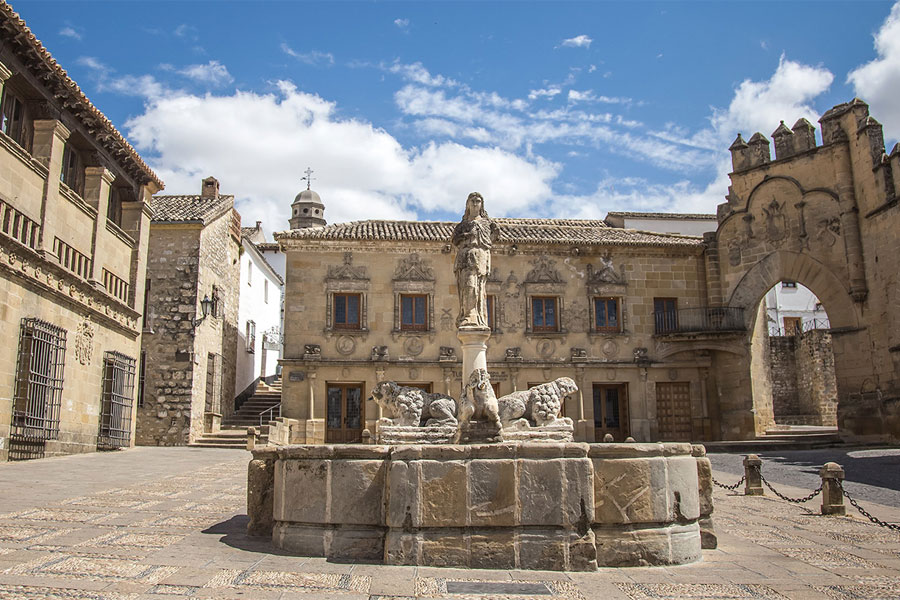
Both Ubeda and the neighbouring city of Baeza benefited from extensive patronage in the early 16th century resulting in the construction of a series of Renaissance style palaces and churches, which have been preserved ever since. In 2003, UNESCO declared the historic cores and monuments of these two towns a World Heritage Site.
Ubeda


- The most outstanding feature of the city is the monumental Vázquez de Molina Square, surrounded with imposing Renaissance buildings such as the Palacio de las Cadenas (so named for the decorative chains which once hung from the façade) and the Basílica de Santa María de los Reales Alcázares.
- The Chapel of the Savior or Capilla del Salvador was constructed to house the tombs of local nobility. Both the interior and exterior are decorated; for example, the interior has elaborate metalwork screen by the ironworker Bartolomé de Jaen.
- The Hospital de Santiago, designed by Vandelvira in the late 16th century, with its square bell towers and graceful Renaissance courtyard, is now the home of the town's Conference Hall.
- Ubeda has a Parador hotel, housed in a 16th-century palace which was the residence of a high-ranking churchman of that period.
- The town lends its name to a common idiom in Spanish, andar por los cerros de Úbeda (literally 'to walk around the hills of Úbeda'), meaning 'to go off at a tangent'.
- The city possesses 48 monuments, and more of another hundred of buildings of interest, almost all of them of Renaissance style
Click thumbnail for a larger photo
Baeza
Baeza is a city and municipality of Spain belonging to the province of Jaén. It is now principally famed for having some of the best-preserved examples of Italian Renaissance architecture in Spain. Along with neighbouring Úbeda, it was added to UNESCO's list of World Heritage Sites in 2003. The former Visigothic bishopric of Baeza remains a Latin Catholic titular see.

The sixteenth century was the golden era of Baeza (and nearby Úbeda). It grew rich from several industries, notably textiles, and the noble families, which were well connected with the Spanish Imperial state. They hired major architects of the era (including Andrés de Vandelvira) to design the present cathedral, churches, public buildings, and private palaces in the then-fashionable Italian style. The town's university building dates to 1533. The city declined in importance in the seventeenth century, with the only remaining industry consisting of local production of grain and olive oil. As few newer structures were built during this period, this had the effect of preserving the town's Renaissance legacy. The university closed for a time before being reopened by the nineteenth century as a seminary.
Baeza still houses several fine public buildings:
- Natividad de Nuestra Señora Cathedral, presents an early Gothic and Plateresque pilasters and crossed vaults finished in the XVI century in a Renaissance style by architect Andŕes de Vandelvira, and since 1584 by architect and mathematician Juan Bautista Villalpando. The tower was redone in 1549 and the Chapel of St Michael was added in 1560.
- Town Hall (Ayuntamiento), a Plateresque building originally built as a combined courthouse and prison, leading to two separate main entrances
- Baeza University, established in 1533 now a secondary school
- Santa Cruz Church, a Romanesque church with a two-aisle nave and semicircular apse. A side wall incorporates a Visigothic arch.
- St Paul's Church, a Gothic church with a Renaissance portal with a two-aisle nave and Gothic chapels. Includes the tomb of Pablo de Olavide.
- The Chapel of St Francis, in the ruins of a Renaissance building from 1538 formerly used as a monastery
- Jabalquinto Palace (Palacio de Jabalquinto), including an Gothic entrance flanked by two cylindrical pilasters with Plateresque capitals with mocárabes ornamentation, a Renaissance courtyard, and a Baroque staircase
- Spain Plaza (Plaza de España)
- Constitution Plaza (Plaza or Paseo de la Constitucíon), including a marble fountain decorated with Caryatides
- St Mary Fountain (1564)
- The Fountain of the Lions, from the Ibero-Roman ruins of Cástulo and possibly representing Himilce, wife of the Carthaginian general Hannibal
- The Úbeda Gate and JaénGate.
- The Villalar Arch (Arco de Villalar), erected for Charles V's 1526 visit to honor his 1521 victory at Villalar.
- Seminary oratorio of St Philip Neri(1660)
Click thumbnail for a larger photo
Spain UNESCO World Heritage