
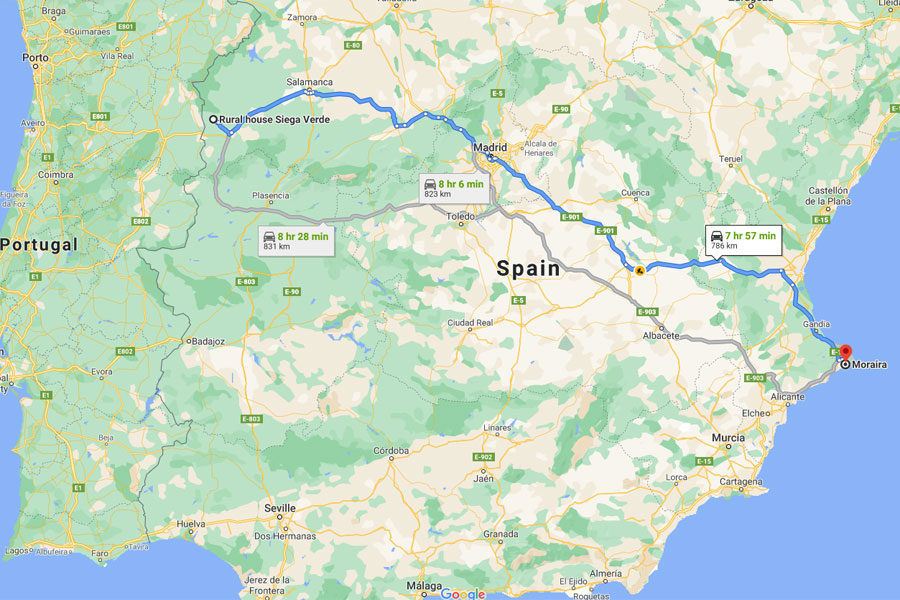
This unique archaeological site is on the banks of the River Águeda, 15km downriver of the town of Ciudad Rodrigo. Pools of water exist even in the driest weather, doubtlessly making it a special place, chosen in Prehistory as a crossing place where the animals that came to drink could be observed.
Siega Verde is the most important open-air Palaeolithic site in the region of Castilla-Leon, and together with the nearby Portuguese site of Foz Coa, the most outstanding open-air site in the Iberian Peninsula. The first examples of rock art were discovered in 1988 by M. Santonja and R. Pérez, while making the Archaeological Inventory of the Province of Salamanca.
The site consists of a series of rock carvings. Subjects include equids, aurochs, deer and goats, among the most common ones, as well as bison, reindeer and the woolly rhinoceros, which were not yet extinct at the time. The engravings date to the Gravettian culture of the Upper Palaeolithic (circa 20,000 years ago). There are also more recent, anthropomorphic representations, dating to the Magdalenian age (c. 9,000 years ago). There is a total of 91 panels, spanning some 1 kilometers of rock.
Click thumbnail for a larger photo
 |
 |
 |
 |
 |
 |
 |
 |
 |
 |