


The Umayyad conquest of Hispania, starting in AD 711, brought large parts of the Iberian Peninsula under Moorish control and established al-Andalus. Because the city was situated on a low plain and, as a result, difficult to protect from attacks, the ruler decided to transfer his residence to the higher situated area of Gárnata. According to Arabic sources Ilbira (Elvira) was razed during Fitna of al-Andalus, afterwards it was not restored at its previous place and instead Garnata, which was a Jewish ghetto before, replaced it as the main city. In a short time this town was transformed into one of the most important cities of al-Andalus.
In 1492, the last Muslim ruler in Iberia, surrendered complete control of the Emirate of Granada to the Catholic Monarchs , after the last episode of the Granada War. The terms of the surrender, expressed in the Alhambra Decree treaty, explicitly allowed the Muslim inhabitants, known as mudéjares, to continue unmolested in the practice of their faith and customs. By 1499, however, Cardinal Francisco Jiménez de Cisneros grew frustrated with the slow pace of the efforts of the first archbishop of Granada to convert non-Christians and undertook a program of forced baptisms, creating the converso (convert) class for Muslims and Jews.
Responding to the rebellion of 1501, the Crown of Castile rescinded the Alhambra Decree treaty, and mandated that Granada's Muslims convert or emigrate. Many of the elite Muslim class subsequently emigrated to North Africa. The majority of the Granada's mudéjares converted (becoming the so-called moriscos or Moorish) so that they could stay. Both populations of converts were subject to persecution, execution, or exile, and each had cells that practiced their original religion in secrecy .
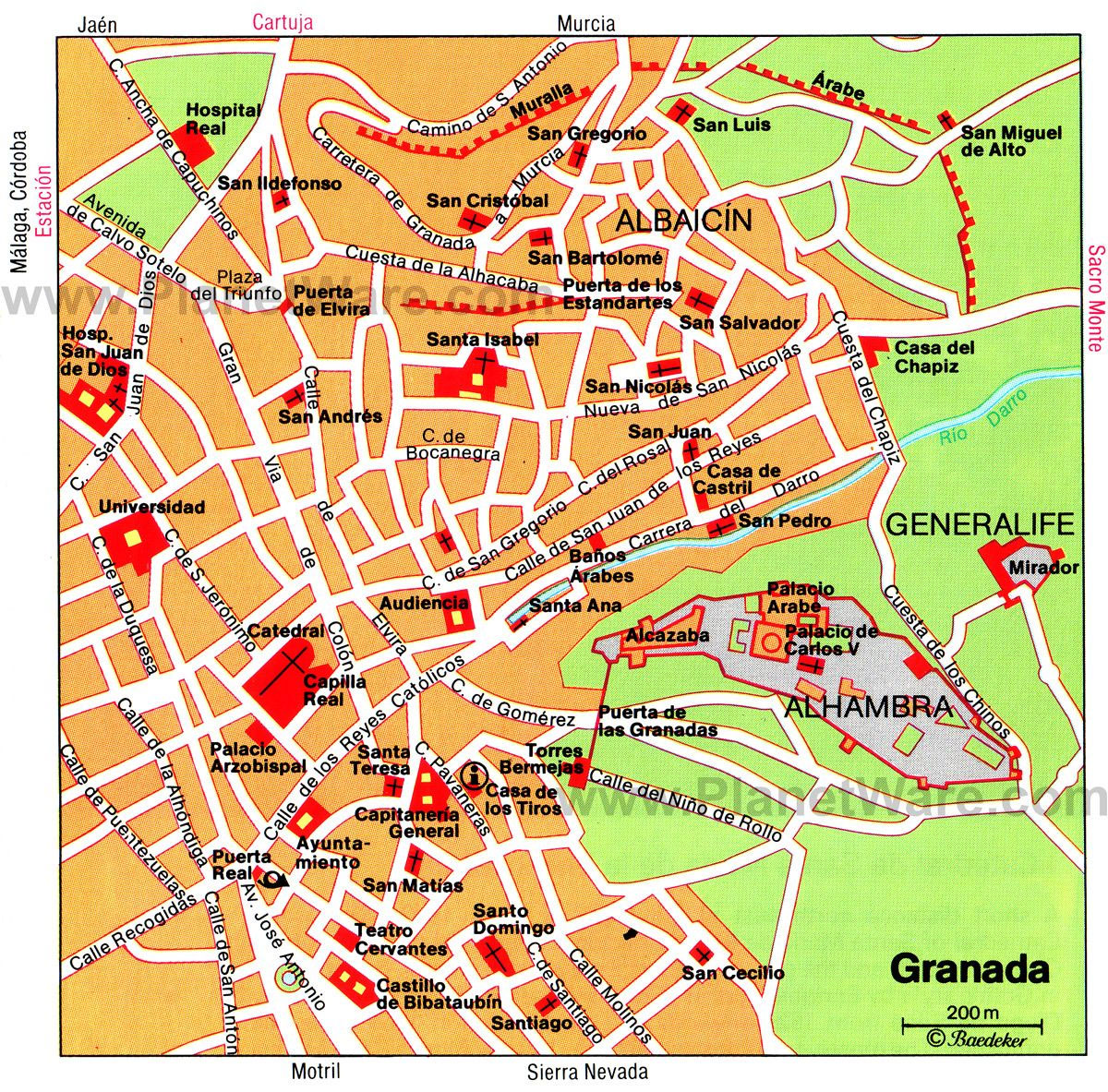
The Alhambra, an ancient Nasrid citadel and palace, is located in Granada. It is the most renowned building of the Islamic historical legacy with its many cultural attractions and architectural elements that make Granada a popular destination among the tourist cities of Spain. The Almohad influence on architecture is also preserved in the Granada neighborhood called the Albaicín with its fine examples of Moorish and Morisco construction. Granada is also well known within Spain for the University of Granada which has an estimated 82,000 students spread over five different campuses in the city. The pomegranate (in Spanish, granada) is the heraldic device of Granada.
In the 11th century the Castle of the Alhambra was developed as a walled town which became a military stronghold that dominated the whole city. But it was in the 13th century, with the arrival of the first monarch of the Nasrid dynasty, Muhammad I of Granada , that the royal residence was established in the Alhambra. This marked the beginning of its heyday. The Alhambra became palace, citadel and fortress, and was the residence of the Nasrid sultans and their senior officials, including servants of the court and elite soldiers (13th–14th centuries).
In 1492 the Catholic Monarchs, Ferdinand and Isabela, expelled the final Moors from the city of Granada. They established permanent residency in the Alhambra, and it was here that Christopher Columbus requested royal endorsement for his westward expedition that year. In 1527 Charles V, Holy Roman Emperor demolished part of the architectural complex to build the Palace which bears his name. Although the Catholic Monarchs had already altered some rooms of the Alhambra after the conquest of the city in 1492, Charles V wanted to construct a permanent residence befitting an emperor. Around 1537 he ordered the construction of the Peinador de la Reina, or Queen's dressing room, where his wife Isabel lived, over the Tower of Abu l-Hayyay. There was a pause in the ongoing maintenance of the Alhambra from the 18th century for almost a hundred years, and during control by the First French Empire, substantial portions of the fortress were blown apart. The repair, restoration and conservation that continues to this day did not begin until the 19th century. The complex currently includes the Museum of the Alhambra, with objects mainly from the site of the monument itself and the Museum of Fine Arts.
Sights
Click thumbnail for a larger photo
 |
 |
 |
 |
 |
 |
 |
 |
 |
 |
 |
 |
 |
 |
 |
 |
 |
 |
 |
 |
 |
 |
 |
 |
 |