 |
 |
 |
 |
| Very popular with taddy bears | |||
 |
 |
 |
 |
The Ħal Saflieni Hypogeum is an outstanding underground burial complex that bears testimony to a civilization that has disappeared. It was in use between 4000 BC and 1500BC. Covering a remarkable 500 square metres, it was amongst the first Maltese entries on the UNESCO World Heritage List together with the Ġgantija Megalithic Site.
The Hypogeum is a Neolithic subterranean structure dating to the Saflieni phase (3300 – 3000 BC) in Maltese prehistory. It is often simply referred to as the Hypogeum , literally meaning "underground" in Greek. The Hypogeum is thought to have been a sanctuary and necropolis, with the estimated remains of more than 7,000 people documented by archeologists, and is among the best preserved examples of the Maltese temple building culture that also produced the Megalithic Temples and Xagħra Stone Circle.
The Ħal Saflieni Hypogeum lies on the summit of a hill in Paola, not far from the Grand Harbour. It was accidentally discovered in 1902 by a stone mason who was laying the foundations to build a number of houses. By the time the Hypogeum was reported most of the houses had been completed and made ready for habitation. As a consequence, the upper level of the monument sustained irreversible damage. By the end of 1903 the site became public property and its excavation lasted until 1911.
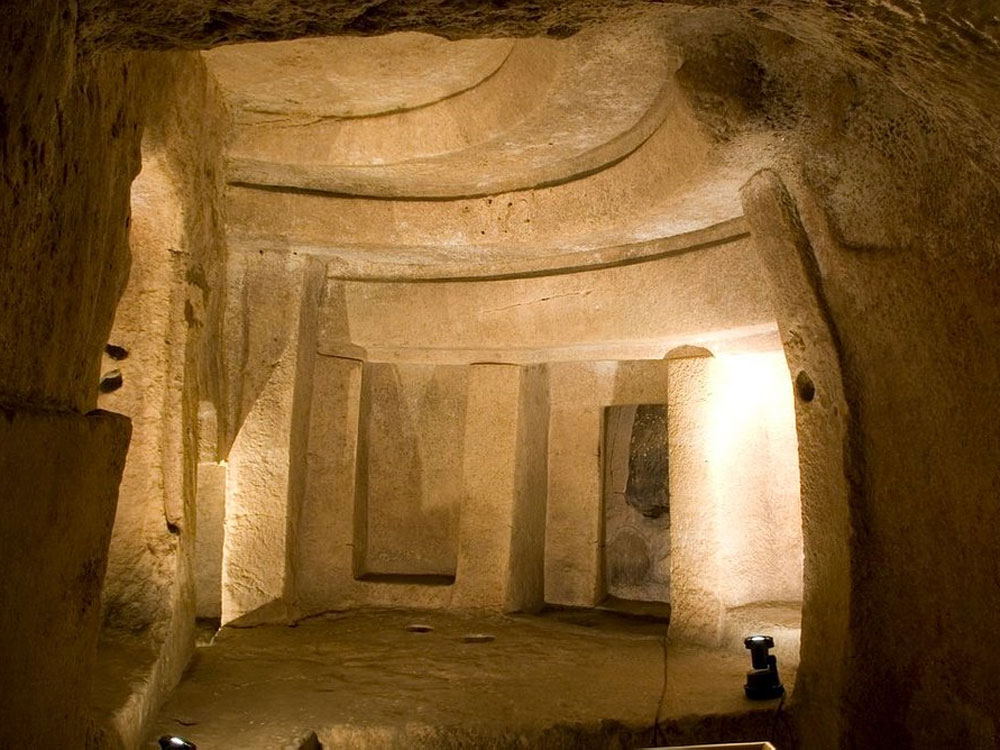
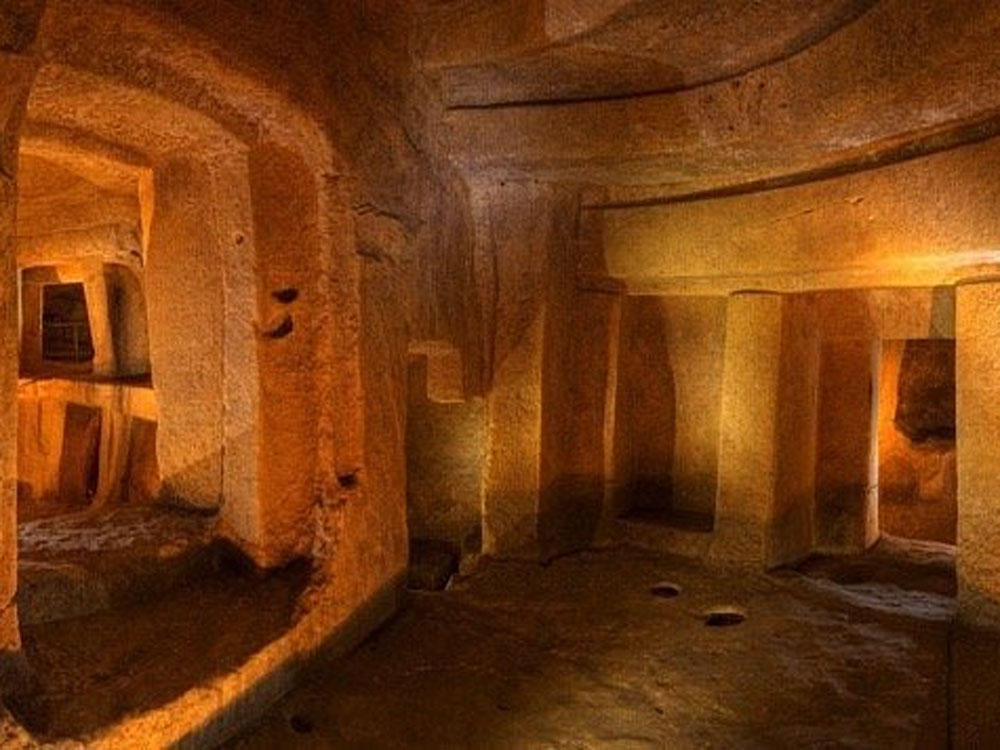
The site yielded a wealth of archaeological material, including pottery, human bones, personal ornaments, little carved animals and larger figurines. The Hypogeum at Ħal Saflieni is a unique monument, consisting of halls, chambers and passages hewn out of globigerina limestone. The complex is dug in three levels: the upper level, the middle level, and the lower level, with the site users digging deeper as space became limited.
The upper level consists of a large hollow with a central passage and burial chambers cut on each side. One of the chambers still contains original burial deposits. Some of the smoothly-finished chambers of the middle level recall the interiors of above-ground megalithic structures. The deepest room in the lower level has four side niches and lies 10.6 metres under road level.
This unique monument was inscribed on the UNESCO World Heritage List in 1981, as a site that bears unique testimony to a civilization that has disappeared
Heritage Malta (the government body that looks after historical sites) allows entry to only 80 people per day, while the site's microclimate is strictly regulated. In 2011, a more intensive program was launched to monitor the decay of the site. Scientific research on the Hypogeum is ongoing, and in 2014, an international team of scientists visited to study acoustics. The Hypogeum reopened in May 2017 after closing for a year to improve its environmental management system. So to gain access, we had to book a slot two weeks in advance. And we had to pay, as it was not covered by our free Heritage Malta passes. The impressive thing about the Hypogeum is the sheer size, which is difficult to portray in photos. But it is big
Click on any of the thumbnail photos for a larger version
|
|
|
|
| Very popular with taddy bears | |||
|
|
|
|