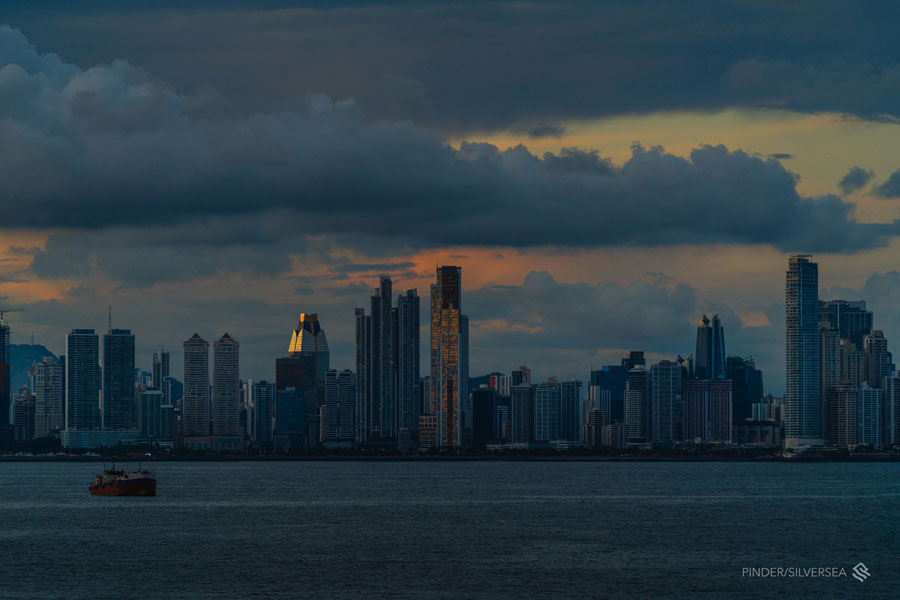
Panama does not have a cruise port, so all cruise ships have to do what we did: anchor offshore and tender the punters to a jetty in a marina at Fuerte Amador. From there it was a short bus ride into the old town, a UNESCO World Heritage site.
The city is located at the Pacific entrance of the Panama Canal. It was founded in 1519, by a Spanish conquistador, Pedro Arias Dávila. The city was the starting point for expeditions that conquered the Inca Empire in Peru. It was a stopover point on one of the most important trade routes in the American continent, leading to the fairs of Nombre de Dios and Portobelo, through which passed most of the gold and silver that Spain took from the Americas.
In 1671, the original city, Panamá Viejo, was destroyed by a fire when privateer Henry Morgan sacked and set fire to it. The city was reestablished two years later on a peninsula located 8 km from the original settlement. The site of the previously devastated city is still in ruins. The new rebuilt city location is now known as the Casco Viejo (Old Quarter) of the city. It was designated a World Heritage Site by UNESCO in 2003
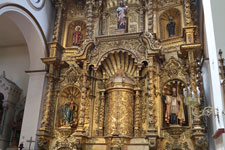
Casco Antiguo displays a mix of architectural styles that reflect the country's cultural diversity: Caribbean, Republican, art deco, French, and colonial architecture mix in a site comprising around 800 buildings. Most of Panama City's main monuments are located in Casco Antiguo, including the Salón Bolivar, the National Theater (founded in 1908), Las Bóvedas, and Plaza de Francia. There are also many Catholic buildings, such as the Metropolitan Cathedral, the La Merced Church, and the St. Philip Neri Church. The distinctive golden altar at St. Joseph Church was one of the few items saved from Panama Viejo during the 1671 pirate siege. It was buried in mud during the siege and then secretly transported to its present location.
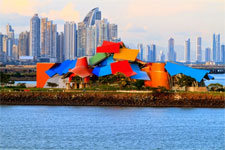
We saw from afar, but did not visit, the Biomuseo, a museum focused on the natural history of Panama. Located on the Amador Causeway in Panama City, Panama, it was designed by architect Frank Gehry. This is Gehry's first design for Latin America. The design was conceived in 1999 and the museum opened in 2014.We have already visited Gehry's Guggenheim in Bilbao, and his hotel, the Marquise de Riscal, in Rioja
Since our last visit to Panama a few years ago, the city has been extensively gentrified, with a lot of money being spent on restoration work.We had a pleasant walk round the old town, with a stop for tapas, excellent cerviche, in the restored Central Hotel, a 5 star establishment on the square facing the Cathedral
Click on any of the thumbnails to get a bigger version of the picture
 |
 |
 |
 |
 |
 |
 |
 |
 |
 |
 |
 |
 |
 |
 |
 |
 |
 |
 |
 |
 |
 |
 |
 |
 |
 |
 |
 |
 |
 |
And with that it was goodnight to Panama City, as the Silver Explorer made its way south to the Darien Jungle