
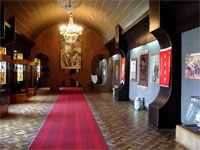
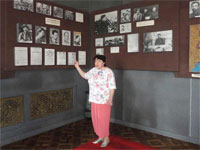
Nowhere did Stalin’s hero status last longer than in his Georgian birth town Gori. His statue was only removed from the Central Town Square (still named after him) in June 2010 and his museum is still in full operation today. Comtourist visited the Stalin Museum in August 2011 and were pleased to find out that nothing seems to have changed for the last 50 years here. The museum is a Soviet Time Capsule where even the guides seem to be imported from the USSR.
Stalin is presented a a jovial benevolent uncle. Gori itself is an unremarkable small town, and without the Stalin Museum , it would not see any tourists at all
Stalin was born in Gori in 1878, so there always had to be a shrine to the great leader in Gori after his death. A local history museum begun in 1951 intended to become a Stalin Memorial after his death. Stalin died in 1953, the Museum was dedicated to him in 1957. The Stalin museum managed to survive De-Stalinization in 1961 when his body was removed from the Mausoleum in Moscow and cities and streets named after him were renamed. Soviet authorities probably did not want to offend the Georgians who were still proud of their most famous compatriot and Gori was also far away from Moscow.
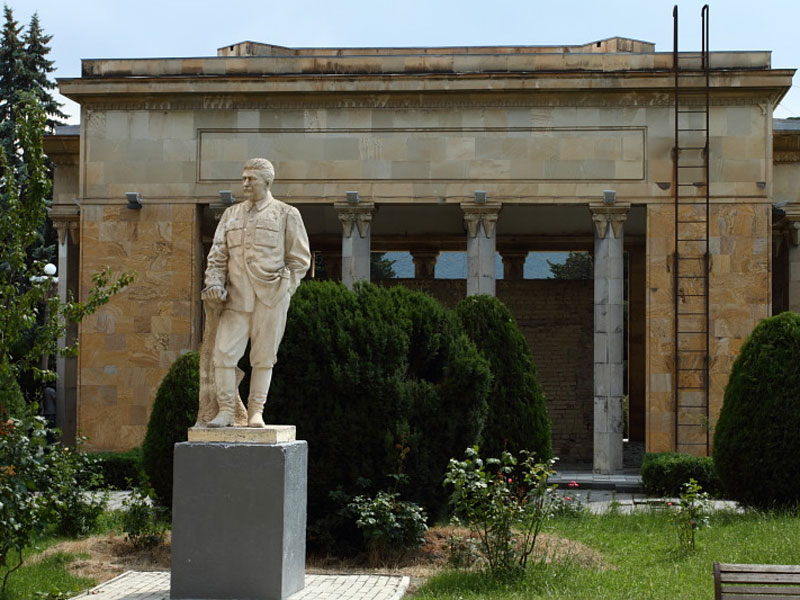
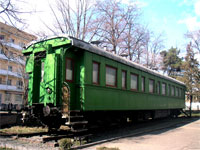
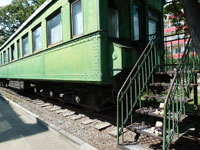
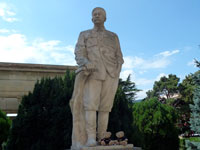
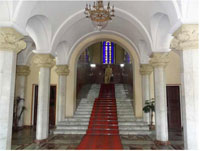
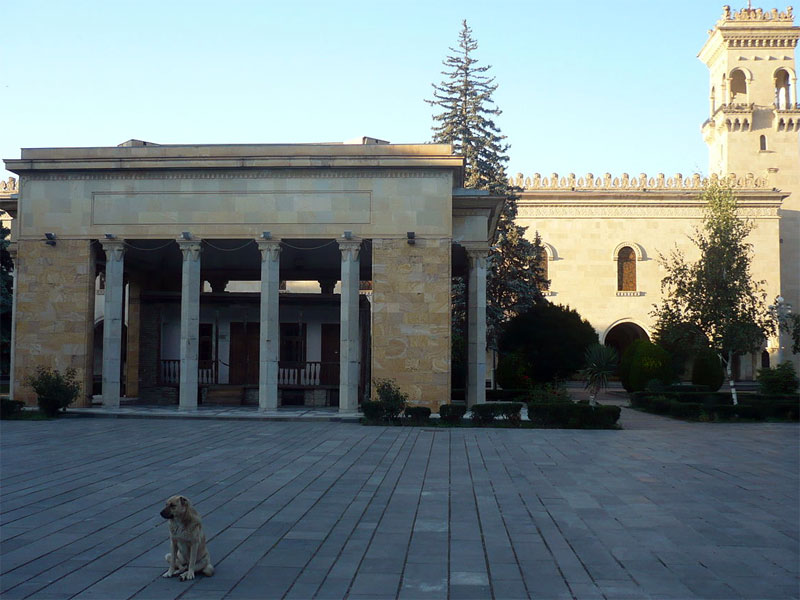
The museum was closed in 1989 but was re-opened in recent years as local authorities understood that the museum is a potent tourist attraction. There have been plans to transform the Stalin Museum into the “Museum of Russian Aggression” since 2008, this has not happened yet since this will impact tourist revenues in a time of great economic depression. Let’s hope that the Georgian government understands the historic significance and uniqueness of the Museum and leave it in its current state! The museum building is a large palace in Stalinist Gothic style, complete with clock tower and column gallery. There is a small Stalin statue in front of the Museum: this is not the statue that was removed from the Central Square in 2010. The museum intends to erect the big statue in front of the Museum, a hole has already been dug. Stalin’s birth house is located in front of the Museum and his rail carriage on one side.
The Stalin museum has three sections, all located in the town's central square. It was officially dedicated to Stalin in 1957. With the downfall of the Soviet Union and independence movement of Georgia, the museum was closed in 1989, but has since been reopened, and is a popular tourist attraction.
In the 2008 Russo-Georgian War, the town came under aerial attack by the Russian Air Force from the outset of the conflict. Military targets and residential districts of Gori were hit by the airstrikes, resulting in civilian injuries and deaths. Human Rights Watch (HRW) claimed that Russian forces had indiscriminately deployed cluster bombs in civilian areas around Gori. According to HRW, on August 12 Russian forces dropped cluster bombs in the centre of Gori, killing 11 civilians and wounding dozens more. Russian military officials deny using cluster munitions in the conflict, calling the HRW assertion "slanderous" and questioning the HRW's objectivity. Numerous unexploded "bomblets" have been found by locals and HRW employees. By August 11, Georgian military personnel, government, and most residents had fled the city, which was then captured and occupied by the Russian military and South Ossetian separatist militia. HRW accused the militia of unleashing a campaign of looting, arson, kidnapping and other attacks against the remaining civilian population. The Russian and South Ossetian forces withdrew from the city on August 22, 2008
In the aftermath of the 2008 South Ossetia war, on 24 September 2008, Georgia’s Minister of Culture announced the Stalin museum would be reorganized into the Museum of Russian Aggression in the nearest future. In recent years a banner was placed at the entrance stating: "This museum is a falsification of history. It is a typical example of Soviet propaganda and it attempts to legitimise the bloodiest regime in history." However, as of 2017 the banner has been removed. On 20 December 2012, the municipal assembly of Gori voted to put an end to plans to change the museum's content.
Click on any of the thumbnails to get a bigger version of the picture
 |
 |
 |
 |
 |
 |
 |
 |
 |
 |
You have to see it, in order to believe it!