
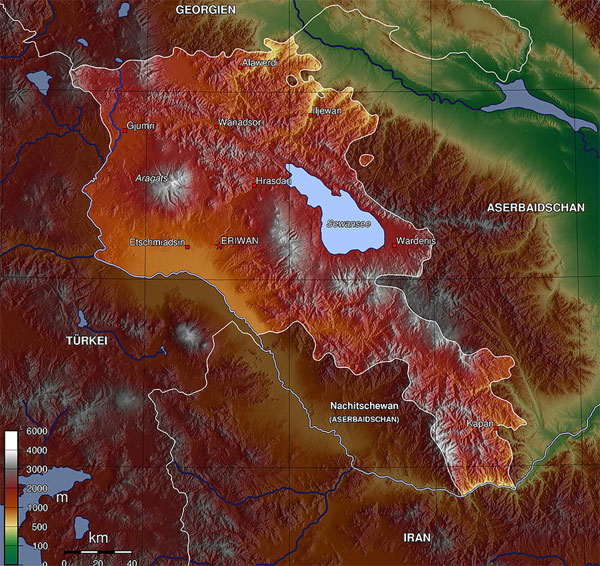
De Facto map of Armenia in 2018
Armenia is a country in the South Caucasus region of Eurasia. A mainly mountainous country bordered by Turkey to the west, Georgia to the north, the de facto independent Republic of Artsakh and Azerbaijan to the east, and Iran and Azerbaijan's exclave of Nakhchivan to the south. It is extremely mountainous
Armenia is a country with a long history, and therein lies the the problems of today. The Kingdom of Armenia reached its height under Tigranes the Great in the 1st century BC and became the first state in the world to adopt Christianity as its official religion in the late 3rd or early 4th century AD. It should be said that all the borders in this part of the world have moved regularly over the years, what is the "real Armenia" is difficult to say, but Armenians today are taught a version of history that is very nationalistic - history as they say is written by the "home team"

The ancient Armenian kingdom was split between the Byzantine and Sasanian Empires around the early 5th century. Under the Bagratuni dynasty, the Bagratid Kingdom of Armenia was restored in the 9th century. Declining due to the wars against the Byzantines, the kingdom fell in 1045 and Armenia was soon after invaded by the Seljuk Turks. An Armenian principality and later a kingdom Cilician Armenia was located on the coast of the Mediterranean Sea between the 11th and 14th centuries.
Between the 16th and 19th centuries, the traditional Armenian homeland composed of Eastern Armenia and Western Armenia came under the rule of the Ottoman and Iranian empires, repeatedly ruled by either of the two over the centuries. By the 19th century, Eastern Armenia had been conquered by the Russian Empire, while most of the western parts of the traditional Armenian homeland remained under Ottoman rule.

Distribution of Armenians before WW1 and today (today in red)
The outbreak of World War I lead to confrontation between the Ottoman Empire and the Russian Empire in the Caucasus and Persian Campaigns. The new government in Istanbul began to look on the Armenians with distrust and suspicion, because the Imperial Russian Army contained Armenian volunteers.
In April 1915, Armenian intellectuals were arrested by Ottoman authorities and eventually a large proportion of Armenians living in Anatolia perished in what has become known as the Armenian Genocide. The genocide was implemented in two phases: the wholesale killing of the able-bodied male population through the killing of army conscripts to forced labour, followed by the deportation of women, children, the elderly and infirm on death marches leading to the Syrian desert. Driven forward by military escorts, the deportees were deprived of food and water. The events of 1915 to 1917 are regarded by Armenians to have been state-sponsored mass killings, or genocide.Turkish authorities still deny the genocide took place.
An estimated 600,000 Armenians died during deportation from 1915–16. This figure increased over the next few years. The International Association of Genocide Scholars places the final death toll at "more than a million". These events are traditionally commemorated yearly on 24 April, the Day of the Armenian Genocide.
At the end of the war, the victorious powers sought to divide up the Ottoman Empire. Signed between the Allied and Associated Powers and Ottoman Empire at Sèvres in August 1920, the Treaty of Sèvres promised to maintain the existence of the Armenian republic and to attach the former territories of Ottoman Armenia to it. The treaty, however, was rejected by the Turkish National Movement, and never came into effect. Turkish nationalist forces invaded the fledgling Armenian republic from the east. Turkish forces under the command of Kazım Karabekir captured Armenian territories that Russia had annexed in the aftermath of the 1877–1878 Russo-Turkish War and occupied the old city of Alexandropol (present-day Gyumri). The conflict finally concluded with the Treaty of Alexandropol on 2 December 1920. The treaty forced Armenia to disarm most of its military forces, and to cede all former Ottoman territory granted to it by the Treaty of Sèvres. Simultaneously, the Soviet Eleventh Army invaded Armenia and entered Yerevan in Dec 1920 and the short-lived Armenian republic collapsed.
By the end of 1920, the state was incorporated into the Transcaucasian Socialist Federative Soviet Republic, and in 1922 became a founding member of the Soviet Union. In 1936, the Transcaucasian state was dissolved, transforming its constituent states, including the Armenian Soviet Socialist Republic, into full Union republics.
Tensions between Armenia and Azerbaijan led to the pogrom of Armenians in Baku in January 1990, which forced almost all of the 200,000 Armenians in the Azerbaijani capital Baku to flee to Armenia.
The modern Republic of Armenia became independent in 1991 during the dissolution of the Soviet Union.
The Nagorno-Karabakh War was an ethnic and territorial conflict that took place in the late 1980s to May 1994, in the enclave of Nagorno-Karabakh in southwestern Azerbaijan, between the majority ethnic Armenians of Nagorno-Karabakh backed by the Republic of Armenia, and the Republic of Azerbaijan. As the war progressed, Armenia and Azerbaijan, both former Soviet Republics, entangled themselves in a protracted, undeclared war in the mountainous heights of Karabakh as Azerbaijan attempted to curb the secessionist movement in Nagorno-Karabakh. The demand to unify with Armenia gradually grew into an increasingly violent conflict between Armenians and Azerbaijanis, resulting in claims of ethnic cleansing by both sides.
When Azerbaijan declared its independence from the Soviet Union and removed the powers held by the enclave's government, the Armenian majority voted to secede from Azerbaijan and in the process proclaimed the unrecognized Republic of Nagorno-Karabakh. Full-scale fighting erupted in early 1992. In early 1993, Armenian forces captured regions outside the enclave itself, threatening the involvement of other countries in the region. By the end of the war in 1994, the Armenians were in full control of the enclave (with the exception of the Shahumyan Region) in addition to surrounding areas of Azerbaijan proper, most notably the Lachin Corridor, a mountain pass that links Nagorno-Karabakh with mainland Armenia.
A Russian-brokered ceasefire was signed in May 1994, but regular peace talks between Armenia and Azerbaijan since then have failed to result in a peace treaty. This has left the Nagorno-Karabakh area in a state of legal limbo, with the Republic of Artsakh remaining de facto independent but internationally unrecognized while Armenian forces currently control approximately 9% of Azerbaijan's territory outside the enclave. As many as 230,000 Armenians from Azerbaijan and 800,000 Azerbaijanis from Armenia and Karabakh have been displaced as a result of the conflict.
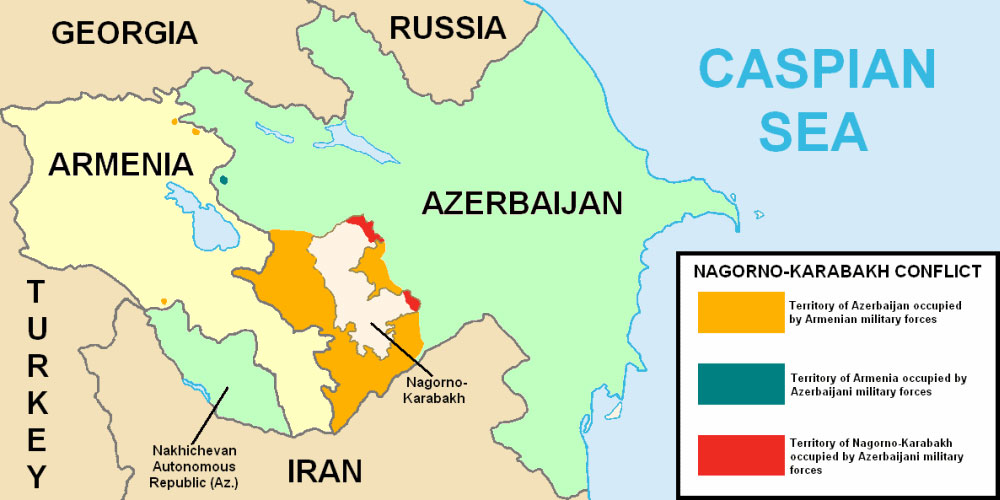
The unique Armenian alphabet was invented by Mesrop Mashtots in 405 AD. Armenia is a member of the Eurasian Economic Union, the Council of Europe and the Collective Security Treaty Organization. Armenia supports the de facto independent Republic of Artsakh (Nagorno-Karabakh), which was proclaimed in 1991.
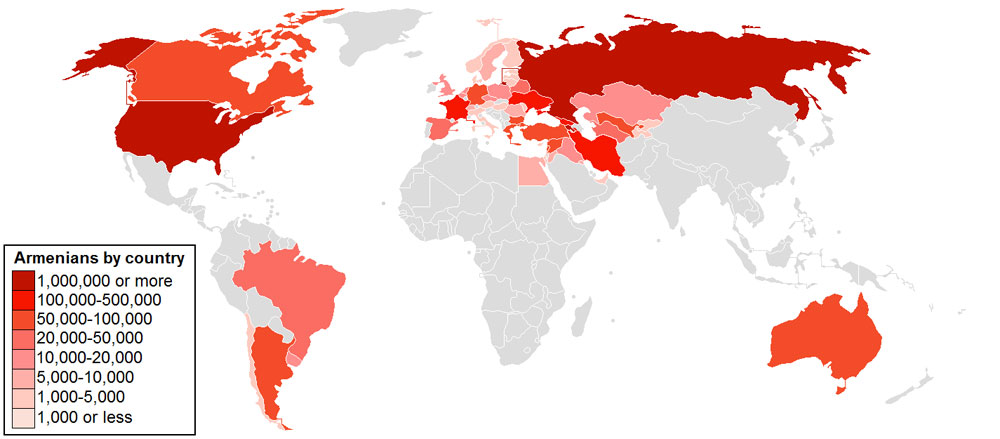
For a number of reasons, including the Ottoman expulsionsand economic migration, there are many Armenian communities over the world. It is difficult to see what the definition of an Armenian abroad actually is - traditonally Armenian communities in other countries have kept apart, married only thier own people and worshiped in Armenian churches. I am not sure that this holds today, and therefore to what extent Armenians are assimilated into their new countries after a number of generations. The American Armenians appear to be very generous in endowing projects within Armenia.
The bottom line is that as things stand today, Armenia is a pretty isolated small country with only a small open border to Iran and another to Georgia - most of their miles of borders are sealed, and 3500 Russian troops are stationed in Armenia specifically to patrol the Turkish and Iran borders. Armenia has large numbers of troops deployed on the Azerbaijan border. Eventually it will have to solve its border problems if it is to live a "normal" international life, but as things appear today, the hope of finding a solution is bleak.