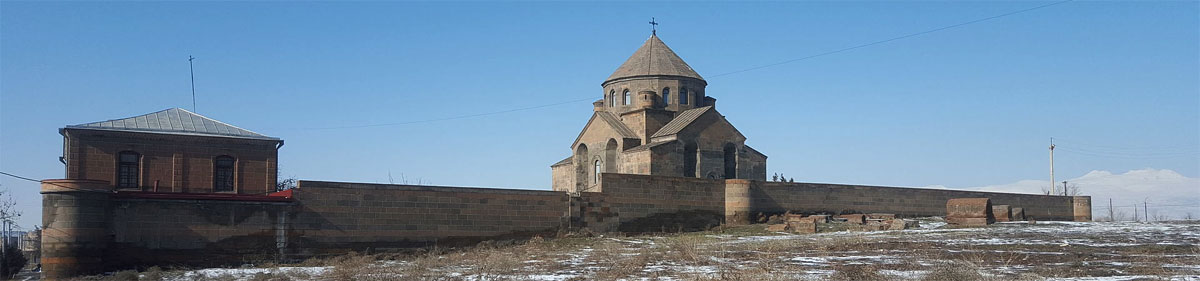
Hripsime
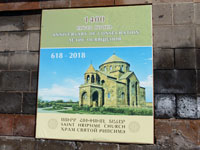
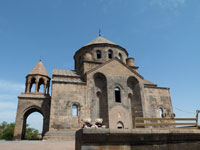
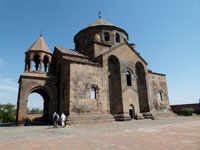
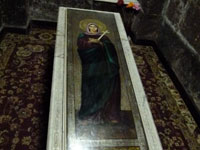
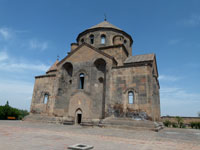
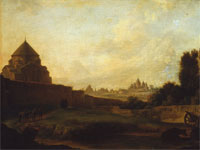
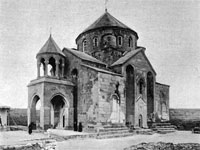
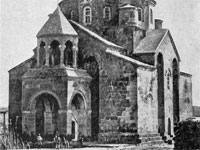
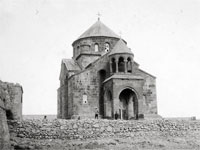
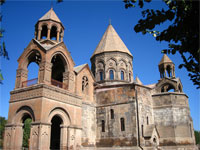
Saint Hripsime Church is a seventh century Armenian Apostolic church in the city of Vagharshapat (Etchmiadzin), Armenia. It is one of the oldest surviving churches in the country. The church was erected by Catholicos Komitas to replace the original mausoleum built by Catholicos Sahak the Great in 395 AD that contained the remains of the martyred Saint Hripsime to whom the church is dedicated.
The current structure was completed in 618 AD. It is known for its fine Armenian-style architecture of the classical period, which has influenced many other Armenian churches since. It was listed as a UNESCO World Heritage Site along with other nearby churches, including Etchmiadzin Cathedral, Armenia's mother church, in 2000.
Hripsime and the abbess Gayane and thirty-eight unnamed nuns are traditionally considered the first Christian martyrs in Armenia's history. They were persecuted, tortured, and eventually killed by king Tiridates III of Armenia. According to the chronicler Agathangelos, after conversion to Christianity in 301, Tiridates and Gregory the Illuminator built a martyrium dedicated to Hripsime at the location of her martyrdom, which was half buried underground.. Excavations around the church have uncovered remains of several tortured women buried in early Christian manner, which, according to Agop Jack Hacikyan et al., "seem to support the story of Agathangelos." In 395 Patriarch Sahak Partev (Isaac the Parthian) rebuilt or built a new martyrium, which had been destroyed by the Shapur II of the Sasanian Empire in the 360s
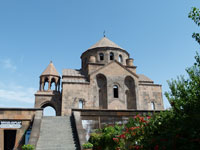
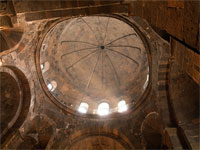
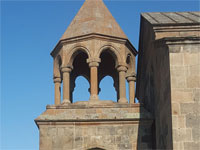
The current building was erected during the reign of Catholicos Komitas (615–628). It replaced the earlier mausoleum of Hripsime. The dome was probably restored in the 10th or 11th centuries. The church was dilapidated and abandoned by the early 17th century. According to an inscription on the western façade, the church was renovated by Catholicos Philipos, in 1653. Under his commission an open narthex (gavit) was erected in front of the western entrance. A bell tower was built on the narthex in 1790 under the commission of Catholicos Ghukas I of Karin. In 1880 the eastern and southern walls were built of smoothly hewn stone.
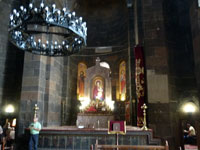
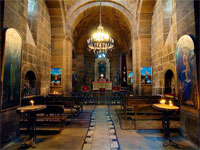
The church underwent considerable renovation in 1898. Its foundations were strengthened and the roof and dome were repaired in 1936. In 1958 plaster was removed from the interior walls and the interior floor was lowered. The bell tower was renovated in 1987.
Click on any of the thumbnails to get a bigger version of the picture
 |
 |
 |
 |
 |
 |
 |
 |
 |
 |
 |
 |
 |
 |
 |
1783 |
1878 |
1901 |
1911 |
1925 |
The Catholicos of All Armenians is the chief bishop and spiritual leader of the Armenian Apostolic Church, and the worldwide Armenian diaspora. According to tradition, the apostles Saint Thaddeus and Saint Bartholomew brought Christianity to Armenia in the first century. Saint Gregory the Illuminator became the first Catholicos of All Armenians following the nation's adoption of Christianity as its official religion in 301 AD. The seat of the Catholicos, and the spiritual and administrative headquarters of the Armenian Church, is the Mother See of Holy Etchmiadzin, in Vagharshapat. The Armenian Apostolic Church is part of the Oriental Orthodox communion that do not subscribe to the Christological formulas of the Council of Chalcedon. It includes the Coptic Orthodox Church of Alexandria, the Ethiopian Orthodox Tewahedo Church, the Syriac Orthodox Church, the Malankara Orthodox Syrian Church, and the Eritrean Orthodox Tewahedo Church.

Etchmiadzin Cathedral
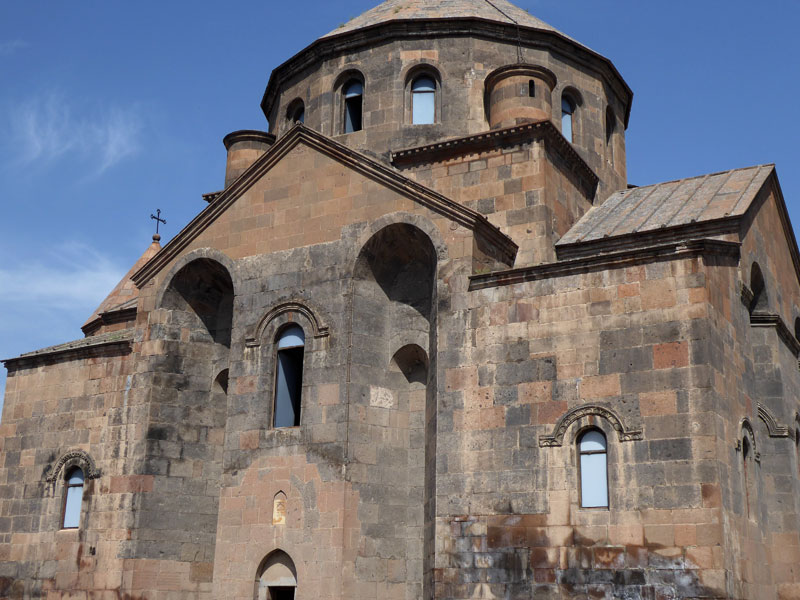
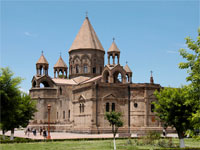
Etchmiadzin Cathedral is the mother church of the Armenian Apostolic Church, located in the city of Vagharshapat (Etchmiadzin), Armenia. According to scholars it was the first cathedral built in ancient Armenia, and is considered the oldest cathedral in the world. The original church was built in the early fourth century—between 301 and 303 according to tradition—by Armenia's patron saint Gregory the Illuminator, following the adoption of Christianity as a state religion by King Tiridates III. It replaced a preexisting temple, symbolizing the conversion from paganism to Christianity.
The core of the current building was built in 483/4 by Vahan Mamikonian after the cathedral was severely damaged in a Persian invasion. From its foundation until the second half of the fifth century, Etchmiadzin was the seat of the Catholicos, the supreme head of the Armenian Church. Although never losing its significance, the cathedral subsequently suffered centuries of virtual neglect. In 1441 it was restored as catholicosate and remains as such to this day.
Since then the Mother See of Holy Etchmiadzin has been the administrative headquarters of the Armenian Church. Etchmiadzin was plundered by the Safavids in 1604, when relics and stones were taken out of the cathedral to New Julfa in an effort to undermine Armenians' attachment to their land. Since then the cathedral has undergone a number of renovations. Belfries were added in the latter half of the seventeenth century and in 1868 a sacristy was constructed at the cathedral's east end. Today, it incorporates styles of different periods of Armenian architecture.
Diminished during the early Soviet period, Etchmiadzin revived again in the second half of the twentieth century, and under independent Armenia. As the main shrine of religious Christian Armenians worldwide, Etchmiadzin has been an important location in Armenia not only religiously, but also politically and culturally. A major pilgrimage site, it is one of the most visited places in the country. Along with several important early medieval churches located nearby, the cathedral was listed as a World Heritage Site by UNESCO in 2000.
In 1903, the Russian government issued an edict to confiscate the properties of the Armenian Church, including the treasures of Etchmiadzin. Russian policemen and soldiers entered and occupied the cathedral. Due to popular resistance and the personal defiance of Catholicos Mkrtich Khrimian, the edict was canceled in 1905.
During the Armenian Genocide, the cathedral of Etchmiadzin and its surrounding became a major center for the Turkish Armenian refugees. At the end of 1918, there were about 70,000 refugees in the Etchmiadzin district. A hospital and an orphanage within the cathedral's grounds were established and maintained by the U.S.-based Armenian Near East Relief by 1919.
During the Great Purge and the radical state atheist policies in the late 1930s, the cathedral was a "besieged institution as the campaign was underway to eradicate religion." The repressions climaxed in 1938 when Catholicos Khoren I was murdered in April by the NKVD. In August of that year, the Armenian Communist Party decided to close down the cathedral, but the central Soviet government seemingly did not approve of such a measure. Isolated from the outside world, the cathedral barely continued to function and its administrators were reduced to some twenty people. It was reportedly the only church in Soviet Armenia not to have been seized by the Communist government.
The religious importance of Etchmiadzin slowly recovered during the Second World War. The Holy See's official magazine resumed publication in 1944, while the seminary was reopened in September 1945.In 1945 Catholicos Gevorg VI was elected after the seven-year vacancy of the position. The number of baptisms conducted at Etchmiadzin rose greatly: from 200 in 1949 to around 1,700 in 1951. Nevertheless, the cathedral's role was downplayed by the Communist official circles. "For them the ecclesiastical Echmiadzin belongs irrevocably to the past, and even if the monastery and the cathedral are occasionally the scene of impressive ceremonies including the election of a new catholicos, this has little importance from the communist point of view," wrote Walter Kolarz in 1961.
Etchmiadzin revived under Catholicos Vasken I after the period known as the Khrushchev Thaw in the mid-1950s, following Stalin's death. In 1959; the cathedral underwent a major renovation. Wealthy diaspora benefactors, such as Calouste Gulbenkian and Alex Manoogian, financially assisted the renovation of the cathedral. Gulbenkian alone provided $400,000. In 2000 Etchmiadzin underwent a renovation prior to the celebrations of the 1700th anniversary of the Christianization of Armenia in 2001
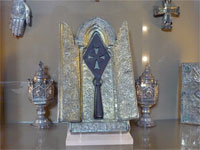
Its most famous relic, The Holy Lance, also known as the Holy Spear, the Spear of Destiny, or the Lance of Longinus (named after Saint Longinus), according to the Gospel of John, is the lance that pierced the side of Jesus as he hung on the cross. There are at least 4 locations across the world that claim to have this relic. It was previously held in the monastery of Geghard. The first source that mentions it is a text 'Holy Relics of Our Lord Jesus Christ', in a thirteenth-century Armenian manuscript. According to this text, the spear which pierced Jesus was to have been brought to Armenia by the Apostle Thaddeus. The manuscript does not specify precisely where it was kept, but the Holy Lance gives a description that exactly matches the lance. In 1655, the French traveler Jean-Baptiste Tavernier was the first Westerner to see this relic in Armenia. In 1805, the Russians captured the monastery and the relic was moved to Tchitchanov Geghard, Tbilisi, Georgia. It was later returned to Armenia at Echmiadzin, where it is always visible in the museum Manoogian, enshrined in a 17th-century reliquary.
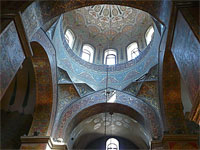
The latest renovation of the cathedral began in 2012, with a focus on strengthening and restoring the dome and the roof
Click on any of the thumbnails to get a bigger version of the picture
 |
 |
 |
 |
 |
 |
 |
 |
 |
 |
 |
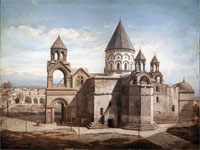 |
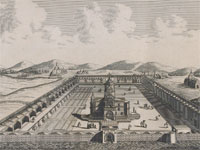
In 1670 |
in 1870 |
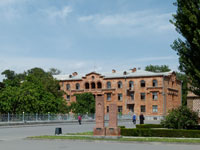
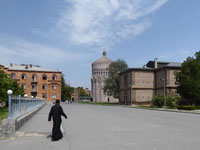
Cathedral Grounds
There are about 150,000 sq meters of grounds. The Etchmiadzin complex is considered sanctified soil and has been called the Armenian Vatican
For many centuries, Etchmiadzin was the national and political center of the stateless Armenian people. The locus of Etchmiadzin is considered "a sanctified soil" in a way similar to Temple Mount and the Golden Temple, for Jews and Sikhs, respectively. The cathedral complex has been called "Armenian Vatican" or "Armenian Mecca" as it is a major pilgrimage site for religious Armenians worldwide. Because the cathedral has been so important to the development of Armenians' sense of identity, a pilgrimage to Etchmiadzin is "as much as ethnic as a religious experience." American journalist and historian Francis Whiting Halsey described the cathedral as "the most treasured possession of the Armenian nation" and "the source of that strength which has held them together through centuries of persecution, warfare and massacre." Royal Navy Captain James Creagh highlighted its immense role for the Armenian people in his 1880 book, writing that "The monastery and cathedral of Echmiadzin may, without any exaggeration, be described as the heart of the Armenian nation." Before the foundation of the First Republic of Armenia and the official designation of Yerevan as its capital in 1918, Western sources emphasized Etchmiadzin's political significance. A 1920 book prepared by the Historical Section of the British Foreign Office acknowledged that Etchmiadzin "was regarded as the national capital of the Armenians." "Deprived of a political head and even a political capital the [Armenian] people have, for at least five hundred years, looked to Etchmiadzin as the home of their people, the centre to which they looked for guidance, unfailing sympathy, and practical aid," wrote Welsh journalist and politician W. Llewelyn Williams in his 1916 book about Armenia.


Click on any of the thumbnails to get a bigger version of the picture
 |
 |
 |
 |
 |
 |
 |
 |
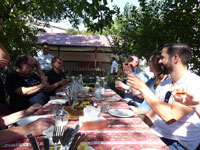
Lunch at a nearby B&B
Quite a professional lunch in one of the "home" B&Bs that the tour operator uses
Click on any of the thumbnails to get a bigger version of the picture
 |
 |
 |
 |
And on to the twin monasteries of Saghmasyank and Heranvank